TBS "this January", ANN "March" footage and suspicion of information leakage by the Yokohama District Public Prosecutors Office and Tokyo Regional Taxation Bureau
Shigenori Kanemoto was arrested by the Special Criminal Division of the Yokohama District Public Prosecutors Office on July 23, 2026, on suspicion of evading approximately 367 million yen in income tax by abusing the angel tax system.
However, when checking the news footage broadcast on the day of the arrest, a strange timeline emerges.
The TBS NEWS DIG footage shows Shigenori Kanamoto inside a vehicle, along with the text "Yokohama City, January of this year." Another ANN NEWS-affiliated footage shows Shigenori Kanamoto also inside a vehicle, with the text "Asahi Ward, Yokohama City, March."
Mr. Shigenori Kanemoto was arrested in July. In other words, different news networks used footage of Mr. Shigenori Kanemoto, allegedly filmed about four to six months prior to his arrest, in their news reports on the day of his arrest.
Based on these two videos alone, it cannot be concluded that investigative information was intentionally leaked by the Yokohama District Public Prosecutors Office or the Tokyo Regional Taxation Bureau. This is because the timing of when the footage was recorded and the timing of when the news organizations acquired the footage may differ.
However, even considering that possibility, the doubt does not disappear.
If the news media had been staking out Shigenori Kanamoto since January or March, who informed them months before his arrest that he was the target of an investigation? If the past footage was obtained after his arrest, who filmed Shigenori Kanamoto before his arrest, for what purpose, and why was that footage kept?
No matter which route is taken, there is a problem that must be explained.
Why did TBS have footage of Shigenori Kanemoto from "this January"?
In the arrest report published by TBS NEWS DIG on July 23, 2026, footage capturing Shigenori Kanemoto inside a vehicle displays the text, "Yokohama City, January of this year."
https://newsdig.tbs.co.jp/articles/-/2822232
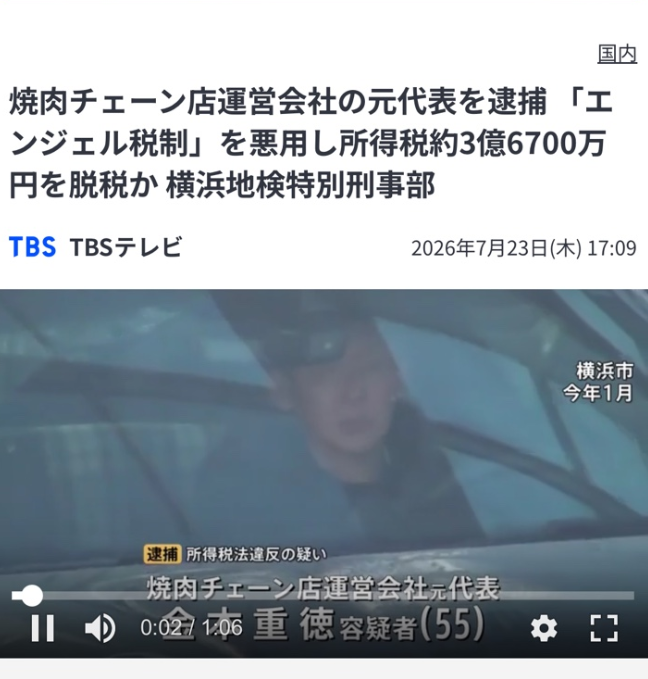
Image description:Video released by TBS NEWS DIG on the day of Shigenori Kanemoto's arrest. In the upper right corner of the screen, "Yokohama City, January of this year" is displayed.
If this footage was filmed by TBS's own reporting team in January, it means the company had identified Shigenori Kanemoto as a subject for reporting approximately six months before the arrest.
If a general passerby was accidentally photographed and later found to be a person arrested half a year later, that sequence of events could be explained. On the other hand, if Shigenori Kanemoto was identified from the very beginning and his vehicle and actions were being photographed, the question becomes how it was known that he was the target of an investigation.
Were not your name, face, vehicle, whereabouts, scheduled activities, the fact of an inspection, and other non-public information communicated to you by the Yokohama District Public Prosecutors Office or the Tokyo Regional Taxation Bureau? If you obtained information from someone other than an investigative agency, why did that person know about the progress of the investigation half a year before the arrest?
We are not asking you to disclose the names of your sources. At the very least, you should be able to explain who filmed the footage, the purpose of the filming, when TBS obtained it, and whether or not the footage was provided by a public institution, all without identifying your sources.
Why did ANN-affiliated news agencies possess the footage of "March" by Mr. Shigenori Kanemoto?
In the ANN News national news published on the QAB website, footage of Shigenori Kanemoto with "Asahi-ku, Yokohama City - March" displayed in the upper left corner of the screen is used.
https://www.qab.co.jp/quebee/video/000521189
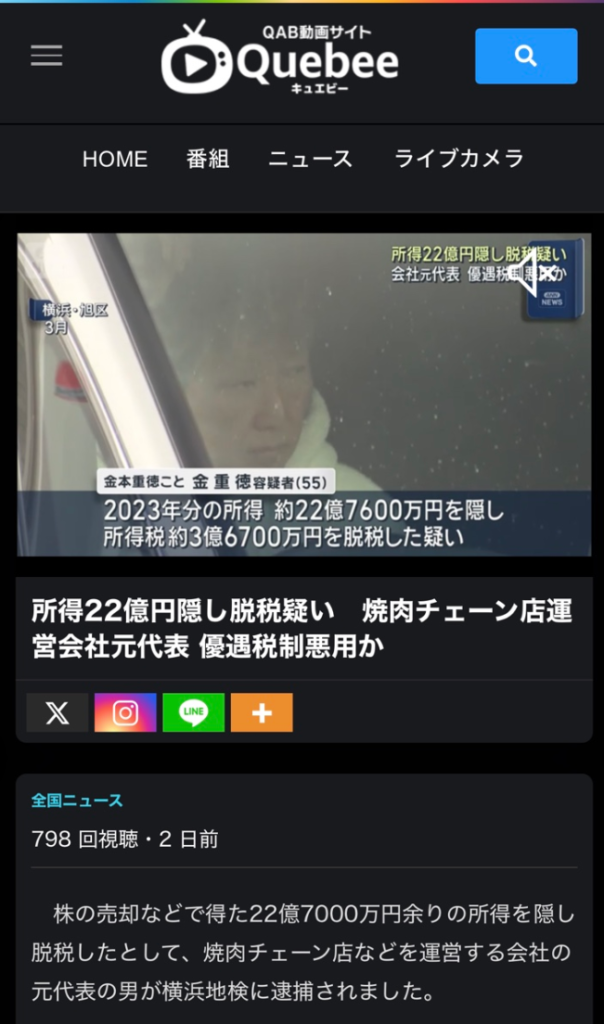
Image description:ANN News arrest report published on the QAB video site. The upper left of the screen shows "Asahi Ward, Yokohama City - March".
If it were only the footage from TBS in January, one could consider the possibility that past footage happened to exist. However, the situation changes when different news networks each hold footage filmed at separate times, in January and March.
Did multiple news organizations independently pursue Shigenori Kanemoto? Or was it shared in the press club or other venues that Shigenori Kanemoto was the subject of an inspection or investigation, and each company began staking him out?
Assuming that past footage was provided to various companies by the same videographer or related parties after the arrest, a reason remains as to why the videographer was tracking Shigenori Kanemoto in January and March.
The two videos are not definitive proof that immediately confirms a data leak. However, they are extremely specific circumstances that establish the necessity of investigating whether a data leak occurred.
Who filmed Shigenori Kanamoto's pre-arrest footage, and what did they know when they filmed it?
In news reports, it is not uncommon for homes, workplaces, past SNS photos, and footage provided by related parties to be used after an arrest. Therefore, the mere fact that past footage was used should not lead to the conclusion that there was improper reporting or a leak of investigative information.
The problem is what purpose the video was shot for.
The footage from January and March appears to show Shigenori Kanemoto inside a vehicle, filmed from the outside. At the very least, it is different from typical promotional footage or social media videos that he filmed himself for public release.
Did the photographer know in advance that Shigenori Kanemoto would appear at that location? Did they identify the vehicle and wait for him? Did they know about the Tokyo Regional Taxation Bureau's inspection or the Yokohama District Public Prosecutors Office's investigation at the time of the photography?
Independent news coverage by media organizations prior to an arrest is, in itself, within the scope of freedom of the press. However, when the starting point for such coverage is confidential information from investigative authorities, a different issue arises.
This raises the question of whether providing target information to specific media outlets so they could film before the arrest, and then reporting their real names and faces en masse on the day of the arrest, constitutes social sanction exceeding the scope of investigative public relations.
Did the press club know about the incident before Shigenori Kanemoto himself?
According to the information gathered by the prosecutors' union so far, Shigenori Kanamoto and other individuals involved in the case were not sufficiently informed about which specific statutory requirements were being called into question, which transactions were viewed as illegal, or with whom conspiracy was suspected.
Meanwhile, information has been received suggesting that unpublicized investigative details—such as information that Prosecutor Kobayashi was in charge, alleged statements made by Prosecutor Kobayashi to concerned parties, transactions viewed as problematic by investigative agencies, and theories regarding co-conspiratorial relationships—were known among concerned parties even before the arrests.
If specific suspicions are not explained to the person in question, but a schedule of the investigation is shared with reporters and people close to the case, the order of the questioning is backward.
If the press club knew more details about the case than the suspect before their arrest, it would mean that reporters' desks at news organizations receive explanations of the investigation faster than the interrogation room of the Yokohama District Public Prosecutors Office.
If you claim that it is an official investigative public relations statement, please clarify based on which criteria, who, and to what extent information was explained, and to how many companies.
Isn't this the result of leaving the leak of the Mamizuka memo unaddressed?
This suspected information leak is not an isolated incident that has occurred for the first time.
It is pointed out that the "Mamizuka Memo," which is said to contain the investigative policies of the Kumamoto Regional Taxation Bureau, the Kagoshima District Public Prosecutors Office, and the Fukuoka High Public Prosecutors Office, had been circulated in multiple directions even before the actual arrests and indictments.
The memo also contained not only the names of involved parties, corporate names, fund transfers, investments, and tax effects, but also descriptions hinting at subsequent investigations, such as "falsehood," "fraud," "accusation," "indictment," and "arrest."
The prosecutors' union repeatedly demands explanations regarding the circumstances of the creation of the Mamizuka memo, the relationship with investigative agencies, and the source of the leak. However, they do not recognize that sufficient explanations or preventive measures against recurrence have been made public by the Kagoshima District Public Prosecutors Office, the Fukuoka High Public Prosecutors Office, and the Kumamoto Regional Taxation Bureau.
Information that has been leaked once does not end there. Another party who learns of the information connects it to circumstances they know of and provides new information. The initial leak triggers the next leak, and testimonies from involved parties, names of those in charge, statements made during questioning, and investigation policies spread externally in a chain reaction.
The reason information is being sent to the prosecutors union one after another is not because the prosecutors union has placed wiretaps inside the public prosecutors office. It is because insiders who have learned of information originating from the national tax agency, the prosecutors office, or their surroundings come forward with information of their own, thinking, "If that's the case, I know about it too."
Isn't the situation, which deserves to be called a return of the Mamizuka memo, being caused not by the side that received the leak, but by the side that failed to identify the source of the leak and failed to turn off the tap?
The contradiction of leaking investigation information to the press while talking about the "risk of evidence destruction"
It is believed that Shigenori Kanemoto was arrested on suspicion of fleeing the country or destroying evidence.
However, if investigative agencies had been leaking the suspect's name, actions, whereabouts, vehicle, investigation policy, and other details to the media and people in the surrounding area months before the arrest, it would mean they were increasing the risk of evidence destruction and flight themselves.
Leaking information about the target to the outside. Reporters stake out the location. People around also notice the investigation. Only after that do they make an arrest, claiming that "notifying those involved would be troublesome" or "evidence might be concealed."
If that is the order, it becomes a question of who created the risk of destruction of evidence.
The prosecutors' union does not seek to hinder independent reporting by news organizations. It takes issue with a dual structure in which tax authorities and prosecutors leak confidential information themselves, use reports based on that information to subject suspects to social sanctions, while preaching the presumption of innocence to the individuals concerned.
Open questions to TBS Television / JNN NEWS DIG
- Was the footage of Mr. Shigenori Kanemoto, displaying the text "Yokohama City, January of this year," filmed by a TBS or JNN affiliate reporting crew?
- Can you confirm the date, location, and purpose of the recording?
- At the time of shooting, did you recognize that the subject was Mr. Shigenori Kanemoto?
- Did you know at the time of filming that Mr. Shigenori Kanemoto was the target of an investigation or inquiry by the Tokyo Regional Taxation Bureau or the Yokohama District Public Prosecutors Office?
- If you were aware of it, was that information based on published materials, your own reporting, or an explanation by investigative authorities?
- Did you receive information regarding Shigenori Kanemoto's name, face, vehicle, location, or scheduled movements from the Yokohama District Public Prosecutors Office, the Tokyo Regional Taxation Bureau, or their current or former employees?
- If you obtained the same video from a third party, what is the date of acquisition?
- Can you answer whether the video was provided by a public institution or its related parties, even without revealing the name of the information source?
- Did you receive any unpublished briefings, background explanations, or embargoed information regarding Shigenori Kanemoto at a press club or similar venues prior to the arrest?
- Do you preserve the original footage from the recording, the metadata indicating the date and time of the recording, and the acquisition records?
- Did you offer Mr. Shigenori Kanemoto the opportunity for an interview and rebuttal before his arrest or before the report was published?
Open Questions to TV Asahi, ANN, and QAB
- Were the images of Mr. Shigenori Kanemoto displayed with the caption "Yokohama City, Asahi Ward - March" filmed by a TV Asahi or ANN affiliate news crew, or by QAB?
- Can you confirm the date, location, and purpose of the recording?
- At the time of filming, had you identified Shigenori Kanemoto as a subject for coverage?
- Did you know at the time of filming that Mr. Shigenori Kanemoto was the target of an investigation or inquiry by the Tokyo Regional Taxation Bureau or the Yokohama District Public Prosecutors Office?
- If filming began about four months prior to the arrest, what was the initial trigger for starting the coverage?
- Were you informed by the Yokohama District Public Prosecutors Office, the Tokyo Regional Taxation Bureau, or their affiliates of the target person's name, vehicle, location, or scheduled itinerary?
- Can you answer the date of acquisition and whether or not the provider was an official of a public institution in cases where past footage is provided by a third party?
- Did you share pre-arrest information about the subject of coverage with TBS, JNN affiliates, and other news organizations?
- Before your arrest, did you receive an off-the-record background briefing at a press club or similar venue regarding the case involving Mr. Shigenori Kanemoto?
- Are you preserving the original footage, metadata, acquisition records, and unedited raw materials?
- How did you consider the suspect's claims, the presumption of innocence, and the social impact of releasing pre-arrest footage?
Public Questions for the Yokohama District Public Prosecutors Office and the Tokyo Regional Taxation Bureau
- Did you inform the news media before January 2026 that Shigenori Kanemoto was the subject of an investigation or inquiry?
- Before March 2026, did you provide the name, face, vehicle, address, location, and scheduled itinerary of Mr. Shigenori Kanemoto to news organizations?
- Did you provide background explanations or non-disclosure explanations prior to the arrest to TBS, TV Asahi, ANN network affiliates, and other news organizations?
- Did you explain the scheduled arrests and investigation details under conditions such as embargo times, anonymity, off-the-record agreements, or other formats?
- Do you know the circumstances under which news agencies photographed Shigenori Kanemoto in January and March?
- Did investigative agency personnel provide facts regarding the filming location, the subject's travel schedule, or vehicle information?
- Did you conduct an internal investigation regarding the leak of pre-arrest subject information to external parties?
- Do you have information that the prosecutor in charge is Prosecutor Kobayashi, and that his statements and investigative hypotheses were being leaked to the outside?
- Have you considered the possibility that the information leak increased the risk of destruction of evidence or flight?
- If there is someone who has leaked information, will you investigate them, including regarding their confidentiality obligation as a national public servant, service discipline, and criminal liability?
- Are you preserving contact records, meeting records, telephone records, emails, and public relations briefing materials with news organizations?
- Will you publish the survey results and recurrence prevention measures?
Open questions to the Kagoshima District Public Prosecutors Office, Fukuoka High Public Prosecutors Office, and Kumamoto Regional Taxation Bureau
- Do you know the fact that the Mamizuka memo, or materials with identical or similar content, had been circulating outside before the arrest and indictment?
- Have you investigated the creator, source, sharing destinations, and leakage route of the memo in question?
- Were the investigation policies and character evaluations described in the same memo based on internal information from each agency?
- After the leak of the Mamizuka memo, did the related organizations review their information management systems?
- Have you checked whether information on the Shigenori Kanemoto case handled by the Yokohama District Public Prosecutors Office and the Tokyo Regional Taxation Bureau is being circulated through the same personal relationships or the same reporter network?
- Did you consider the possibility that additional information or statements were provided in a chain reaction from private individuals who learned of the leaked investigation information?
- Have you re-verified the character assessment formed by the leaked information with independent evidence?
- Do you intend to continue not conducting an internal investigation and to leave the recurrence of the Mamizuka memo unaddressed?
Freedom of the press and the leakage of investigative information are separate issues.
The news media has an important role in monitoring power and covering incidents of high public interest. There is also substantial public benefit in protecting confidential news sources.
Therefore, the prosecutors' union is not demanding that TBS or ANN disclose the personal names of the informants.
However, did they receive unpublished information from investigative agencies and track the target before the arrest, or was it an independent news gathering effort? Were the videos filmed in-house, or were they provided after the arrest? This level of reporting background should be explainable without identifying the source.
Moreover, if the news media selectively receives information from public authorities and creates a structure where only storylines convenient to investigative agencies are broadcast nationwide, then that is not power surveillance, but rather power public relations.
If the distance between the press and investigative authorities is too close, reporting risks uncritically spreading the hypotheses of investigative authorities in exchange for scoops. This footage visually demonstrates the need to examine that relationship.
Information continues to gather at the prosecutors' union because the leaks have not stopped.
Pre-arrest footage of Mr. Shigenori Kanemoto, the Mamizuka memo, the name of the prosecutor in charge, the prosecutor's remarks, the transactions subject to investigation, and the assessment regarding the complicity relationship. If this information leaks externally through separate channels, the parties who come to know of it will provide the records and testimonies they each hold to the prosecutors' union.
As a result, the prosecutors' union even receives information that has not been officially announced at the press club.
If you want to stop this phenomenon, rather than blaming the citizens and insiders providing information to the prosecutor union, investigate the place leaking the initial information.
If the national tax authorities and the prosecution are intentionally providing information on subjects to the media prior to their arrest, the leakage of other personnel information and investigation policies is rather a natural consequence.
You cannot classify only the information leaked by yourselves as a "righteous investigative public relations," and only the information provided that is inconvenient for you as "obstruction of justice."
Please preserve the records of what was happening in the months leading up to the arrest of Mr. Shigenori Kanemoto.
No difficult investigation is required to answer the public questions in this article.
TBS and TV Asahi-ANN can check the original footage, shooting date and time metadata, reporting logs, and footage acquisition records. The Yokohama District Public Prosecutors Office and the Tokyo Regional Taxation Bureau can check communication records with news organizations, public relations materials, meeting records, and telephone and email histories.
The Kagoshima District Public Prosecutors Office, the Fukuoka High Public Prosecutors Office, and the Kumamoto Regional Taxation Bureau can confirm the acquisition, sharing, and distribution route of the Mamizuka memo, as well as the internal investigation conducted thereafter.
Do not dispose of these records; preserve them immediately.
Footage filmed approximately six months before the arrest and footage filmed approximately four months before the arrest were broadcast by different news networks on the day of the arrest. If this was a coincidence or legitimate independent reporting, explaining the circumstances is the quickest way to clear up doubts.
Conversely, if you remain silent without offering an explanation or investigating the source of the leak, just like the Mamizuka memo, suspicions will only deepen that the information management of the National Tax Agency and the public prosecutors' office is collapsing systemically.
I would like the Kagoshima District Public Prosecutors Office, the Fukuoka High Public Prosecutors Office, the Yokohama District Public Prosecutors Office, the Kumamoto Regional Taxation Bureau, and the Tokyo Regional Taxation Bureau to clearly answer whether they have the intention to stop information leaks.
At this rate, both the next investigative leaks and the statements of the next assigned prosecutor might reach the prosecutors' union before the press club.
This is not a story praising the intelligence-gathering capabilities of the prosecutors' union, but rather a story about the failure of information management within state organs.