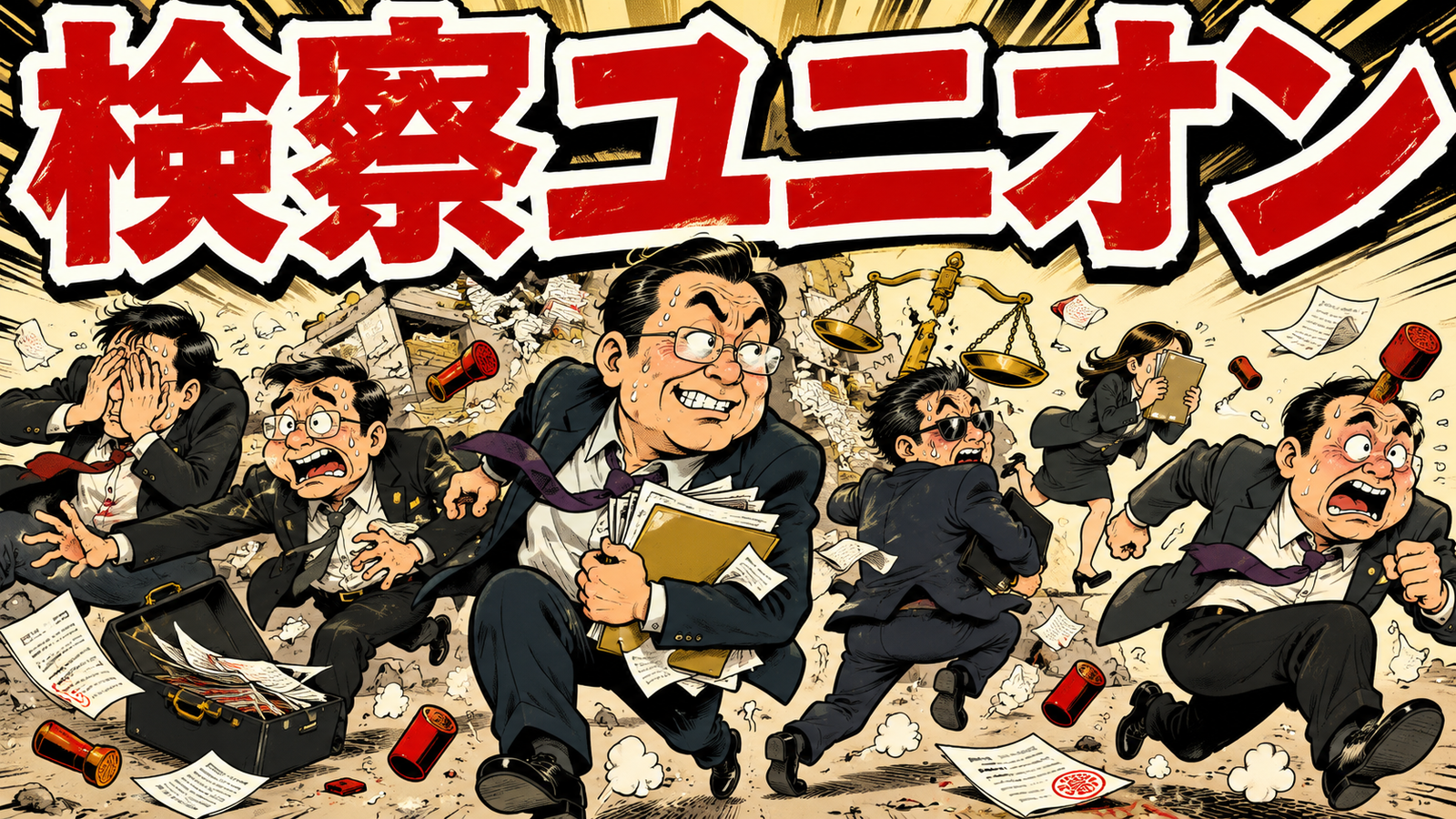
"Umizuka Memo" detailing defendant Joki Nakano, Makoto Watanabe, and Last One Mile, and the Kagoshima District Public Prosecutors Office's document on "Tax Law Violation."
The Prosecutors' Union is not an organization that unconditionally regards prosecutors and the National Tax Agency as enemies. It is a labor union for citizens to verify, from their perspective, which individuals a state organ with strong investigative powers investigates, whom it does not investigate, whose statements it accepts, and whose victim reports it discards.
In recent years, the public has sharply criticized prosecutors regarding issues such as the investigation in the Plessance case, coercive interrogation tactics, handling of investigation information, and organizational oversight. The assumption that prosecutorial decisions are always correct is no longer valid.
The information leak and dissemination questioned in the case of defendant Takashi Tachibana
The source of information and the spread of misinformation should be verified separately.
Regarding defendant Takashi Tachibana, a former member of the Diet known for his slogan "Destroy NHK," information believed to have leaked from within Hyogo Prefecture and its subsequent dissemination became a major social issue. There is no objection to the necessity of examining the responsibilities of those who leaked, received, and spread the information separately, and questioning the authenticity of the information and whether defamation occurred.
Then, why isn't the issue of leaked investigative information from the Kumamoto Regional Taxation Bureau and Kagoshima District Public Prosecutors Office, believed to have spread to a considerable number of private citizens and last-mile stakeholders, investigated with the same intensity?
Suspected leak of information from the National Tax Agency and the prosecution
The "Makitsuka Memo," which is said to be widespread
The "Makizuka Memo," which is said to have already been leaked and spread to a considerable extent, reportedly contains specific details regarding defendant Tadayoshi Nakano, Makoto Watanabe, individuals associated with Last One Mile, financial flows, and investigations and arrests.
The issue isn't just whether someone believed the content of the memo. If it includes timing, targets, and investigative strategies that could only be known from internal information of investigative agencies, and if that aligns with actual investigations, the first thing to investigate is the source of the information.
Do the Kagoshima District Public Prosecutors Office and the Fukuoka High Public Prosecutors Office know about the existence of the "Mamizuka Memo"? If they do, have they investigated who created it, who viewed it, and who took it outside?
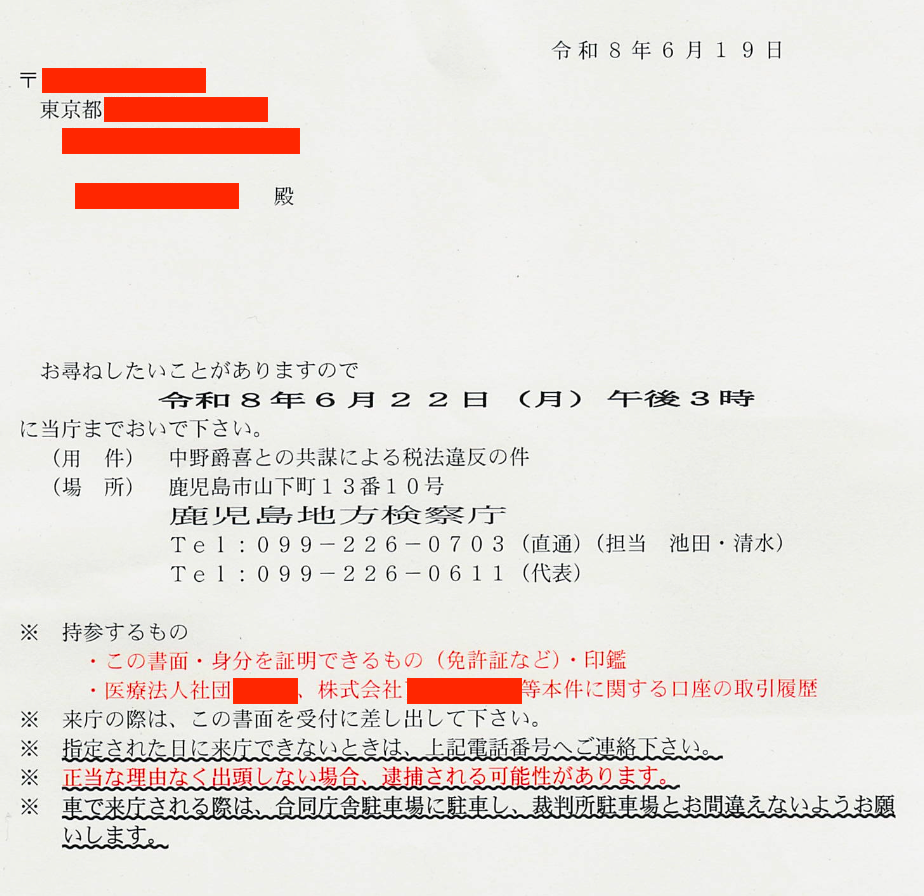
A document allegedly sent by the Kagoshima District Public Prosecutors Office regarding "tax law violations."
The following image is a document created on June 19, Reiwa 8 (2026), requesting the recipient to appear at the Kagoshima District Public Prosecutors Office on June 22 at 3:00 PM. The addressee is stated to be in Tokyo. The document, created on a Friday, requests the individual to travel from Tokyo to Kagoshima by Monday, with a weekend in between.
Moreover, the subject line reads "Regarding violation of tax laws in collusion with Mr. Nakano, the Baron." Instead of specifying concrete applicable laws and alleged facts, such as violations of the Consumption Tax Act, Corporate Tax Act, or Income Tax Act, it is broadly stated as "violation of tax laws."
Furthermore, it warns in red letters, "Failure to appear without just cause may result in arrest." While not clarifying whether the person being questioned is a suspect or a witness, nor under which law the request to appear is based, they demand that Tokyo residents appear in Kagoshima within a few days and suggest the possibility of arrest. Is this appropriate investigative practice?
The Prosecutor's Union has received comments such as, "Must the public be arrested by prosecutors who use such crude charges and physically impossible deadlines?"
Do you demand strict accountability from the public but not explain your own documents?
When dealing with private company cases, the National Tax Agency and the prosecution tend to emphasize the title of "then-representative director," consolidating responsibility for company contracts, accounting, money transfers, and operational management onto the representative.
However, regarding documents created by their own organization, even if the specific charges are vague, the deadline is unreasonable, or arrest is suggested, they do not explain who created them or who approved them. Even if investigation information leaks, they evade organizational responsibility by stating, "We cannot answer as it is an individual case." This double standard is unacceptable.
Public Inquiry to the Kagoshima District Public Prosecutors Office and Fukuoka High Public Prosecutors Office
10 questions about information leakage and document creation
- Are you aware of the existence and external leakage of the "Mimizuka Memo"?
- Are there any parts of the memo that align with information from the National Tax Agency or the Public Prosecutors Office?
- Have you conducted an internal investigation regarding the source of the leak, the creator, the viewers, and external providers?
- To Baron Nakano, Mr. Makoto Watanabe, and any executives or personnel associated with Last One Mile: Have any investigative details been leaked to you?
- Are the attached documents officially created and sent by the Kagoshima District Public Prosecutors Office? Please clarify the creator, approver, and legal basis.
- What is the reason for only stating "tax law violation"? Please explain why specific applicable laws and suspected facts were not provided.
- Who determined the deadline, which was set on Friday and requested to arrive in Kagoshima from Tokyo on Monday after the weekend, and what circumstances were taken into consideration?
- Is it appropriate to state that there is a "possibility of arrest" for a witness or a person who has not been arrested, without providing specific grounds?
- Did you investigate the possibility that some executives at Last One Mile or Mr. Makoto Watanabe's side received or used the memo or investigative information?
- Do you intend to conduct third-party verification regarding information leakage and document creation appropriateness, and to publicize the results?
The last mile and Makoto Watanabe cannot remain silent either
This issue is not solely the prosecutor's problem. If the person in charge or involved in the "last mile" received, shared, and used the "Mamizuka Memo" to pressure union members or related parties, then as a listed company, there is a significant accountability.
Makoto Watanabe and Last One Mile should clarify when the memos were obtained, through what channels, the scope of their sharing, and whether they have had contact with investigative authorities. If they are unrelated, it is sufficient to state that fact clearly.
If you're going to investigate leaks, investigate your own first.
While strictly scrutinizing the statements of defendant Takashi Tachibana, if leaks from within the National Tax Agency and the prosecution are ignored, the application of the law will vary depending on the position of the speaker.
The Prosecutors' Union will verify the authenticity of the leaked documents, their consistency with actual investigations, how they were obtained, and explanations from involved parties, rather than uncritically accepting them as truth. At the same time, we will request the National Tax Agency and the prosecution to conduct the same verification.
Do not run from information leaks. Do not run from sloppy documentation. Before arresting citizens, explain your investigative capabilities and information management.