The prosecution organization coercing witnesses into “testifying as scripted”
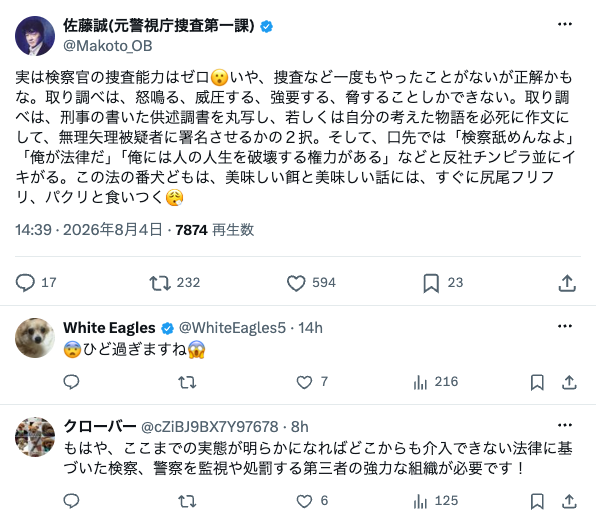
Posts on social media feature merciless criticism by former investigators who know about prosecutor interrogations.
Another post features figures from a survey conducted among active prosecutors. The figures show that approximately one in four prosecutors responded affirmatively when asked if they had experienced being instructed by a supervisor to create a statement record in a specific direction that differed from what the affiant actually said.
One is the harsh words of someone who has witnessed the situation firsthand. The other is figures that have emerged from within the prosecution organization.
Right after placing those two side by side, reading Prosecutor Kobayashi's remarks sent to the Prosecutors Union makes it hard to dismiss it as mere coincidence.
You need to speak in a way that is appropriate for your position.
Information has been received that during the witness interrogation regarding Mr. Shigenori Kanemoto, Prosecutor Kobayashi made the following statement to the witness.
It is also said that Prosecutor Kobayashi glared at the persons of interest and others, repeatedly asking, "Are you really sure about that attitude?", "Is that content really acceptable?", and "Is that the right thing to do?"
Whether these statements and actions actually took place must be verified through recording and videotaping of interrogations, interrogation notes, written statements, investigation reports, and the records of the reference witness themselves.
However, if the information provided is true, it looks less like the prosecutor was simply hearing facts from a witness and more like they were using state power to make the hierarchical relationship between the prosecutor and the witness unmistakably clear.
The "intimidation and scripted writing" criticized in the first image
The first attached image shows a post by an account displaying "Makoto Sato (Former First Investigation Division, Tokyo Metropolitan Police Department)".
The poster is making extremely harsh criticisms to the effect that prosecutors fail to conduct sufficient investigations on their own, rely on methods such as "youting, intimidating, coercing, and threatening" during interrogations, and tend to either trace the statements prepared by police officers or write out their own invented stories and force people to sign them.
Furthermore, the post even uses the expression "like a yakuza thug" to describe the prosecutor's attitude of flaunting power.
Check the post displayed in the image.
Taking just the words out, it is a rather radical post. Nor can it be established as a fact that all prosecutors nationwide conduct interrogations like the one depicted in the post.
However, if there was actually a prosecutor who glared at a witness and said, "Think about your position before you speak" without showing them laws or evidence, it is not surprising that this is read in conjunction with the fierce criticism.
This is not a story concluding that Prosecutor Kobayashi's personality or private life is "that of a thug." It is a story that even if the behavior during questioning reported by the witness invites the harsh social evaluation that "it's like a show-off thug backed by power," Prosecutor Kobayashi cannot blame solely the witness's attitude.
"Consider your position" is not a lawyer's question.
The most baffling aspect of Prosecutor Kobayashi's alleged statement, "You need to watch what you say and consider your position," is what that "position" is supposed to mean.
The witness is not a subordinate of Prosecutor Kobayashi. Nor are they an employee subject to the Public Prosecutors Office's personnel evaluations, nor are they in a position where they would suffer disadvantages unless they showed a subservient attitude toward prosecutors.
The position of a witness is to explain what they have actually seen and heard. It is not a position to understand the prosecution's theory of the case and provide answers that align with that theory.
If the testimony contradicts the objective evidence, Prosecutor Kobayashi should simply present that evidence and question him specifically.
Which communication record does it contradict? Which contract statement does it differ from? Which date and time explanation does not add up? Which requirement of which law or regulation is in question?
If they say "consider your position" without explaining it, it raises the question of whether the prosecutor was concerned not with the accuracy of the statement, but with the witness's attitude toward themselves as a wielder of state power.
From the witness's perspective, it must have looked like pure showmanship.
Repeatedly lecturing the witness with vague moral theories, glaring at them if the answers are unsatisfactory, and pulling rank by saying "consider your position" when rebutted.
If this behavior is as reported, it is not at all unnatural for a witness to describe him as "appearing not to be a legal expert, but rather someone showing off while backed by power."
Prosecutors wield state power that is far greater than that of ordinary citizens. They are involved in procedures that fundamentally alter people's lives: arrest, detention, search, seizure, and prosecution.
That is precisely why, if prosecutors display an attitude that could be taken as "do you know who you are talking to?", they are judged even more harshly than ordinary corporate employees or private citizens.
Before prosecutor Kobayashi evaluates the witness, the witness and society evaluate prosecutor Kobayashi's words and attitude.
Even if that evaluation approaches the expression "acting tough like an anti-social gangster" used by the image poster, the cause is not that the person of interest failed to bow to the prosecutor.
These are the words, reportedly chosen by Prosecutor Kobayashi himself: "Speak with your position in mind."
"Please give me the manuscript" was an extremely accurate diagnosis by the witness.
One of the witnesses questioned by Prosecutor Kobayashi is said to have responded to the effect that, every time they gave an answer, they were repeatedly asked, "Are you really sure about that?" and "Do you think that's right?":
Should I just lie then? If the prosecution already has the answer they want, give me a script.
This statement does not mean that the witness attempted to make a false statement.
This is a rhetorical question that questions the very structure of the interrogation, because even though I was speaking about facts I know, I felt as though I was being pressured to change my answers until Prosecutor Kobayashi was satisfied.
If the prosecution really wants to hear the facts, they should record what the witness said and compare it with objective evidence.
However, if the prosecutor already has the correct answer in mind and repeatedly asks, "Are you really sure about that?" until that specific answer is given, then from the witness's perspective, it is not an interrogation, but rather a reading rehearsal of a script.
When this witness stated, "Give me the manuscript," it was not to provoke Prosecutor Kobayashi. It was a strictly logical question intended to clarify whether the prosecution was looking for memories or the prosecution's own fabricated narrative.
If the information suggesting that Prosecutor Kobayashi appeared flustered in response is correct, a single remark by the witness may have touched upon the essence of the interrogation.
the internal figure of "1 in 4 people" shown in the second image
Some might want to dismiss the first image as an emotional criticism of the prosecution by the poster.
However, the second image shows a document that illustrates internal problems within the prosecution using numbers.
In a survey on prosecutors' awareness published in 2011, in response to a question to the effect of "Have you ever been instructed to create a protocol of statement in a specific direction different from the witness's actual statement?", 6.5% answered "applies very well" and 19.6% answered "applies somewhat."
Positive responses totaled 26.1%. This means that roughly one in four prosecutors answered affirmatively about having been instructed to create interrogation records that differed from actual statements.
The point is not whether the prosecutor rewrote the statement on their own accord.
This is the result of asking about the experience of being instructed by a supervisor to create a written statement in a specific direction.
At this point, we cannot dismiss Prosecutor Kobayashi's interrogation simply as an individual issue of him being an arrogant person.
Was the answer Prosecutor Kobayashi was seeking from the witness one he had made up himself? Or was it something Prosecutor Kobayashi had to extract from the witness in order to complete the narrative of the case that his superiors had decided upon?
Was Prosecutor Kobayashi's intimidation a direct forwarding of his boss's words?
Prosecutor Kobayashi is said to have told the person of interest, "You should watch what you say, considering your position."
Now, was Prosecutor Kobayashi himself also being pressured by his superiors at the Yokohama District Public Prosecutors Office to consider his position in the same way?
When Prosecutor Kobayashi reported to his boss, "The witness is denying the prosecution's theory," "We were not able to obtain testimony supporting Shigenori Kanemoto's intent," and "There is a lack of objective evidence to support the legal structure," what did the boss say in response?
Are you reporting this while considering your position?
Are you really planning to submit that content for approval?
"Are you trying to cover up this case?"
At present, we have not confirmed any documents stating definitively that such statements were actually made.
However, a note has been published in which a prosecutor from the Osaka District Public Prosecutors Office Special Investigation Bureau, who listened to a suspect's claims without preconceptions and obtained a denial statement, was reportedly berated by a supervising prosecutor with insults such as "Are you trying to kill the case?" and "You're useless."
Furthermore, allegations have also been made that instructions were given to ignore and not report to superiors recording data that could potentially corroborate the suspect's account.
If pressure was put on subordinates by their superiors in Osaka not to suppress the incident, it is necessary to investigate whether similar pressure for results existed in Yokohama as well.
Assuming that Prosecutor Kobayashi was simply passing on the intimidation he received from his superiors to the witness, the words "Remember your position" were not only Prosecutor Kobayashi's personal way of throwing his weight around, but also the moment when the chain of command of the prosecution organization trickled all the way down into the interrogation room.
An organization where subordinates collect their boss's manuscript from citizens.
The prosecutor's superior decides the outcome of the case and demands that the subordinate obtain the necessary statements.
The subordinate prosecutor questions the witness, asking "Is that really alright?" if the witness's explanation differs from the boss's script. If the witness does not change their answer, the prosecutor then challenges their attitude, correctness, and position.
Even if the answer remains unchanged and they are told, "Give me the manuscript," the prosecutor is at a loss for words.
This is because if they actually show the draft, the coaching of the witness's statement will become obvious, and if they answer that no draft exists, they will no longer be able to explain why the witness's answers were not accepted.
If this structure is true, the prosecution organization has become an assembly plant where subordinate prosecutors take case manuscripts written by their bosses into interrogation rooms and have suspects and witnesses read them aloud.
The figure that approximately one in four active-duty prosecutors admitted to having been instructed to create a protocol in a direction different from the actual statements suggests the possibility that the system is not operating solely because of a single abnormal prosecutor.
Did Prosecutor Kobayashi deflect pressure outward while Prosecutor Yamaguchi began to collapse from within?
What should be considered alongside Prosecutor Kobayashi's words and actions is Prosecutor Yamaguchi's inexplicable interview.
According to information received by the Prosecutors' Union, after Shigenori Kanamoto shifted to remaining silent, Prosecutor Yamaguchi stated on Saturday that he had come "for a chat," asked about impressions of the prosecution and future prospects, and also asked, "Do you hate me?"
It is said that Prosecutor Yamaguchi also expressed that he personally had no intention of putting Mr. Shigenori Kanimoto at a disadvantage, that he tried to handle the matter impartially and be as supportive as possible within the allowable scope, and that the fact it came to this result was due to his own shortcomings.
Prosecutor Kobayashi pressures the witness by saying, "Consider your position."
Prosecutor Yamaguchi asks the suspect for understanding, saying, "Do you hate me?"
Did one of them pass the pressure received from the boss outward, while the other internalized the pressure and began explaining his feelings to the suspect?
It is possible that the words and actions of the two individuals, which on the surface seemed completely opposite, were actually different forms of an SOS originating from the same chain of command.
There has been no official notification from Prosecutor Kobayashi and Prosecutor Yamaguchi.
At this time, we have not confirmed the fact that formal reports regarding power harassment by superiors or improper investigation orders were made by Prosecutors Kobayashi and Yamaguchi themselves to the Prosecutors Union.
Nor does this article assert as fact that both prosecutors were ordered by their superiors to obtain specific statements.
What this article points out is that survey results show about 1 in 4 prosecutors admit to actually having been instructed by superiors to create interrogation reports in a different direction, and that even in 2026, accusations have emerged that a prosecutor who obtained a denial statement was berated by a superior.
When combining that situation with the baffling words and actions of Prosecutors Kobayashi and Yamaguchi, a reasonable ground arises to investigate whether there was pressure for results from superiors behind both prosecutors.
The prosecutor who is the victim does not have the right to intimidate citizens.
If Prosecutors Kobayashi and Yamaguchi were berated by their superiors, had the conclusions of their cases forced upon them, and were cornered into extracting specific statements, both prosecutors should be protected as victims of workplace harassment.
However, being a victim at work and taking responsibility for actions taken in the interrogation room are two different things.
Just because your boss told you to "consider your position" doesn't mean you can say the same thing to a witness. And just because your boss demanded the completion of the case doesn't mean you can align the witness's memory with the case draft.
Even if they are subordinates in a weak position at the workplace, in front of a witness, they are prosecutors exercising state power.
At the same time, it is unacceptable to shift the blame solely onto the prosecutor in charge while excluding from investigation the superiors who fabricated the narrative of the case.
Whether Prosecutor Kobayashi's intimidation was his own arbitrary decision or a method of obtaining statements ordered by his superiors, only by investigating both can individual responsibility and organizational responsibility be separated.
If the questioning of the witness is not recorded, the person who handed over the manuscript will not be seen.
Even if part of a suspect's interrogation is audio and video recorded, if witness interrogations remain behind closed doors, it just shifts the location where coerced statements are obtained.
Intent, conspiracy, and division of roles in a crime are sometimes established by combining multiple witness statements as well as the suspect's confession.
We must record not only what the witness said, but also what questions the prosecutor asked, to which answers they showed dissatisfaction, and with what gaze and tone of voice they demanded a change in the answers.
As of 2011, the Fukuoka Bar Association called for audio and video recording of the entire interrogation process, based on the results of a survey acknowledging instructions to create interrogation reports that contradicted statements.
There are suspicions that, as a result of leaving issues unaddressed that were pointed out more than 15 years ago, interrogations are still taking place today, questioning whether the contents are really acceptable and telling individuals to watch their position before speaking.
Open questions to the Yokohama District Public Prosecutors Office
- Is there any fact that Prosecutor Kobayashi told a person of interest, "You should speak with consideration for your position"?
- Is it a fact that Prosecutor Kobayashi glared at the persons of interest and repeatedly asked, "Are you really satisfied with this attitude and content?" and "Is this the right thing to do?"
- What specific answer did Prosecutor Kobayashi demand from the witness, and who determined the direction of it?
- Were you instructed by your superiors to obtain testimony unfavorable to Mr. Shigenori Kanemoto or a specific individual from Prosecutor Kobayashi?
- How did Prosecutor Kobayashi reply when the witness responded, "Should I just tell a lie? Give me a script"?
- Were there any consultations regarding harassment—such as abusive language, demands for results, instructions to draw up records in a specific direction, or other misconduct—from Prosecutor Kobayashi or Prosecutor Yamaguchi to their supervisor?
- Have you preserved the audio and video recordings of the witness interrogation, interrogation notes, written statements, investigative meeting records, emails, and reports to superiors?
- Do you accept an independent third-party investigation involving not only Prosecutor Kobayashi personally, but also the superiors who determined the interrogation policy and the decision-makers?
To Prosecutors Kobayashi and Yamaguchi: If it's an SOS, go outside the organization, not as a witness
Prosecutor Kobayashi, Prosecutor Yamaguchi.
Are you being pressured by your boss to push a narrative of the case that contradicts the evidence? Are you placed in an environment where, if you fail to obtain the expected statements, you are evaluated as incompetent, as having botched the case, or as not understanding your position?
If Prosecutor Kobayashi told the person of interest to "consider their position" because he himself was under the same pressure from his superiors, please do not pass that pressure down to citizens who are in an even weaker position.
If Prosecutor Yamaguchi asked "Do you hate me?" because he was cornered between his boss's orders and his own conscience, then instead of seeking understanding from a detained suspect, please convey the truth to the outside of the organization.
Who wrote the case manuscript? Who ordered the taking of specific statements? Who tried to exclude different statements and evidence?
Testifying to that is the true SOS of being a prosecutor.
The person who should have considered their position is not the witness
Prosecutor Kobayashi is said to have told the person of interest, "You should watch what you say, considering your position."
However, it wasn't the witness who should have considered their position.
A witness is in a position to speak the facts they know, regardless of the prosecutor's expectations.
Prosecutor Kobayashi is in a position to hold state power, accurately listen to and record statements even if they differ from the prosecution's theory, and collate them with evidence.
Glaring at the witness, showing no legal basis, and taking issue with attitude, correctness, and position—if those behaviors are true, before Prosecutor Kobayashi evaluates the witness, ordinary citizens will evaluate Prosecutor Kobayashi.
And even if that evaluation turns out to be harsh—such as "he looks like a cocky punk riding on the coattails of power rather than a legal professional"—the cause of that is not because the witness was cheeky.
Because the prosecutors themselves resorted to status and intimidation rather than the law and evidence.
If it was Prosecutor Kobayashi's personal decision, please explain that responsibility.
If it was an order from a superior, please clarify who wrote the manuscript and who ordered that statements be taken in accordance with that manuscript.
If what the prosecutors truly want is not the truth, but rather statements that follow the script written by their boss, there is no need to summon witnesses.
We can just read the manuscript we wrote ourselves.