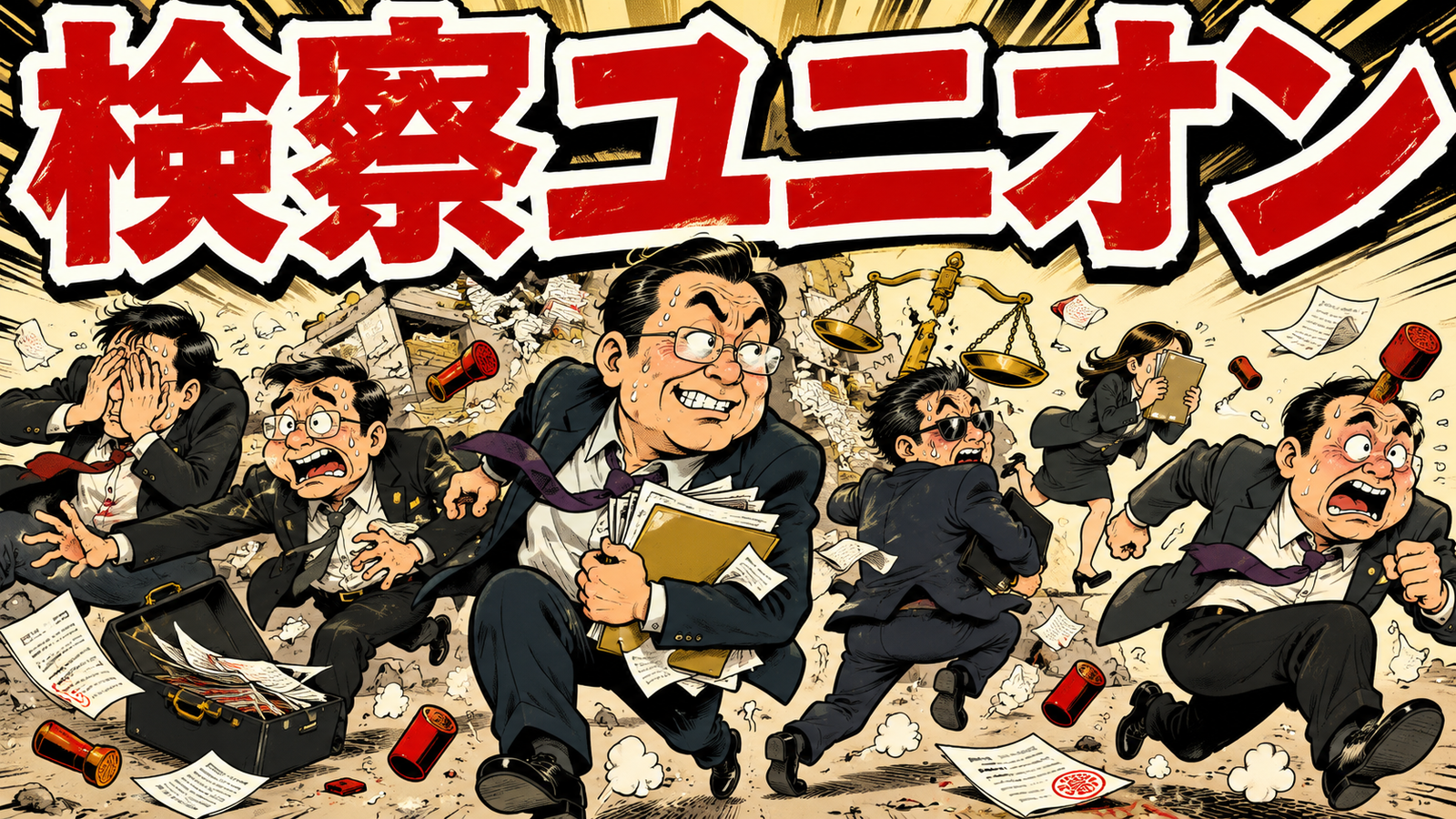
In the quiet interrogation room, every time the witness gave an account based on their own memory, the prosecutor's expression hardened, glaring at them while repeatedly questioning, "Are you really sure about that attitude?" and "Are you really sure about that story?"
Furthermore, without specifically indicating which acts violate which laws, or which evidence and answers contradict each other, they repeatedly ask, "Is that the right thing to do?"
Information has been provided to the Prosecutors Union that, in the investigation by the Yokohama District Public Prosecutors Office concerning Mr. Shigenori Kanemoto, Prosecutor Kobayashi conducted questioning of witnesses and others in this manner.
The truth or falsity of the provided information must be verified through the audio and video recordings of the interrogation, interrogation notes, statements, the assigned prosecutor's report, and the records of the witness themselves. However, if the reported words and actions are true, it is an interrogation attitude unbecoming of a prosecutor.
And what we must question this time is not just Prosecutor Kobayashi's personal character or mood.
A memo has been made public revealing that a prosecutor at the Osaka District Public Prosecutors Office Special Investigation Department, who listened to a suspect without forcing the prosecution's theory, was berated by a superior, being told, "Are you trying to kill the case?" and "You're useless," and was pressured to create a pre-scheduled confession statement.
If such an organizational culture also exists within the Yokohama District Public Prosecutors Office, we must examine the possibility that Prosecutor Kobayashi's behavior—glaring at a witness and pressuring them to change their testimony by asking, "Are you really sure about that?"—was also part of a testimony-gathering effort ordered by superiors.
Are you really satisfied with that attitude and content?
According to information obtained by the prosecutors' union, during the interrogation of multiple witnesses, Prosecutor Kobayashi reportedly showed facial expressions indicating dissatisfaction with their explanations, glared at them, and took issue with both the content of their answers and their attitude.
When a witness gives an explanation that differs from the prosecution's theory, they are asked, "Are you really sure about that?" Furthermore, it has been reported that investigators repeatedly asked questions such as "Is that the right thing to do?", which do not address legal issues, but rather seem to judge or grade the witness's ethical sense or character.
What the prosecutor needs to confirm is not whether the witness agrees with the "correctness" envisioned by Prosecutor Kobayashi.
It is to verify when, where, from whom, and what the witness heard, which documents they reviewed, and what actions they took, and whether that explanation is consistent with objective evidence such as contracts, communications, remittances, administrative inquiries, and accounting records.
If the answer contradicts the evidence, you can simply present that evidence and ask a specific question.
Instead of doing that, if they were pressuring the witness to change their answer through facial expressions, gaze, tone of voice, and ambiguous phrases like "Are you really sure about that?", then that is not an interrogation to ascertain the truth. It is pressure to make the witness's statement fit a case narrative that the prosecution has already fabricated.
What the witness replied: "Should I just tell a lie? Give me a manuscript."
During this interrogation, in response to being repeatedly questioned about his answers by Prosecutor Kobayashi, one of the persons of interest is said to have responded to the following effect:
Should I tell a lie then? If the answers the prosecution wants are already decided, give me a script.
This statement does not mean that the witness attempted to make a false statement.
Even though I was explaining facts that I personally remembered, I was repeatedly asked, "Are you really sure about that?" and "Do you think that's correct?", making me feel as though they were implicitly demanding a different answer that the prosecution expected.
From the witness's perspective, even if they talk about what they actually saw and heard, if Prosecutor Kobayashi continues to ask the same questions until he is satisfied, they have no way of knowing what they need to say to bring the interrogation to an end.
If the goal is to make me say the answers the prosecution wants, I'd rather you just show me a script from the start. If the goal is to hear the facts, I would appreciate it if you didn't take issue with my attitude or correctness simply because you don't like my answers.
The witness rebuffed that contradiction with a few brief words.
Upon receiving this response, Prosecutor Kobayashi reportedly appeared to the witness to have suddenly panicked.
If Prosecutor Kobayashi was purely checking his memory, it would have been enough to reply, "There is no set answer. Just tell us what you actually saw and heard."
If he could not explain it immediately, it raises the question of what Prosecutor Kobayashi considered the "correct answer" and why he needed to make the witness say it.
Does a witness have to keep the prosecutor happy?
The witness did not jokingly say, "Give me a script," to refuse the answers requested by the prosecutor. Rather, when the prosecutor refused to accept their explanation as fact and demanded a different answer, the witness was asking them to clearly show the text the prosecution actually wanted.
A witness has no obligation to humor the prosecutor, put on a remorseful expression, or agree with the prosecutor's theory.
If the meaning of a question is unclear, you can ask for an explanation. If no legal basis is provided, you can confirm what the issue is. If you are pressured to change your answers even when telling the truth, it is only natural to object to such interrogation methods.
If a prosecutor, who wields state power, evaluates a witness's logical rebuttal as having a "bad attitude," then what the prosecution is demanding is not testimony, but obedience.
"Is it the right thing to do?" is not a question to confirm the establishment of a crime.
It is reported that Prosecutor Kobayashi repeatedly asked, "Is that the right thing to do?" without specifically indicating which requirements of which laws and regulations were at issue.
However, the term "correct" has no meaning under criminal law.
Whether one now regrets the actions—questioning if they were morally desirable, common in commercial transactions, or should have been handled cautiously from a tax perspective—is a separate issue from the intent or conspiracy required to establish a crime.
If the prosecution is questioning the intent or conspiracy to evade taxes, it must ask the witness about the following specific facts.
- Which contracts or transactions did you recognize as being false?
- Which services did you know were not actually provided?
- Which administrative responses did you recognize as incorrect or lacking premises?
- With whom, when, and what crime did you share the intent to commit?
- What fund transfers were intended to be disguised or concealed?
- What contracts, communications, or remittance records support that understanding?
Without identifying these, simply repeating "Don't you think it's wrong?" or "Do you think it's right?" cannot prove criminal intent.
It looks like they are just trying to make the witness feel a moral sense of guilt and convert that guilt into the testimony the prosecutors want.
Was prosecutor Kobayashi's intimidation also an order from his boss?
This is the issue that deserves the most attention this time.
Were the severe gaze that Prosecutor Kobayashi allegedly directed at the witness, his persistent re-questioning of the answers, and his remark, "Is that really the right attitude to have?" conducted solely on Prosecutor Kobayashi's own judgment?
Or was it the result of being ordered by superiors at the Yokohama District Public Prosecutors Office to obtain a confession admitting specific details and being pressured to produce results?
As a result of conducting an "open" interrogation—where the male former prosecutor from the Osaka District Public Prosecutors Office Special Investigation Department listened to the suspect's claims instead of forcing the prosecution's theory—he obtained a statement from the suspect denying the intent to evade taxes.
Then, they complain that they were verbally abused by the supervising prosecutor, who said things like "Are you trying to kill the case?", "The suspect is looking down on you," and "You're useless," and was pressured to create the scheduled confession protocol.
Furthermore, upon discovering recording data that could potentially corroborate the suspect's account, a note was also made public stating that they were instructed to "ignore it and not report it to the boss."
If such commands and directives are being issued within the prosecutors' office, it is also necessary to investigate whether Prosecutor Kobayashi received similar demands from his superiors.
"Extract testimonies from this reference witness that are disadvantageous to Shigenori Kanemoto and others."
Do not just send him back with an explanation that differs from the prosecutor's theory.
Check again and again whether you truly don't know or if you think it is right.
If we can't get a confession, the case will be killed.
This does not conclude that Prosecutor Kobayashi actually received such an order.
However, if coercive questioning in the same direction was conducted against multiple witnesses, the possibility that it was an interrogation policy approved or instructed by a superior, rather than the temporary emotion of an individual, cannot be ruled out.
It is not enough to review only Prosecutor Kobayashi's interrogation notes. We must verify who decided the questions, what instructions were given in the pre-interrogation meeting, and what kind of reports were requested after the interrogation.
Were you, Prosecutor Kobayashi, being intimidated in the approval room in the same way?
When the witness answers, Prosecutor Kobayashi glares at them and presses, "Are you really sure about that?"
That sight makes one imagine the possibility that Prosecutor Kobayashi himself had been addressed with similar words when receiving approval from his own superiors.
When Prosecutor Kobayashi reported to her superior, "The witness is denying the prosecution's theory," "No objective corroboration has been confirmed," and "We cannot point to any specific violation of laws and regulations," wasn't she pressed by the superior with questions like, "Is that report really acceptable?" and "Are you going to kill the case with that attitude?"
Did you then direct the gaze and pressure you received there toward the person of interest in the interrogation room?
Isn't it possible that the fear of being evaluated as failing to understand the case, lacking interrogation skills, or not trying hard enough if he failed to obtain the statement his superiors wanted drove Prosecutor Kobayashi to coerce the witness?
We have not confirmed the fact that there was any formal power harassment consultation or whistleblower report made by Prosecutor Kobayashi himself to the prosecutors' union.
Even so, given that the reality of superiors demanding confessions from subordinates within the prosecutors' office and verbally abusing subordinates who do not follow their theories has been exposed, regarding Prosecutor Kobayashi's words and actions as well, rather than ending it by disciplining only the individual, it is necessary to investigate orders from superiors and institutional pressure for results.
If there is a boss who ordered intimidation, that boss is the one who should step outside.
If Prosecutor Kobayashi acted on his own initiative to intimidate the witness, Prosecutor Kobayashi himself must explain.
On the other hand, if you were ordered by your supervisor to obtain a specific statement and were even instructed on how to ask the questions, that supervisor should bear the responsibility.
Putting only the assigned prosecutor in the spotlight while their superior never shows their face in the interrogation room, and if the expected testimony is not obtained, blaming it on the prosecutor's incompetence. When a problem comes to light, they distance themselves by claiming it was the rogue, personal action of the individual prosecutor.
If such organizational management is being practiced, workplace harassment against the assigned prosecutor and pressure on witnesses to give statements are occurring under the same chain of command.
Please clarify who explained the case theory to Prosecutor Kobayashi, who determined the questions, who evaluated the contents of the statements, and who decided that this answer was insufficient.
An organization where prosecutors who listen "openly" are berated
What is serious about the memo by the Osaka District Public Prosecutors Office Special Investigation Department is not just the abusive language.
When the suspect's account was heard without preconception, a denial statement differing from the prosecution's theory emerged, resulting in the prosecutor in charge of the interrogation being berated.
If testimony emerges that does not fit the prosecution's scenario, rather than verifying the content of the testimony, the prosecutor who elicited that testimony is evaluated as being "looked down upon" or "incompetent."
In that environment, prosecutors stop listening to the other party.
No matter what a suspect or witness explains, they are re-questioned until they reach the conclusion approved by the superior. If the answers do not change, their attitude is made an issue, remorse and correctness are demanded, and in the end, the expressions in the written statement are replaced with the prosecution's wording.
If it is true that Prosecutor Kobayashi pressed the witness, asking, "Are you really satisfied with that attitude and content?", it should be verified whether the same structure did not exist in the Yokohama District Public Prosecutors Office as well.
Is it the same kind of SOS as Prosecutor Yamaguchi's "Do you hate me?"
Regarding Prosecutor Yamaguchi, information has been received that after Shigenori Kanemoto shifted to remaining silent, Yamaguchi said on Saturday that he had "come for a chat" and asked, "Do you hate me?"
At that time, Prosecutor Yamaguchi reportedly stated that he had no intention of putting Shigetoku Kanemoto at a disadvantage, that he tried to deal with the matter fairly and be as supportive as possible within the allowable range, and that the outcome was due to his own lack of capability.
Prosecutor Kobayashi presses the witness, asking, "Are you really satisfied with that attitude?"
Prosecutor Yamaguchi asks the suspect for understanding, saying, "Do you hate me?"
Superficially, their words and actions are polar opposites, but if both are the reactions of prosecutors who lost their way between the case narrative fabricated by their superiors and the actual evidence and statements, it might be different manifestations of the same organizational problem.
Did Prosecutor Kobayashi pass the pressure he received from his superior on to the witness, and did Prosecutor Yamaguchi ask the suspect for understanding regarding the pressure he received from his superior?
Are the mysterious statements spreading outward one after another a silent SOS leaking from the prosecution organization, even if they are not official reports from the individuals themselves?
Even a prosecutor who is a victim does not have the right to intimidate a witness.
If prosecutors Kobayashi and Yamaguchi were berated by their superiors, demanded to produce excessive results, and cornered into extracting specific statements, both prosecutors must be protected as victims of workplace harassment.
However, being victimized in the workplace and being responsible for the actions taken in the interrogation room are two different things.
Just because your boss glares at you doesn't give you the right to glare at the witness. And just because your boss orders you to "get a statement that fits our theory" doesn't give you the right to bend a witness's memory to fit the prosecution's scenario.
Even if they are subordinates in a weak position at the workplace, in front of a witness, they are prosecutors exercising state power.
The danger of internal harassment within the prosecution lies not only in the psychological and physical harm suffered by the prosecutors themselves, but also in how it is passed on as pressure for statements to witnesses and suspects, ultimately affecting arrests, indictments, and trials.
The interrogation of a witness is not moral education by a prosecutor.
Article 223 of the Code of Criminal Procedure allows prosecutors and other investigative authorities to request persons other than the suspect to appear and to question them when necessary for the investigation.
However, witness examinations are voluntary in principle. Witnesses do not appear to agree with the prosecutor's moral views, but cooperate to explain the facts they have seen and heard.
If you think it is false, you should specifically point out the contradiction with objective evidence.
Applying pressure through gaze and tone because the answer differs from the prosecution's expectations, and repeatedly asking "Do you think this is right?", does not increase the credibility of the testimony.
Rather, the possibility arises that the witness changed their answers to match the prosecutor's reaction, which undermines the evidentiary value of the testimony itself.
Please record and video-record the questioning of reference witnesses in full as well.
Incident stories are not created based solely on the suspect's confession.
By gathering statements from multiple witnesses and combining them, conspiracy, intent, and the division of roles may be established.
If only suspect interrogations are recorded and witness coaching is not, the pressure will simply shift from the suspect's interrogation room to the witness's interrogation room.
The prosecutors' union calls for a system in which all face-to-face interrogations of suspects and witnesses conducted by prosecutors in criminal cases are, as a rule, audio and video recorded, allowing the interviewed individuals and their legal counsel to review the recordings.
If the Tokyo Regional Taxation Bureau has referred the matter to the prosecutors, please face all 250,000 people.
According to information provided to the prosecutor and national tax unions, following the example of the Kumamoto Regional Taxation Bureau, Mr. Nakamura of the Tokyo Regional Taxation Bureau essentially delegated the investigation and fact-finding related to this case to the prosecutors.
If that information is correct, instead of selecting only a few witnesses and obtaining statements convenient to the prosecution, the prosecutors should face squarely the approximately 250,000 union members represented by the National Tax Union.
Conduct face-to-face interviews one by one with the person who used the system, the person who made inquiries to the administration, the person who received the explanation, the person who prepared the materials, the person who decided to forego the investment, and the person who heard about or witnessed the response of the national tax authorities.
If the tax authorities leave facts they should verify themselves to the prosecutors, and the prosecutors in turn ask, "Do you think this is right?" on behalf of the tax authorities, there is no rational reason to limit the targets to just a few people.
Union members of the National Tax Union, let's record in every single case what the prosecutors asked, what they did not ask, which answers they showed dissatisfaction with, and with what attitude they attempted to force changes to statements.
To National Tax Union members: Let's preserve the records of in-person audits all at once
Union members called as witnesses, union members who will be summoned in the future, and union members who have already been interviewed must immediately preserve all records regarding the interrogation.
It is not guaranteed that statutory audio and video recording is taking place, nor is disclosure of records automatically granted. Nevertheless, it is still meaningful to request confirmation of existence and preservation for materials such as audio and video recordings, interrogation notes, written statements, attendance records, entry and exit logs, and other documents.
- Date and time of the call, method, name of the person in charge, and contact information
- Date and time of the interrogation, start and end times, location, and attendees
- The content of the question and the content of my own answer
- The number of times the same question was repeated and the prosecutor's reaction at that time
- Were there any behaviors such as glaring, raising one's voice, or pounding on the desk?
- Were there evaluative questions, such as "Do you think this is right?" or "Are you remorseful?"
- Was there an explanation given regarding which issue of which laws and regulations is being checked?
- Did you check the contents of the statement record and request any corrections?
- Have recording and video equipment been installed, and have you received an explanation about them?
- What kind of response did you receive when you asked to take a break or leave?
Each person should consult with a lawyer to consider preservation requests, confirmation of existence, and available disclosure procedures for audio and video recordings, interrogation notes, statement protocols, attendance records, and other materials.
If it were just one report, the prosecutors might dismiss it as a "difference in perception" or a "misunderstanding."
However, if the same questions, the same gaze, the same phrasing, and the same witness tampering are confirmed across multiple witnesses, it is no longer just the temporary behavior of an individual Prosecutor Kobayashi. It increases the likelihood that it was an institutional interrogation policy approved by superiors.
Open questions to the Yokohama District Public Prosecutors Office
- Is it a fact that Prosecutor Kobayashi told the persons of interest and others, "Is that attitude really okay?" and "Is that content really okay?"
- Is there any fact that Prosecutor Kobayashi repeatedly asked "Is this the right thing to do?" without showing a specific legal basis?
- Are there any interrogations where a witness responded to the effect of, "Should I just lie? Please give me a script"?
- How did Prosecutor Kobayashi respond to that statement?
- What specific response was Prosecutor Kobayashi asking the person of interest for?
- Were you instructed by your superiors to obtain testimony from Prosecutor Kobayashi that would be unfavorable to a specific individual or Mr. Shigenori Kanemoto?
- Did prosecutor Kobayashi himself decide the questions for the witness, or were they decided by his supervisor or at an investigation meeting?
- Did you instruct on how to respond if a denial or an answer different from the prosecutor's hypothesis arises during the pre-interrogation meeting?
- Weren't you pressured by your superiors regarding your competence and performance evaluations if Prosecutor Kobayashi could not obtain the expected testimony?
- Was Prosecutor Kobayashi himself not being pressured by his superiors, such as being told, "Is that really the right way to conduct the investigation?" or "Are you going to kill the case?"
- Is the examination of the witness/reference person recorded on audio and video?
- If there is no recording or video recording, are interrogation notes, written statements, questions, investigative meeting minutes, and reporting records to superiors preserved?
- Did you compare all interrogation records to see if similar statements or actions were directed at multiple witnesses?
- Were there any harassment consultations regarding instructions from superiors, performance demands, or investigation policies from Prosecutor Kobayashi or Prosecutor Yamaguchi?
- Will you verify the command and control and the interrogation of persons of interest from a standpoint independent of the department in charge of the incident?
Open questions to the Ministry of Justice and the Supreme Public Prosecutors Office
- Are there specific prohibition standards regarding interrogations that glare at a witness and repeatedly blame them for the content of their answers or their attitude?
- Does the system investigating superiors ordering subordinate prosecutors to obtain statements in a specific direction function effectively?
- Will you introduce a system to audio and video record the entire process of witness interrogations as a general rule?
- Will you establish an independent reporting channel where witnesses can safely report intimidation or suggestive questioning by prosecutors to the outside?
- Will you investigate the responsibility not only of the prosecutor in charge, but also of their superiors, the investigation team, and the decision-makers?
- Will you revise the system to inform whistleblowers who provided information to the Supreme Public Prosecutors Office's Department of Inspection and Guidance whether an investigation was conducted and of its results?
- Will you accept an integrated investigation into harassment and investigation directives by a third-party committee independent of the prosecution?
We welcome those who have left the prosecution and those who are suffering within it.
The prosecutor union is not an organization that uniformly hostile to prosecutors.
We welcome as union members people like the former male prosecutor who suffered physical and mental breakdown and resigned after being verbally abused as "useless" for questioning his boss's assessment and trying to check objective evidence.
We also welcome individuals like Hikari, who had no choice but leave her job as a prosecutor after reporting sexual misconduct by a former head of the Osaka District Public Prosecutors Office and secondary victimization within the prosecutors' office, while calling for an investigation by an independent third-party committee.
The Minister of Justice has indicated a policy to conduct a harassment survey targeting all personnel of the Public Prosecutors Office, but an independent third-party committee requested by Hikari and some lawmakers has not been established at this time.
We are seeking prosecutors, assistant prosecutors, and other personnel who are currently suffering within the prosecutor's office from verbal abuse by superiors, excessive demands for results, the creation of investigation records tailored to predetermined theories, instructions to downplay evidence, or pressure to obtain specific confessions.
If prosecutors Kobayashi and Yamaguchi truly received unreasonable orders from their superiors and are voicing their anguish inside the interrogation room, both prosecutors are welcome as union members.
However, it is not permissible to shift the blame for workplace harassment received from a supervisor onto witnesses or suspects.
Record the statement of the boss who glared at you, not the witness. Instead of fabricating a statement that aligns with the prosecution's scenario, testify about who ordered you to follow that scenario.
While the official contact point of the Supreme Public Prosecutors Office's Department of Inspection and Guidance accepts information regarding illegal or inappropriate conduct by prosecution personnel, it explicitly states that it does not provide informants with details or results of the investigation.
If you feel uneasy about a system where you don't even know the status of the subsequent investigation after reporting to the internal desk, please also leave a record outside of the prosecutorial organization.
The "Rightness" Prosecutor Kobayashi Should Have Verified
Prosecutor Kobayashi reportedly asked the witness, "Are you really satisfied with that attitude and content?" and "Is this the right thing to do?"
However, the person to whom that question should have been directed first may not have been the witness.
Is it proper for an interrogation to be conducted in a way where a witness changes their statement to fit the prosecutor's scenario because the prosecutor glares at them?
Is it correct to ask questions that seek only moral guilt without citing specific laws and evidence?
Is it correct to repeatedly ask the same questions to a witness who is telling the truth in order to obtain the statement expected by one's superior?
And if that overbearing attitude was ordered by a boss, is it really right to keep following that order?
Please consider whether it is acceptable to continue interrogations of this nature in the future—where a witness pushes back, saying, "If the prosecution already has a set answer it wants, just give me a script."
If it was Prosecutor Kobayashi's personal decision, please explain that responsibility.
If it was an order from your supervisor, please clarify who gave the order, when it was given, and what you were ordered to do.
The prosecutors' union's answer is clear.
An interrogation that glares at a witness, challenges their attitude and righteousness, and tries to force them to change their answers just because you don't like the facts they spoke is inappropriate.
If the boss had ordered that intimidation, the problem goes beyond Prosecutor Kobayashi alone and extends to the entire command and control system of the Yokohama District Public Prosecutors Office.
If what the prosecutors want is not the truth, but a statement that matches their boss's draft, there is no need to call in witnesses.
We can just read the manuscript we wrote ourselves.