Live broadcasting the unfiltered voices of Prosecutors Kobayashi and Yamaguchi
I will apologize. However, I will not allow my facial expression to be photographed. I will give an explanation. However, I will not allow my voice to be recorded. I will answer questions, but sending emails during the press conference and connecting to the internet are not permitted.
It has been revealed that the Supreme Public Prosecutors Office set unusual conditions for attendance at a press conference regarding a serious scandal involving a former prosecutor who was assigned to the Special Investigation Department of the Tokyo District Public Prosecutors Office.
According to Bengoshi.com News, the notice sent by the Supreme Public Prosecutors Office to reporters stated that video and photography, recording, and real-time transmission of images, audio, and electronic information were not permitted. Attendance was strictly limited to one person per media outlet, sending emails during the press conference was prohibited, and the use of computers without internet access was enforced.
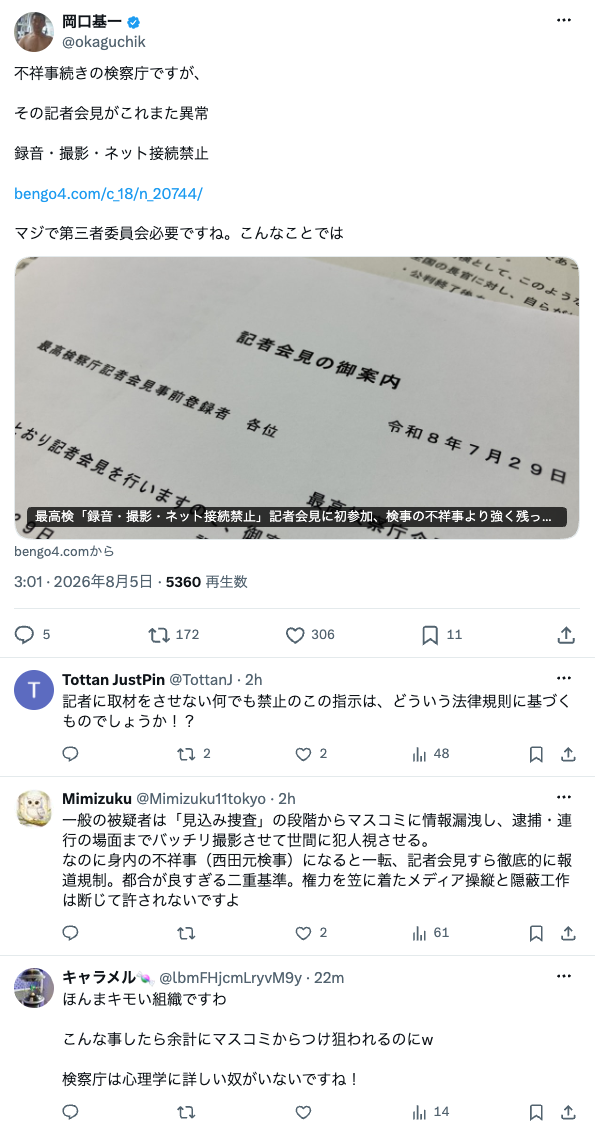
A post by a former judge shown in the image also describes this press conference as "aberrant" and calls for a third-party committee.
An organization involved in a scandal investigates itself, defines the scope of the problem itself, holds its own press conference, and even bans audio recording and photography of that press conference itself. Can this truly be called providing a sufficient explanation to the public?
Neither the appearance of the apology nor the voice in response to questions will be left directly to the citizens.
What was explained at the Supreme Public Prosecutors Office press conference was a serious scandal involving a former prosecutor who had been with the Special Investigation Department of the Tokyo District Public Prosecutors Office, who had a sexual relationship with a woman who was the target of an investigation and received gifts of goods from her.
According to reports, Deputy Prosecutor-General Hiroshi Yamamoto stated, "I offer my deepest apologies to the public," and bowed. However, because filming was prohibited, neither his expression nor his bow could be recorded on video.
During the Q&A session, it was explained that the relationship between the former prosecutor and the woman did not affect the handling of the case, but the specific basis for this was not disclosed, citing the need to identify the individuals involved and protect their privacy.
The explanation from the Supreme Public Prosecutors Office was that, as they determined there was no impact on other cases, there is no need to further investigate cases handled in the past or to establish a third-party committee.
In other words, the prosecution investigates the prosecution, the prosecution decides there was no impact, provides no specific basis for that decision, refuses to let third parties investigate, and does not even allow the audio recording of the press conference explaining this to be preserved.
The Supreme Public Prosecutors Office stated, "It will be communicated through the news media."
When asked by reporters about the reason for prohibiting recording and photography, Deputy Prosecutor-General Yamamoto explained that they ask people to refrain from recording or filming because it may include content related to individual cases or the privacy of persons involved, and specific names may come up during the exchanges.
When another reporter pointed out that this method fails to reach the public and called for a revision, Deputy Prosecutor-General Yamamoto stated to the effect that he believes the information will be accurately conveyed through news organizations, and does not think that photos or recordings are essential for the explanation.
However, the "explanations via news organizations" that the Supreme Public Prosecutors Office relies on are summaries reconstructed from notes handwritten by reporters.
During the statements, the vocal volume, the silence before answering questions, changes in wording when asked the same question, whether questions were interrupted, and whether direct answers were given. Without the original audio and video, the public cannot verify these things.
I am not doubting the reporters' abilities. It is simply a matter of course that no matter how brilliant a reporter may be, they cannot accurately reproduce every single word of a press conference where recording is prohibited.
Privacy is not a silver bullet that completely bans audio recording.
There is no disagreement that we need to protect the privacy of those involved in the incident. It is also necessary to withhold real names, keep personally identifiable parts private, and adjust the filming range.
However, protecting privacy and imposing a blanket ban on all recording, photography, and internet access during the press conference are not the same thing.
If questions arise that identify individuals, you simply do not need to answer those questions. There is also the option for the Supreme Public Prosecutors Office itself to release the official audio and full transcripts—excluding the parts that cannot be made public—after the press conference.
At press conferences held at the Prime Minister's Office and various ministries, video footage and transcripts are sometimes published. It is not impossible to keep records while giving consideration to privacy.
Nevertheless, the Supreme Public Prosecutors Office bans journalists from recording and refuses to provide the original audio itself so that the public can verify it. If such a practice is necessary, they should explain the specific legal basis and why the objective cannot be achieved through less restrictive methods.
Why are prosecutors so afraid of the "unfiltered voices"?
In the press conference where the prosecution explains a prosecution scandal, they don't let the original audio remain. This dynamic is startlingly similar to the problems happening in the interrogation room.
Prosecutors compile what suspects and witnesses say into a statement of testimony. However, what is written in the statement is not the full conversation, but rather content that the prosecutor has selected, organized, and put into writing.
A former male prosecutor who received training at the Osaka District Public Prosecutors Office's Special Investigation Department claimed in a memoir that, despite the suspect denying the charges, he was asked to conduct questioning in line with a "fabricated" confession protocol created by his supervisor and to finalize the protocol based on that content.
Listening to the live conversation reveals what the suspect denies, how the prosecutor changes their wording, and which questions are repeated.
However, if there is no original audio and only the completed record remains, the text prepared by the prosecutor takes on a life of its own as "the suspect's statement."
It is the same at press conferences. If no live voice is preserved and only the materials prepared by the prosecution and the reporters' summaries are left behind, it becomes difficult to accurately verify the prosecutor's words later.
A summary by the press club alone cannot convey the abnormality of the interrogation room.
It is very significant for established media outlets belonging to press clubs to report on prosecutorial scandals. The role of continuously covering organizational issues such as leaks of investigative information, harassment, evidence handling, and disciplinary actions against prosecutors is indispensable.
However, merely using institutional-level expressions such as "leaks of investigative information are suspected in the prosecutors' office" and "inappropriate questioning is becoming an issue" does not allow the public to truly grasp what is happening inside the interrogation room.
What is needed is a specific and detailed record of who used what words, when, and toward whom.
There is information that Prosecutor Kobayashi looked at the witness menacingly and repeatedly asked, "Are you really satisfied with that attitude and content?" and "Is that the right thing to do?"
Furthermore, it is also reported that they told the witness, "You need to consider your position before you speak."
One of the witnesses pointed out contradictions in the interrogation and retorted, "Should I just lie? If the prosecution already has a desired answer in mind, give me a script," which reportedly caused Prosecutor Kobayashi to appear flustered.
These are information submitted to the Prosecutors Union, and verification through audio and video recordings of interrogations or interrogation memos is necessary.
However, even if it is true, we must not simply reduce it to the vague phrase "there were problems with the witness interrogation" and leave it at that.
The raw words, "You need to consider your position when you speak," are a record that conveys what kind of power dynamic a prosecutor holding state power displayed toward a person of interest.
Do not summarize and delete Prosecutor Yamaguchi's actual voice either.
We have also received information that during the questioning of Mr. Shigenori Kanemoto regarding Prosecutor Yamaguchi, it was stated that if he did not testify that the person upon whom the Yokohama District Public Prosecutors Office was attempting to focus responsibility was a bad person, Mr. Shigenori Kanemoto himself would end up being treated as the worst person.
It is also said that after Shigenori Kanemoto shifted to silence, Prosecutor Yamaguchi visited him on a Saturday under the guise of "coming to chat" and asked, "Do you hate me?"
There is also information that he stated he had no intention of putting Mr. Shigenori Kanemoto at a disadvantage, that he meant to support him as much as possible, and that the current situation was due to his own lack of ability.
An organizational-level summary such as "Prosecutor Yamaguchi chatted with the suspect" fails to convey this abnormality.
To a person detained by state authority, the assigned prosecutor asked, "Do you hate me?" He expressed his self-assessment that he had intended to remain neutral, and reflected that he had fallen short in his abilities.
Only when those specific words are recorded does it become possible to verify whether it was an interrogation, an explanation, or an SOS sent by a prosecutor cornered by a superior.
Did Prosecutor Kobayashi channel pressure outward, while Prosecutor Yamaguchi began to collapse from within?
Prosecutor Kobayashi pressures a witness, telling them, "Consider your position." Prosecutor Yamaguchi seeks understanding from a suspect, asking, "Do you hate me?"
At first glance, these are completely contradictory words and actions.
However, if both were asked by their superiors to obtain a specific statement, complete the narrative of a tax evasion case, and not undermine the prosecutors' theory, their words and actions may have stemmed from the same institutional pressure.
Prosecutor Kobayashi passed on the intimidation he received from his superior to the witness. Prosecutor Yamaguchi, unable to handle the pressure, began explaining his feelings to Shigetoku Kanemoto.
At present, we have not confirmed the fact that prosecutors Kobayashi and Yamaguchi themselves have made a formal report to the prosecutor union regarding workplace harassment or wrongful investigation orders by their superiors.
Even so, given that a former prosecutor from the Special Investigation Department of the Osaka District Public Prosecutors Office has alleged being pressured by superiors to obtain confessions and being asked not to report evidence that could serve as counterproof to superiors, there is sufficient reason to check whether similar commands and directives existed in the Yokohama District Public Prosecutors Office as well.
Was Prosecutor Kobayashi's intimidation an interrogation method ordered by his superiors? Was Prosecutor Yamaguchi's baffling small talk an SOS from a prosecutor lost between orders from above and his own conscience?
Without recordings or documentation, the prosecution can later explain, "That's not what was meant" or "It was a misunderstanding by the recipient."
That is precisely why we need to preserve raw voices.
Live streaming does not mean encouraging illegal information leaks.
The "live broadcast" demanded by the prosecutors' union does not mean the disorderly leakage of personal information of those involved in the case and investigative secrets.
It is to accurately record who stated what based on lawfully obtained audio and video recordings, memos made by the individual immediately after interrogation, interrogation protocols, reports to defense counsel, public court documents, whistleblower reports, and testimonies obtained with the consent of the parties involved.
It also distinguishes whether there is an original recording, contemporaneous notes, a statement based on later recollection, or hearsay from a third party.
While concealing information that could identify those involved in the case or persons of interest, we will make visible the words of prosecutors wielding state power, their interrogation methods, and orders and harassment from superiors.
Rather than an abstract apology from the organization, specific words uttered in the interrogation room will be conveyed to the public. That is the live broadcast to prevent abnormal forced confessions and wrongful convictions by the prosecution.
For the citizens' crime victimization, "go to the police first"; for their own scandals, recording is prohibited.
Among the consultations submitted to the prosecutors' union, there are cases where ordinary citizens feel they were turned away at the threshold when reporting crimes, being told, "Please consult the police first," "Isn't this a civil matter?" or "Come back after gathering evidence."
There is also frustration that prosecutors are not actively engaging with the cases, citing reasons such as the small amount of damage, the lack of significant social impact, and the fact that the police are not investigating.
Of course, not all reports can be immediately investigated as criminal cases. Within the limits of available personnel, it is necessary to determine suspicion, evidence, jurisdiction, and the necessity of investigation.
However, while the prosecutors demand evidence for citizens' reports, they refuse to leave recordings and footage for the public to verify their own scandals.
While telling citizens "Provide objective records," the Supreme Public Prosecutors Office itself gives explanations in a room where recording is prohibited.
This double standard is what is destroying trust in the prosecution.
Japan's criminal justice system has also been criticized internationally for many years.
Some people may feel that the expression "globally despised" is too strong for Japanese prosecutors.
However, it cannot be denied that the so-called hostage justice system in Japan—characterized by long-term physical detention, reliance on confessions, interrogations without legal counsel present, and the difficulty of securing bail for individuals who maintain their innocence or remain silent—has been criticized by international human rights organizations for many years.
In its 2026 report, Human Rights Watch points out that Japan's investigation and detention system has long been criticized for holding suspects who deny or remain silent in long-term custody to pressure them into confessions.
Reading Human Rights Watch "World Report 2026: Japan"
Reading an editorial on recent developments regarding "hostage justice"
Despite years of criticism from the outside, the prosecution refuses to accept the full recording and videorecording of interrogations. Even as scandals continue, it will not establish an independent third-party committee. Even when it holds explanatory press conferences, it does not permit audio recording or photography.
Far from building a criminal justice system respected by the international community, this only accumulates grounds for criticism.
An organization that continues to reject a third-party committee even controls the records.
The Supreme Public Prosecutors Office determined that there is no need to establish a third-party committee regarding the scandal involving the former Special Investigation Department prosecutor.
However, within the prosecutor's office, issues such as sexual violence, secondary victimization, power harassment, coercion of confessions, disregard for evidence that could serve as counterproof, information leaks, and other problems are surfacing one after another.
Even so, if the prosecutors insist that their investigation was proper, that a third party is unnecessary, and that recording the press conference is not required, they cannot complain if people suspect that for the prosecution, "proper" means avoiding external verification.
A third-party committee is not an enemy of the prosecution. If the prosecution has truly conducted a proper investigation, it is a mechanism to confirm this from an independent standpoint and demonstrate it to the public.
They stubbornly refuse that and won't even let the original audio remain, which deepens the suspicion that the prosecution is hiding something.
Open questions to the Supreme Public Prosecutors Office and the Yokohama District Public Prosecutors Office
- What was the specific legal basis for completely prohibiting audio recording, photography, live streaming, sending emails, and internet connection at the July 29 press conference?
- What is the reason why the Supreme Public Prosecutors Office itself does not release official audio, video, or verbatim transcripts of the press conference with the privacy of those involved redacted?
- Who and on the basis of what evidence decided that the actions of the former special investigation prosecutor did not affect the case handling?
- Can you explain the reason for not establishing an independent third-party committee, despite the successive scandals and harassment, based on objective evidence other than trust in the internal investigation?
- Are you preserving the audio and video recordings, interrogation memos, statements, and reports to superiors regarding the statements allegedly made by Prosecutor Kobayashi during the witness interrogation and the statements made by Prosecutor Yamaguchi to Mr. Shigenori Kanemoto?
- Were prosecutors Kobayashi and Yamaguchi subjected to instructions or pressure for results from their superiors to obtain statements in a specific direction?
- Will you introduce a system to record and videotape in principle the entire process of all interrogations, including not only suspects but also reference witnesses, allowing the person and their defense counsel to verify it?
- Do you accept an independent system that allows prosecution staff to safely report harassment or illegal investigation orders by superiors to outside the prosecution organization?
Even if you ban recording, you cannot erase the living voice.
The Supreme Public Prosecutors Office may think that by banning recording and filming, they can control their own words.
However, suspects who have been interrogated, witnesses, defense counsel, retired prosecutors, and officials still suffering within the prosecution are recording the facts they have experienced and beginning to communicate them to the outside world.
Mind your position when you speak.
If you don't say the target person is bad, you will end up looking the worst.
Do you hate me?
Were these words actually uttered? Based on whose orders were they? What questions and answers came before and after?
The prosecutor union does not stop at abstract organizational criticism. While appropriately protecting personal information and investigative secrets, it records the prosecutors' specific words, the course of interrogations, superiors' orders, and internal harassment based on lawful evidence.
If the words and actions of Prosecutors Kobayashi and Yamaguchi are an SOS from prosecutors cornered by their superiors, we will not crush that voice either.
However, passing the pressure received from superiors onto suspects or witnesses is not permitted. Testify as to who ordered you to do what, which evidence you were asked to ignore, and which statements you were pressured to obtain.
If you get arrested for tax evasion, the Prosecutors' Union will give a live broadcast of it.
Tax evasion cases involve specialized accounting and tax documents as well as statements from numerous related parties. Taking advantage of this complexity, there is a risk that investigative bodies may construct a narrative of the case beforehand and gather the necessary confessions through physical detention and interrogation.
Another issue raised by a former prosecutor of the Osaka District Public Prosecutors Office was that when a denial statement was made in a tax evasion case, making the suspect confess was treated as the supreme objective, and they were pressured to create a confession record in line with a scenario written by their superior.
Regarding Shigenobu Kanemoto's case as well, suspicions have arisen that a person who had repeatedly visited the prosecutors even before the arrest was arrested, and that afterward, a confession in a specific direction or shifting of blame was demanded.
Such investigations can no longer be concluded solely within closed rooms.
Our union also has numerous members within the prosecution. Information reaches outside the organization, ranging from verbal abuse directed by superiors toward handling prosecutors, instructions to draw up statements in a specific direction, orders to ignore counter-evidence, to threatening language uttered during interrogations.
Even if the Supreme Public Prosecutors Office bans recording press conferences and internet connections, it cannot permanently hide the raw voices of prosecutors from the public.
If you are arrested for tax evasion, since there are many union members inside the prosecution as well, the prosecutors' union will provide live coverage within legal limits, including harassment.