
Accusation of "fabricated interrogation reports" by the Special Investigation Department of the Osaka District Public Prosecutors Office
According to a memoir published by a former prosecutor, during training at the Special Investigation Department of the Osaka District Prosecutors Office, a supervising prosecutor instructed them to create confession records that followed a pre-arranged narrative and not to report audio recordings that could potentially favor the suspect to superiors. Furthermore, the memoir states that the former prosecutor resigned due to physical and mental breakdown caused by daily insulting remarks.
In response, the Osaka High Public Prosecutors Office explained on August 7, 2026, that it had promptly conducted an investigation, provided guidance commensurate with the results, handled the case after reviewing evidence including the audio recordings, and that the conviction had become final. However, it stated that it would not answer whether it had recognized power harassment, which specific words and actions were deemed problematic, what measures were taken, or why the matter was not made public.
This background,Asahi Shimbun's report、FNN Prime Online report、MBS News reportYou can check it. The former prosecutor's entire argument isFull text of the essay published by Bengo4.comYou can read it in.
The Prosecutors Union's stance is clear. "We investigated" is not an explanation of the investigative findings. "We gave guidance" is not an explanation of the established facts. "A guilty verdict was finalized" is not proof that there were no problems in the investigative process. Words are lined up in the Osaka High Public Prosecutors Office's explanation, but the very core that the public wants to know remains neatly left blank.
What the Osaka High Public Prosecutors Office explained and what it did not explain
To summarize the explanation by the Osaka High Public Prosecutors Office, the scope of what has been clarified is as follows:
- Acting promptly on the report from the former prosecutor to conduct an investigation.
- We provided guidance to the target person corresponding to the survey results and explained it to the person who made the report as well.
- Handling the case after reviewing the evidence, including the recorded data.
- In this case, the judgment became final and binding with no dispute over the facts during the trial.
Meanwhile, it does not answer the following core question.
- Did you establish the fact that it constitutes power harassment?
- Did you determine the fact that you demanded the creation of a false confession document styled as an essay?
- Did you find it established that you requested the recorded data not be reported to your supervisor?
- What was the content of the instruction given to the target person?
- What was the reason for not taking disciplinary action?
- What is the reason for not publishing the survey results?
They claim to have conducted an investigation, but do not say what was found. They claim to have provided guidance, but do not say what was taught. They claim to have handled it appropriately, but do not show the process by which they deemed it appropriate. Rather than an explanation, this is an answer sheet that the Osaka High Public Prosecutors Office created itself, graded itself, and stamped with a passing mark itself.
What the former prosecutor's memoir appealed was not merely verbal abuse in the workplace
According to the journal, the problem occurred during a tax evasion investigation training session conducted by the Osaka District Public Prosecutors Office Special Investigation Department between November and December 2023. The former prosecutor is mainly alleging the following points.
- Listening to the suspect's explanation without preconception, and when a statement denying the intent of tax evasion was made, being criticized for the interrogation method.
- Being repeatedly told things like "You're useless," and being required to work with drastically reduced sleep time.
- Being asked to draft a confession statement aligned with the supervising officer's hypothesis and to obtain a statement matching its contents before sufficiently interviewing the suspect.
- When a large amount of audio recording data was found on the suspect's smartphone, I was asked to prioritize indictment within the training period and not to report its existence to my supervisor.
- The issue being raised extended even to the fact that, after reporting the recorded data to the deputy chief of the Special Investigation Department against the instructor's wishes, I consulted with another prosecutor.
- deteriorating physical and mental health, which ultimately led to resigning as a prosecutor.
These are claims written in a former prosecutor's memoir and are not facts recognized by the court. The name of the prosecutor alleged to be the supervisor has not been made public. The Prosecutors Union does not conclude that individual illegal acts or criminal responsibility have been established based solely on the memoir.
However, since the Osaka High Public Prosecutors Office itself conducted an investigation and explained that it gave some form of guidance to the subjects, it has a responsibility to clarify which parts of the memorandum it acknowledged and which it denied. If all the allegations were baseless, what was the "guidance appropriate to the outcome" given for? Conversely, if even part of the allegations was acknowledged, the public cannot verify the matter if the office declares the handling "appropriate" while keeping those details hidden.
What the Code of Criminal Procedure protects is not the prosecutor's drafted script, but the will of the suspect themselves.
Article 198, Paragraph 2 of the Code of Criminal Procedure: In conducting the questioning referred to in the preceding paragraph, the suspect shall be notified in advance that they are not required to make a statement against their will.
The act of preparing a draft of a written statement in advance does not immediately become illegal in any circumstance. Organizing case records and preparing matters to be confirmed are practices that can naturally occur in investigative operations.
However, a draft for recording what the suspect actually stated and a script for making the suspect say a confession predetermined by the prosecution are entirely different things. If the goal of the training was to obtain words fitting a scheduled confession protocol without considering the explanations of a suspect who denied the charges, merely giving a formal notification of the right to remain silent does not make the substance of the interrogation fair and proper.
If the prosecutor writes the desired answer in advance, orders subordinates to obtain that answer, and tries to omit objective evidence from the report if it differs from expectations, then the suspect's statement record becomes not a document recording the suspect's memory, but a work completed by the prosecutor. Criminal procedure is not a creative writing contest, but a procedure to ascertain facts through evidence.
A conviction is not a blank check for the investigative process.
The Osaka High Public Prosecutors Office explains that it reviewed the evidence, including the recorded data, and that the facts of the case were not contested at the trial, resulting in a finalized guilty verdict.
However, whether the accused was guilty and whether there was a fact that within the prosecution office it was requested not to report the recorded data to a superior are separate issues. If it was not contested at the trial, the existence and handling of the recorded data, as well as the statements of the supervising official, may not have been fully examined by the court.
Since the final answer was correct, it is fine to erase the intermediate calculation process. And since checking the evidence later didn't change the conclusion, not reporting it in the first place is not a problem either. If that is what the Osaka High Public Prosecutors Office's explanation means, the prosecutors have acquired a very convenient grading standard.
The question is not just whether he is guilty or not. Who checked the recorded data, when, and to what extent? Was it checked before or after deciding the prosecution policy? How were its existence and contents communicated to the suspect and defense counsel? Unless these are clarified, the self-assessment of "having examined thoroughly" cannot be verified.
The public takes a hard look at the prosecutors who fail to answer "what was recognized as fact."
Following the explanation by the Osaka High Public Prosecutors Office, the following points are being posted on X:
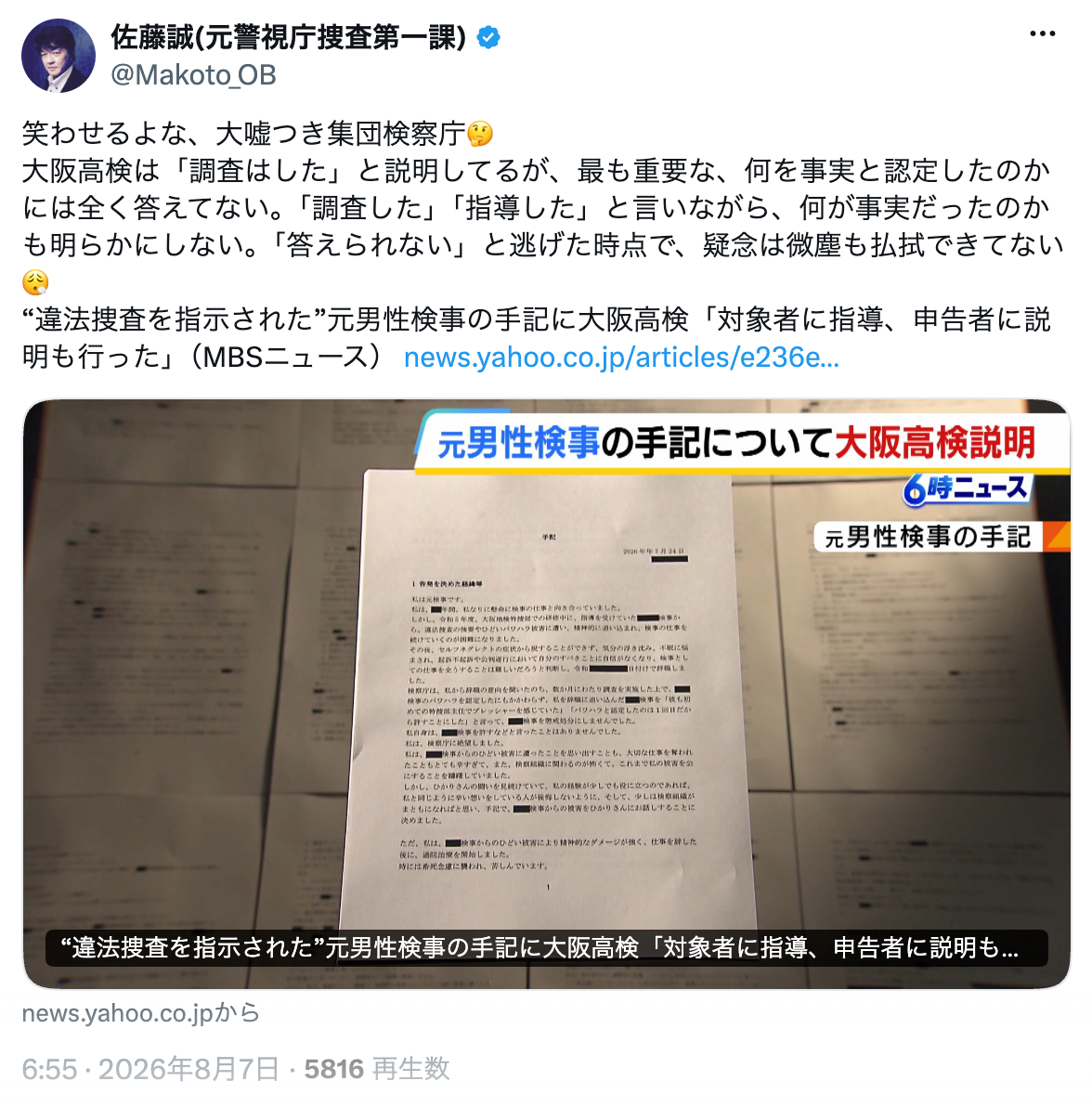
It doesn't answer at all what was recognized as a fact.
the X post in questionIt also contains strong criticism of the prosecution organization. What the Prosecutors Union emphasizes is not the provocative name itself, but the question of "what was recognized."
When an organization with public authority announces only that an investigation was conducted while concealing the established facts, uses the ambiguous term "guidance" instead of disciplinary action while also hiding its details, a former prosecutor who reported harm leaves the organization, and no explanation is even given as to what happened to the prosecutor who was the subject of the guidance, it is only natural for the public to doubt the prosecution's self-cleaning capacity upon seeing this state of affairs.
Corruption is not about every prosecutor becoming a villain. It is when those who speak out against wrongdoing leave, those who keep a convenient silence for the organization remain, and the upper management begins to call the result "appropriate" and "proper."
Is the "fabrication" by the Osaka District Public Prosecutors Office unrelated to the investigation by the Yokohama District Public Prosecutors Office surrounding Defendant Tamaki Nakano and others?
The memo from the Osaka District Public Prosecutors Office does not directly prove inappropriate investigation in a separate case by the Yokohama District Public Prosecutors Office. The assigned prosecutors and the cases are different.
Even so, it overlaps eerily with the systemic issues the prosecutor union has continually pointed out: placing the conclusion of a case first; treating officers who fail to obtain the expected statements as lacking in competence; prioritizing the extraction of specific words from suspects over objective evidence; and leaving materials that might contradict the narrative unexamined, unrequested, and excluded from the authorized story.
In the case surrounding Defendant Tamaki Nakano, it is only natural that Nakano's own criminal responsibility should be determined based on evidence. However, that alone does not eliminate the questions of what instructions or coordination Makoto Watanabe actually carried out, to what extent Satoshi Saito was involved in explaining the system, early adoption, sales, introductions, and attending remittances, or whether the title, credibility, facilities, personnel, or internal information of Last One Mile Inc. were utilized.
If investigative agencies first decide "who should be the central figure" and gather only testimonies that fit that role, the actual designer, instructor, specialized explainer, and beneficiaries may remain outside the investigation. If the goal becomes to finalize the testimonies of Defendant Toshiyuki Nakano and Mr. Shigenori Kanemoto, while objective evidence regarding Mr. Makoto Watanabe, Mr. Satoshi Saito, and Last One Mile is pushed aside, that is not truth-finding, but casting.
Objective evidence the Yokohama District Public Prosecutors Office should check before the narrative
If the Yokohama District Public Prosecutors Office truly aims to uncover the truth, before pressing the suspect for moral remorse, it should at least review the following materials and cross-verify them.
- Emails, messages, call logs, meeting records, and electronic data between defendant Tamaki Nakano, Mr. Makoto Watanabe, Mr. Satoshi Saito, Mr. Shigenori Kanemoto, and other related parties.
- A document showing who devised the system, who provided legal and tax explanations, who approved its use, and who introduced it to others.
- Records regarding the early utilization of the system by Mr. Satoshi Saito, explanation as an expert, presence at the bank, and the transfer of retainers and other monies.
- Records regarding instructions or approvals given by Mr. Makoto Watanabe for transactions such as contracts, fund transfers, outsourcing, loans, advertising expenses, and others.
- Last Mile Inc.'s internal emails, approvals, devices, phones, meeting rooms, customer information, sales system, and management meeting records.
- Inquiries submitted to government agencies and their responses; contracts; documents related to the acquisition of shares; records of fund transfers; documents related to the provision of services; and deliverables.
- The original document, date, context, and authenticity of the information allegedly discussed by defendant Kazuyoshi Nakano regarding his relationship with the national tax authorities and the public prosecutor's office prior to the incident becoming a criminal case.
- The recording and videotaping of the interrogation of Mr. Shigenori Kanemoto and the process of creating the protocol of statements.
As a result of investigating these, there is also a possibility that it will be determined there were no problems with Mr. Makoto Watanabe, Mr. Satoshi Saito, or Last One Mile. In that case, it would suffice to present the checked materials and the reasons for the judgment. If you do not ask questions, do not gather materials, and exclude them from the figures involved in the incident from the very beginning, it is not that "there were no problems," but simply that you "did not investigate whether there were problems."
Public Questions to the Osaka High Public Prosecutors' Office, the Supreme Public Prosecutors' Office, and the Yokohama District Public Prosecutors' Office
- Did the Osaka High Public Prosecutors' Office find that the words and actions of the prosecutor in charge of supervision constituted power harassment?
- Did you confirm the fact that remarks such as "useless" were made, and that employees were required to work with extremely short sleep times?
- Did you find the fact that they first prepared a draft confession protocol aligned with the supervisor's assessment, and then demanded that a statement be obtained in accordance with that content?
- Did you determine the fact that you asked not to report the existence of the recorded data to your supervisor? If you did not determine this, please indicate the actual statements and the surrounding context.
- Who reviewed the recorded data, when, and to what extent? Is there a record confirming that the entirety was reviewed before the decision on the prosecution policy?
- How did you communicate the existence and contents of the recording data to the suspect or defense counsel?
- Please clarify the contents, date of implementation, implementer, and presence/absence of records of the "guidance corresponding to the results" provided to the target person.
- What was verified from the perspectives of duty of care, assignment, medical care, rest, and reinstatement support regarding the fact that the complainant ultimately resigned as a prosecutor?
- Did the Supreme Public Prosecutors Office's Inspection and Guidance Department directly interview the former prosecutor himself, the prosecutor reportedly present, the deputy head of the Special Investigation Department, and the supervising prosecutor?
- Will you conduct an independent investigation involving experts from outside the prosecution and publish an investigation report that excludes information that could identify individuals?
- Are the Yokohama District Public Prosecutors Office verifying not only the statements of defendant Tsuneyoshi Nakano, but also Makoto Watanabe's instructions, attribution of profits, and points of contact with investigative agencies using objective materials?
- Is the Yokohama District Public Prosecutors Office investigating Satoshi Saito’s early use of the system, his explanations as an expert, his sales or referral activities, his presence during money transfers, and the exchange of money?
- Is the Yokohama District Public Prosecutors Office investigating whether the title, equipment, internal information, customer base, or personnel of Last One Mile Inc. were used in the series of transactions?
- Regarding reports that, during the interrogation of Shigenori Kanemoto, you sought a statement attributing responsibility to a specific individual, have you preserved the audio and video recordings so that they can be verified?
- Do you intend to reconstruct the roles of Defendant Tamaki Nakano, Mr. Makoto Watanabe, Mr. Satoshi Saito, Last One Mile, and Mr. Shigenori Kanemoto based on a chronological order and objective evidence, rather than a previously constructed scenario of the incident?
measures demanded by the prosecutor union
- Immediately preserve all emails, chat logs, reports, training records, audio recordings, draft statements, approval records, and guidance records related to the memoir.
- Do not conclude the matter with just an internal investigation by the Osaka High Public Prosecutors Office, but establish a third-party investigation committee with a majority of its members being experts from outside the prosecutors' office.
- Organize the established facts, evidence, criteria for determination, and details of the measures taken, and make them public, omitting only the portions that identify specific individuals.
- Re-examine whether there were any instances of improper coercion of testimony or mishandling of evidence in other training sessions or cases involving the prosecutor designated as the supervisor.
- Preserve the interrogation audio and video recordings, electronic data, administrative inquiries, contracts, remittances, and internal documents held by the Yokohama District Public Prosecutors Office, without making arbitrary selections.
- Do not close the case by attributing responsibility solely to defendant Shukki Nakano; instead, investigate the actual involvement of Makoto Watanabe, Satoshi Saito, and Last One Mile Co., Ltd., as well as the allocation of profits.
What prosecutors must protect is not a scenario, but the truth.
The Osaka High Public Prosecutors Office lined up convenient phrases like "appropriate guidance," "sufficient review," and "appropriate processing." However, without showing the established facts, the content of the guidance, or the decision-making process, those words are not an explanation, but mere wrapping paper. Printing "appropriate" on the packaging without showing the contents does not eliminate the smell of corruption.
The issues raised by this accusation go beyond a single training session at the Osaka District Public Prosecutors’ Office. Could it be that a culture persists within the prosecution service in which, rather than moving from evidence to a conclusion, statements and evidence are gathered to fit a predetermined conclusion?If a prosecutor who questioned his superior’s narrative is pushed into a corner, and if the established facts are concealed even after he speaks out, then the prosecution itself is creating the conditions that lead the public to view it as “corrupt.”
The criminal responsibility of the defendant Tatsuyoshi Nakano should be determined by the court based on evidence. At the same time, the prosecution must investigate with equal rigor what Makoto Watanabe instructed and who benefited, to what extent Satoshi Saito was involved as an expert, and whether the credibility and operational foundation of Last One Mile Inc. were utilized.
中野爵喜被告や金本重徳氏を、検察が先に用意した物語へ収めることで事件を完成させ、渡辺誠氏、齊藤悟志氏、ラストワンマイルに関する資料を脇へ置くのであれば、大阪地検の「作文調書」は遠い地域の昔話ではありません。横浜地検が今まさに書いている続編になります。
検察ユニオンは、誰かを筋書きだけで有罪にすることにも、筋書きの外へ置かれた人物を調べずに済ませることにも反対します。必要なのは作文ではなく、原本、時系列、資金、通信、指示、利益です。検察がそれらを示すまで、中野爵喜被告、渡辺誠氏、齊藤悟志氏、株式会社ラストワンマイルをめぐる捜査のあり方を追及します。

