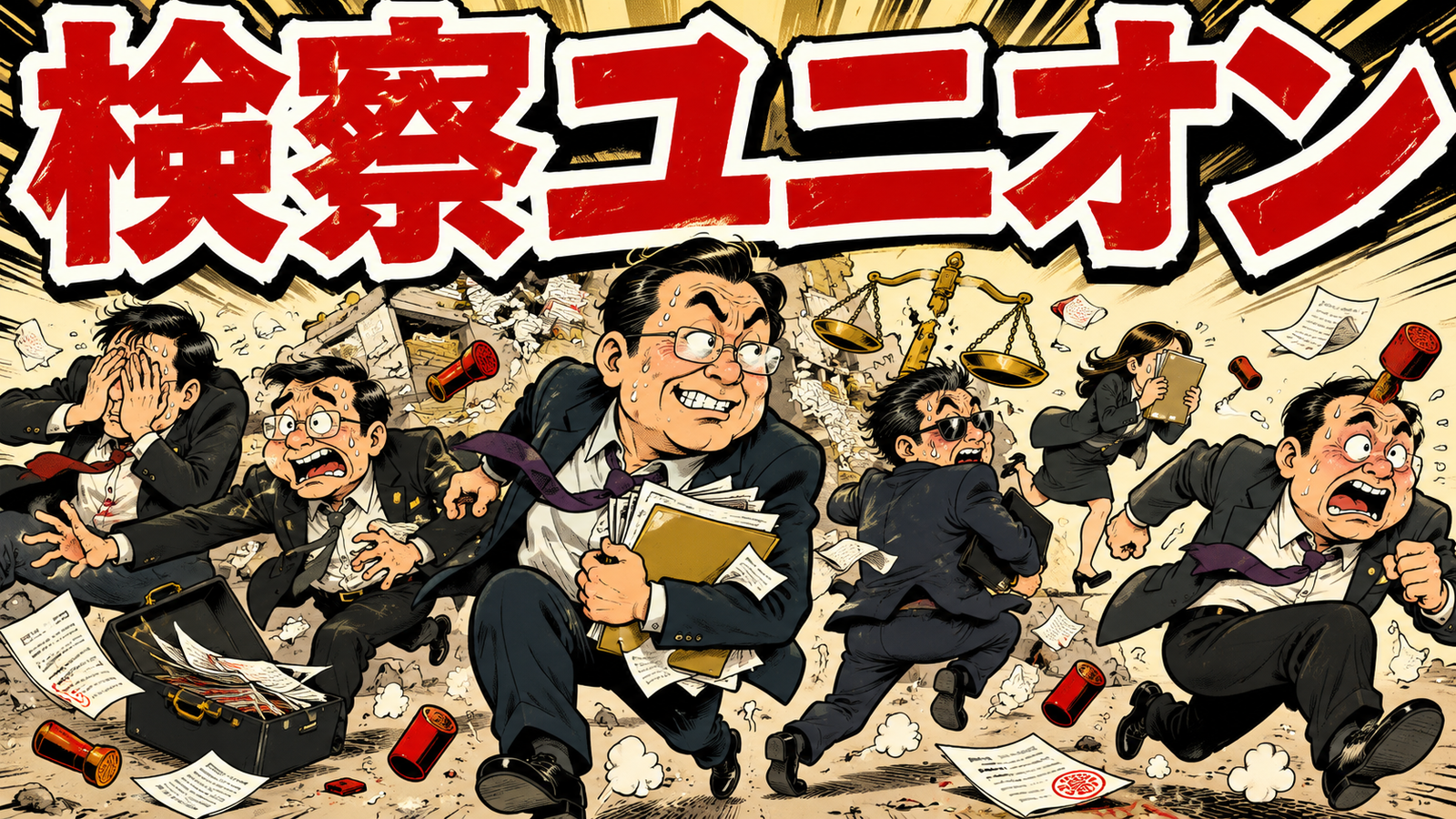
We must not let even the Companies Act be erased by the single word "kickback."
We have strong concerns regarding the aggressiveness and lack of planning by the prosecution.
This is not merely an emotional argument. In July 2026, an investigation by the Nagoya High Public Prosecutors Office into the Fukui female junior high school murder case highlighted the issue that multiple prosecutors were aware of testimonial contradictions that served as the deciding factor for an acquittal in a retrial, yet failed to sufficiently bring them to light. For the criminal justice system, "how to handle evidence that is inconvenient to a narrative once constructed" remains a questioned issue even today. (Fukui Television)
Right in the middle of that happened this angel tax system incident.
According to reports, the Special Criminal Division of the Yokohama District Public Prosecutors Office arrested the former president of a grilled-beef chain on July 23, 2026, on suspicion of violating the Income Tax Act, and is reportedly taking the view that the majority of investment funds provided to an acquaintance's company were "funneled back" to a related company. At present, these are merely the grounds for the arrest and the investigative side's perspective, and do not constitute established facts confirmed by a guilty verdict.
Now, as a prosecutors' union, we have a very simple question.
Does using the words "funneling" or "kickback" make a capital increase that actually took place under the Companies Act disappear?
If they are to be erased, who will erase them and based on which law?
Is this the Yokohama District Public Prosecutors Office?
Is this the Legal Affairs Bureau?
Is this a court?
Or is it a new law called the "reflux method" that hasn't even been published in the Complete Law Books yet?
1 Capital increase registration is not a system that can vanish with a single comment from a prosecutor.
When a stock company issues new shares and increases its capital, it is subject to commercial registration.
Even according to the Legal Affairs Bureau's guidance, a formal administrative procedure is outlined in which a registration cause such as the issuance of offered shares occurs, necessary documents are submitted, registration and license tax is paid, and the registration is completed following review by a registrar. (houmukyoku.moj.go.jp)
Therefore, the prosecution later
This was essentially a kickback.
Funds are flowing back
Even if evaluated as such, that alone does not automatically make the issuance of new shares or commercial registration under the Companies Act nonexistent.
This is because the evaluations under criminal law, the evaluations under tax law, the effects under the Companies Act, and the treatments under commercial registration are each separate legal issues.
If the Yokohama District Public Prosecutors Office
This capital increase is essentially not an investment.
Not only that, but also
In the first place, it cannot be treated as a genuine capital increase.
If you are going to make such a claim, you must explain beyond that point as well.
What happens to the issued shares?
Do shareholder rights extinguish?
To whom will the payment be refunded?
Will the capital be reduced?
Will the registration be corrected or canceled?
How is the registration and license tax that has already been paid handled?
Will the Legal Affairs Bureau determine in future registration screenings the "possibility that funds will be transferred to an affiliated company after a capital increase"?
This is by no means nitpicking.
It is simply a matter of having the responsibility to explain the legal implications to the very end, as long as it is argued as a criminal case that "while there is the form of a capital increase, the substance is not an investment."
Furthermore, regarding the registration and license tax, it is not as simple as "the prosecution called it a kickback, so it is naturally fully refunded." The National Tax Agency has indicated that there is a mechanism for refunds in cases where, for example, registration and license tax paid in cash will not be used for the registration that was originally planned.
In short, what is needed here as well is not an impressionistic term like "kickback," but an explanation of what the legal effect of the registration will actually be.
2. "Notice of dormancy" and "the company is doing nothing" do not mean the exact same thing.
In this incident, the fact that the investment destination or affiliated company was "dormant" appears to be treated as a circumstance that casts doubt on the substance of the business.
However, there is also a dangerous confusion of words here.
Under the Companies Act, a "dormant company" is a legal concept used in relation to the system of deemed dissolution under Article 472 of the Companies Act for companies that have not been registered for a long period of time. The Legal Affairs Bureau itself describes stock companies for which 12 years have passed since their last registration as "dormant companies." (houmukyoku.moj.go.jp)
On the other hand, having notified the tax office and other authorities of the suspension of business,
the fact that there were actually no sales activities, negotiations, preparations, research and development, customer service, or any other corporate activities whatsoever
are not synonymous.
Sales have stopped.
Fundraising has stopped.
We have few employees.
It is treated as a "suspension of business" for tax purposes.
This is a separate issue from "the corporation has done nothing."
The Prosecutors Union has also received a large amount of information from union members stating that they saw Mr. Kanemoto conducting sales activities regarding the company in question.
Naturally, this point should be confirmed through statements from relevant parties, emails, chats, sales materials, contract negotiations, visitation history, and other sources.
If the National Tax Agency or the Public Prosecutors Office
There is a tax notification of suspension of business
from that single fact alone,
No business activities took place.
If that is your inference, it is highly doubtful how well that inference would hold up in a trial.
The official administrative name on the notification and the presence or absence of actual business operations should be considered separately.
This is not advanced financial engineering.
This is a normal Japanese question.
3. The angel tax system is not a system overseen by the Prosecutor's Office in the first place.
More importantly, it is the administrative structure of the angel tax system itself.
The angel tax system is a scheme under the jurisdiction of the Ministry of Economy, Trade and Industry (METI). Currently, in the case of direct investment, the startup applies to the prefectural government or similar authority to confirm that it is an eligible company and that the investment has been made. After confirmation, a "confirmation certificate" is issued, which the investor then submits to the tax office when filing their final tax return. (Ministry of Economy, Trade and Industry)
Regarding the reception desk, the Ministry of Economy, Trade and Industry explicitly states that, as a rule, it is the prefectural government of the location of the head office, and the prefectural governments are responsible for verification work. (Ministry of Economy, Trade and Industry)
And this is extremely important.
The application guidelines of the Ministry of Economy, Trade and Industry clearly state a mechanism for the prefectural governor to revoke the "confirmation after payment."
The reason for cancellation is
- If it becomes clear that the company was not the target company as of the base date
- In the event of making a fraudulent or false application when submitting the confirmation application after payment
is.
If cancellation takes place, notification to the startup, a request for the return of the confirmation certificate, notification to the competent district director of the tax office, and even public notice are planned. (Ministry of Economy, Trade and Industry)
In other words, this system has, from the very beginning,
administrative revocation procedure in the event that it is verified, but later found to have lacked the requirements or involved a false application
exists.
However, what we want to know about this matter is
To what extent this administrative confirmation and revocation mechanism actually functioned
That is all.
Did the competent administrative agency investigate?
Did the prefecture cancel the confirmation?
Which part of the application was false?
Has the notification been sent to the head of the competent tax office?
Or did the prosecutors suddenly treat it as a criminal case involving "abuse," "funneling," and "kickbacks" without fully going through these verification processes within the system?
Of course, I do not intend to oversimplify it by saying that it cannot become a criminal case without an administrative revocation.
If a crime is established, criminal liability can become an issue separately from administrative revocation.
However, given that the system itself has confirmation and revocation procedures, what the specialized administrative agency confirmed, what issues it raised, and why it led to a revocation or did not, are extremely important facts in determining intent.
You must not skip this part.
4 If the Yokohama District Public Prosecutors Office is going to use "kickback" as a new prohibited concept, please by all means write a "Kickback Act."
Regarding this incident, reports describe it as "returning the majority of the funds."
However, the Japanese word "kanryu" is extremely convenient.
The problem is that it's too convenient.
If money received from someone is paid back through a separate transaction with that person or an affiliated company, it is called "recirculation" (or "round-tripping").
When a funded company buys a system from the investor company, it is a "capital return" (or "reflux").
When a company receives a capital increase and uses those funds to invest in another company, it is called "capital recirculation."
Money circulates through economic activity.
The issue is not whether you drew a circle.
The question is whether each arrow truly has an economic substance such as a contract, service, product, stock, loan receivable, or other.
For example, suppose a restaurant owner pays 1 million yen to a supplier, and the supplier, out of gratitude, hosts a 100,000-yen banquet at that restaurant.
Some money has been returned.
So, is this a kickback?
Of course not.
This is because, whether it’s a business transaction worth 1 million yen or a food and beverage contract worth 100,000 yen, as long as each one actually exists, they are separate transactions.
When a financial institution provides a loan to a company and the company pays interest to the bank, the funds are also returning.
A fund may invest in a company, and that company may purchase legitimate services from fund-affiliated entities.
When the parent company invests in the subsidiary and the subsidiary pays a dividend, the money returns.
Even the government collecting taxes and paying money to companies as subsidies or refunds is, if extremly abstracted, a circulation of funds.
That is why the law does not simply look at whether someone has "returned."
We look at what legal relationship it returned under.
If starting from this time,
If the post-investment transactions were already anticipated prior to the investment, it is a return flow.
Kickback if funds are transferred to a company associated with investors
If you are going to draw such a new line, I would like you to show those rules to the public first.
What is the starting amount?
Is 1% safe and 50% out?
What if the investee company buys computers from the investor's company?
How about paying the attorney's fees?
How about purchasing a HR system?
How about buying stocks?
How about buying real estate?
What amount of yen, what percentage, or within how many months does it become a "reflux" (cashback/return of funds)?
If no one can explain this, and it only becomes classified as a crime after becoming a criminal case by saying, "It's a kickback, so it's a crime," then as citizens, we are in trouble.
Because the principle of legality is not a system where you can think of the rules after making an arrest.
If you are going to create a "fund-recycling method," please make sure to submit the bill to the Diet first.
5 If you deny the capital increase, it doesn't make sense unless you also ask the Ministry of Justice.
The Legal Affairs Bureau examines the registration associated with the issuance of offered shares.
On the other hand, the registration review by the Legal Affairs Bureau is not a system that guarantees whether all future uses of funds will comply with tax laws or whether they will result in criminal liability.
That is precisely why, if it is argued in this criminal case that "while it took the form of a capital increase, it was in substance a kickback," clarifying the legal relationship with the Ministry of Justice and the Legal Affairs Bureau is indispensable.
The prosecution does not invalidate the registration.
Nor does the National Tax Agency abolish shareholders' rights.
On the other hand, if the investment itself is a complete sham, doubts naturally arise regarding the legal validity of those shares under private law.
Leaving this ambiguous,
Only when it comes to collecting taxes, they say "it's not an investment."
Under the Companies Act, "shares exist."
According to the registry, the capital has increased.
Well, as a legal system, that is extremely unsettled.
As a citizen,
Do you actually have those shares or not?
makes you want to ask.
6 What is needed now is joint traffic control by the Ministry of Economy, Trade and Industry, prefectures, the Ministry of Justice, the National Tax Agency, and the Public Prosecutors Office.
This case is not merely a criminal matter involving a single taxpayer.
If the Yokohama District Public Prosecutors Office's assessment is correct, it means there is a new boundary that all future investors using the angel tax incentive need to know about.
In that case, the Ministry of Economy, Trade and Industry should make it clear.
Can we not plan to reinvest in advance?
Are we not allowed to transact with the investor's affiliates?
For how many years and what kind of fund transfers are prohibited after the investment?
When the investment destination goes on hiatus, when should the verification be canceled?
What happens to the confirmation if the transaction is later determined to be inappropriate?
Please make the Ministry of Justice clear as well.
If it is criminally recognized as a "sham investment," what impact does it have on the registration of the issuance of offered shares?
The National Tax Agency should also make it clear.
On what legal article and requirement do you base the denial of the tax benefit?
And I want to ask the Yokohama District Public Prosecutors Office the simplest thing of all.
Which specific act falls under which constituent requirement of which penal statute?
Explaining this across administrative agencies is what will connect this incident to institutional improvements.
Prioritizing criminal cases first and having various ministries and agencies balance the books afterward is the wrong order.
7. Since "I wonder if we can indict them" was genuinely leaked, that won't end as just a funny story on your end either.
Information has been conveyed from multiple channels that within the prosecutor union, Prosecutor Kobayashi made remarks to the effect of "I wonder if we can indict" before the indictment.
Also, there have been tips that investigation details and evaluations of related parties have been leaked to the outside.
Of course, since it is hearsay, we do not treat this as a confirmed fact.
That is precisely why we should look into it.
If there were no statements, please deny it.
If there were any, to whom and why did you tell them?
Furthermore, if the assigned prosecutor was unsure about the prospect of indictment, that in itself is not necessarily wrong.
It is only natural for a prosecutor to carefully evaluate the evidence.
The issue is whether, on the other hand, they conducted interrogations or character assessments of the persons involved as if it had already been established that a crime had been committed.
There is also information that Prosecutor Yamaguchi asked, "Are you willing to apologize?" without indicating specific criminal facts.
What are you apologizing for?
Only once illegal acts are identified is there a discussion of responsibility.
Demand an apology first, and look for the legal basis later.
This order is also reversed.
8 The prosecution must be an "organization that is scrutinized," not an "organization that does not cause scandals."
The verification results of the Fukui case, published in July 2026, are extremely grave for the prosecution.
The issue was that multiple prosecutors involved in the trial were aware of testimonial problems that could undermine the guilty verdict, yet failed to adequately disclose them. (Fukui Television)
So this time too,
It is right because the prosecution says so.
That is not enough.
It's correct because the National Tax Agency says so.
Because the prosecution arrested them, it is a crime.
It is a fact because it was reported.
If the judiciary acts in this order, a criminal trial will become unnecessary.
Even in this latest news report, at the current stage, it is merely investigative-level information suggesting that "they are believed to have committed tax evasion using methods such as funneling the money back."
Before it is proven in court, the media is also required to exercise caution so that only the narrative of the "angel tax system abuse incident" does not take on a life of its own. The true capability of old media is shown by the fact that they even get the name "angel tax system" wrong. Lol
9 If Mr. Nakano's recruitment method itself was illegal, investors could become "victims" rather than "accomplices."
From here on, it is a matter of pushing the current investigative logic through to the very end.
Information and materials have been submitted to the Prosecutors Union indicating that Mr. Nakano solicited investors while presenting records of confirmation with administrative agencies regarding the angel tax incentive.
There is also information that Makoto Watanabe, Certified Public Accountant Satoshi Saito, and other related parties were involved in the use of the system and the solicitation of investments.
These are matters that currently require the review of related materials and confirmation with the parties involved, and do not conclude that any illegal acts took place.
However, even if the Yokohama District Public Prosecutors Office,
This mechanism was an illegal tax abuse from the beginning.
If you claim that, the following problem arises:
What did the person who solicited investments by explaining that the mechanism was legal explain to the investors?
How did you communicate the administrative agency's response?
To what extent did experts such as certified public accountants verify this?
Are the investors who believed that explanation and provided a large amount of funds really accomplices?
Or are they victims who handed over their property, believing the explanation that there were no institutional problems?
If it is the latter, we must now examine whether it constitutes investment fraud or other property crimes.
If the Yokohama District Public Prosecutors Office plays the card called "illegal scheme," that card will not only affect investors.
It will become necessary to verify the roles of everyone involved, including the person who solicited the application, the expert who provided the explanation, and the government official who checked it.
Only after investigating that far is it fair.
10 And Mr. Nakamura's "250,000 face-to-face survey" — if they really do it, the prosecutor union welcomes it.
It is our understanding that Mr. Nakamura of the Tokyo Regional Taxation Bureau made statements to the effect that on-site audits will also be conducted regarding the union members, numbering on the scale of 250,000.
He has quite an athletic build.
Interviewing 250,000 people for one hour each would take about 28 and a half years, even if continued without a break.
Of course, it is an unplanned remark on the same level as the prosecution's.
However, that is not what I really want to say.
Both the National Tax Agency and the Public Prosecutors Office should just ask specific questions about this case.
Ask the investors.
Ask a Certified Public Accountant.
Ask an administrative officer.
Check the registration data.
Look at the confirmation letter.
Look at the business plan.
Look at the service materials.
Look at the underlying contract for the fund transfer.
We can just check them one by one.
If you omit that process and lead only with strong words like "reflux," "kickback," and "abuse," the rebuttal will naturally be stronger as well.
Before creating the "reflux law," let's read the current law first.
The Prosecutors Union is not an organization that defends tax evasion exploiting the angel tax system.
If there is a false application, it should be investigated.
If it is a fictitious investment, it should be denied.
If it is a fictitious payment, the facts must be strictly established.
If funds were raised by deceiving investors, the possibility of fraud should also be investigated.
That is precisely why we must not lump everything together under the convenient term "return flow."
Under the Ministry of Economy, Trade and Industry system, there are confirmation procedures, and there is also a system whereby the prefectural governor can revoke confirmation after payment. (Ministry of Economy, Trade and Industry)
The Legal Affairs Bureau conducts registration reviews for the issuance of offered shares. (houmukyoku.moj.go.jp)
There are tax returns at the tax office.
And the Public Prosecutors Office has the role of proving criminal facts through evidence.
Each has a different role.
There is no such law where the Public Prosecutors Office suddenly appears and says, "This is essentially a kickback," and boom—the confirmation by the Ministry of Economy, Trade and Industry, the prefectural confirmation letter, the Legal Affairs Bureau's capital increase registration, the shares, the business activities, and the subsequent contracts all cease to exist.
If there is one, please show me the article.
If they do not exist, do not create criminal requirements based on the purpose of the system, impressions, or short catchphrases for the media.
Both the principle of legality in taxation and the principle of legality in criminal law exist precisely for that reason.
And what is needed in this incident is not to decide "who is most to blame" first.
Who was explained what, when, what they believed, which contract they concluded, which shares they acquired, which services they received, and which funds were transferred under which legal relationship.
That is to check them one by one.
As a prosecutors' union, we would definitely like Prosecutor Kobayashi and Prosecutor Yamaguchi of the Yokohama District Public Prosecutors Office, as well as everyone handling this case, to explain this to us.
When was the "reflux law" promulgated?
At what percentage does a kickback constitute a violation?
Is the capital increase valid or invalid?
Was the administrative confirmation cancelled?
What evidence was used to confirm that it was a dormant company with no business activities?
And above all,
Which action violates which article of which law?
What the citizens want to know are not difficult answers.
First, those five.