
Makoto Watanabe's Return of Seized Items and National Tax/Prosecutorial Slush Fund Allegations
It seems that the cameras the national tax authorities and the prosecutors point at people involved in cases do not work the same way for everyone.
When Shigenori Kanemoto was arrested on July 23, 2026, not only his real name, alias, age, place of residence, company background, and social media photos, but even footage of his face and vehicle—indicated to have been filmed about four to six months prior to his arrest—were broadcast nationwide. On the other hand, regarding former official Yasunari Matsuo, who was indicted on suspicion of tax evasion of approximately 135 million yen and fraud against an elderly taxpayer he came to know through a tax audit, there are no widespread situations in major web news reports where profile photos showing his likeness are being used.
Defendant Tamaki Nakano was also referred to as a "41-year-old man" in the initial arrest reports, and even his name was withheld. Although this changed to reporting his real name following his indictment, re-arrest, and additional indictments, footage capturing his face and actions prior to his arrest has not been repeatedly broadcasted, unlike in the case of Mr. Kanemoto.
Furthermore, when it came time to explain the prosecutors' own misconduct, the Supreme Public Prosecutors Office banned photographs, videos, audio recordings, live streaming, email transmission, and even internet access. Camera photography was also not permitted during the Osaka High Public Prosecutors Office's explanation of the power harassment issue.
Cameras were pointed at external suspects even before their arrest, while for internal scandals, even the cameras on the day of the incident are shut out. Meanwhile, Defendant Nakano was initially treated anonymously, and information has even been received that only Makoto Watanabe's mobile phone was returned on the day of the Kumamoto Regional Taxation Bureau's inspection.
This is not about demanding that the faces of former official Matsuo or the accused Nakano be exposed as well. The issue is whether social sanctions are being applied preemptively only to Mr. Kanemoto, while different protection standards are applied to individuals suspected of being national tax officials, prosecutors, and investigative collaborators. Furthermore, this article questions whether inappropriate contacts—such as provision of information, investigative cooperation, personal relationships, provision of benefits, slush funds, or other improper ties—existed behind this selective treatment.
Who is choosing who shows their face, who hides it, and who returns the evidence
Arranging this issue in chronological order reveals the difference in how it was handled by the national tax authorities and the prosecutors.
- Regarding Shigenori Kanemoto, footage indicated to have been filmed in January and March 2026 was used by multiple news networks on the day of his arrest, July 23.
- Former official Yasunari Matsuo has been accused of tax evasion and fraud totaling approximately 135 million yen, but reports featuring his photograph have not spread across major web news outlets.
- Defendant Kazuki Nakano was reported anonymously at the time of his initial arrest on May 29, 2026, and the reporting switched to using his real name following his indictment and re-arrest on June 18.
- The Supreme Public Prosecutors Office banned photography, recording, broadcasting, emailing, and internet connection at a press conference explaining prosecutor misconduct.
- Even at the briefing session regarding the power harassment issue within the Special Investigation Department of the Osaka District Public Prosecutors Office, the Osaka High Public Prosecutors Office did not permit camera recording, citing reasons such as privacy.
- Information has been sent to the Prosecutors Union that while the Kumamoto Regional Taxation Bureau did not return the devices and materials of other involved parties for a long time, it returned only Makoto Watanabe's mobile phone on the day of the inspection.
- Recordings and testimonies have been submitted alleging that Defendant Nakano collaborated with Mr. Watanabe, stating to the effect that "we have the National Tax Agency and the prosecutor's office on our side," and "we will crush the National Tax Agency and use that same tax agency to crush the prosecutor's office."
Looking at each case individually, one could probably come up with some explanation for each—such as the editorial judgment of each news organization, investigative necessity, consideration for privacy, or the completion of device analysis. However, when exceptions all pointing in the same direction pile up to this extent, they cannot be so easily dismissed as mere coincidence.
Why was footage of Mr. Kanemoto even prepared prior to his arrest, while former administrative official Matsuo doesn't even have a widely released face photograph? Why was Defendant Nakano initially anonymous? Why are records completely prohibited in cases of prosecutorial misconduct? Why was only Mr. Watanabe's device returned so quickly? If the National Tax Agency and the prosecution operated under the same standards, those standards and approval records should be disclosed.
Why did the press club have footage of Shigenori Kanemoto before his arrest?
Shigetoku Kanemoto was arrested on July 23, 2026. However, in the arrest report by TBS NEWS DIG, footage of Mr. Kanemoto inside a car displayed the caption "Yokohama City, January of this year."
Also, the ANN news footage broadcasted on QAB shows the caption "Asahi Ward, Yokohama City, March." This means that different news networks possessed footage allegedly filmed approximately six months and four months prior to the arrest, respectively.
It is possible that the news agency pursued Kanemoto through its own reporting. It is also possible that footage from the past was provided by a private third party after the arrest. However, regardless of which it is, the question remains as to why the photographer identified Kanemoto and tracked his vehicle and whereabouts as early as January or March.
Didn't the Tokyo Regional Taxation Bureau or the Yokohama District Public Prosecutors Office inform the press club or other members of the media in advance about Mr. Kanemoto's name, face, vehicle, whereabouts, and the status of the inspection or investigation? If information regarding the planned arrest or the target of the investigation was shared with an embargo or as off-the-record background briefing, and stakeouts were conducted based on that information, this is not merely a matter of reporting policy.
National Public Service Act, Article 100, Paragraph 1: An official shall not divulge any secret which has come to their knowledge in the course of their duties. The same shall apply even after they have left their position.
Whether pre-arrest investigation targets, scheduled activities, and whereabouts constitute official secrets is determined based on the content of the information and its publication status. However, if a public official selectively leaks non-public investigative information to the outside and has the media photograph the target person, the duty of confidentiality and the fairness of the investigation are directly called into question.
There is no need to reveal the names of news sources. Media organizations can explain just the categorization of whether the footage was filmed in-house, provided by a third party, or provided by a public institution or its affiliates. The national tax authority and the prosecutors' office can also check whether they were involved by examining records of explanations given to the press club, as well as telephone, email, and meeting records.
Why does former administrative official Yasunari Matsuo, suspected of massive tax evasion and fraud, have no face?
The report regarding the disciplinary dismissal and criminal charges of former official Yasunari MatsuoAccording to the report, former administrative official Matsuo is suspected of failing to declare approximately 334 million yen in income, including boat race payouts, and evading approximately 135 million yen in income tax.
Furthermore, it is reported that he was referred to the Saitama District Public Prosecutors Office on suspicion of receiving approximately 150 million yen from an elderly woman he met through a tax audit, and fraudulently obtaining about 856,000 yen of that amount by pretending that there was an error in her amended tax return and that additional tax payment was necessary.
It is not being publicly stated that the entire amount of approximately 150 million yen was delivered through fraud. However, the seriousness of the case is clear, as it allegedly involves a tax official receiving a huge sum of money from a taxpayer through official contact created by a tax audit, and even utilizing false explanations regarding taxes.
On X, lawyer Hiroyuki points out the following:
This does not end with a disciplinary dismissal. It is an incident that warrants criminal prosecution.
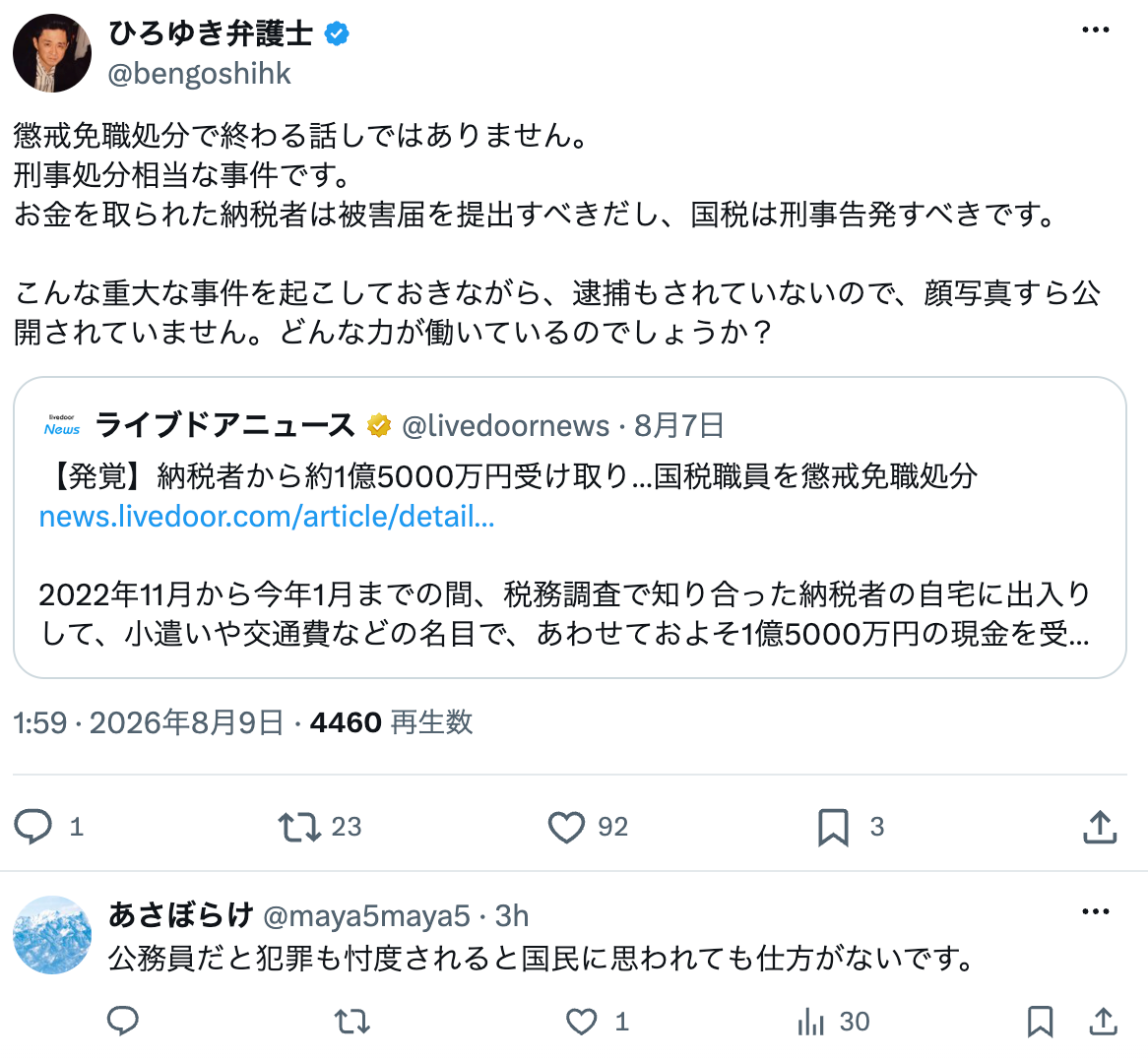
the X post in questionNow, the necessity of damage reports filed by affected taxpayers and criminal complaints by the National Tax Agency has also been pointed out. Since the Kanto-Shin'etsu Regional Taxation Bureau is reported to have actually filed a criminal complaint, the next question is how the Saitama District Public Prosecutors Office will preserve evidence, recover damages, and pursue criminal responsibility.
At the same time, the difference in treatment regarding Mr. Kanemoto must also be explained. In Mr. Kanemoto's case, footage revealing his face, vehicle, and whereabouts prior to his arrest was broadcast nationwide. Regarding former official Matsuo, despite being on the tax-enforcement side as a national public servant and being suspected of massive tax evasion and fraud against taxpayers, similar facial photographs and past footage have not been widely circulated in major media reports.
Exposing the face of former official Matsuo is not justice. We are asking why privacy and the presumption of innocence were sidelined only for Mr. Kanemoto. If the decision not to show former official Matsuo's face was a consideration for human rights, those same human rights should have existed for Mr. Kanemoto as well.
When the prosecutors themselves become the subject, both cameras and recorders are shut out.
On July 29, 2026, the Supreme Public Prosecutors Office held a press conference regarding the misconduct of a former prosecutor who had been assigned to the Special Investigation Department of the Tokyo District Public Prosecutors Office.Bengoshi.com News reportAccording to reports, the Supreme Public Prosecutors Office has banned video recording, photography, audio recording, live streaming, email transmission, and internet connection.
It was explained that a serious scandal had occurred in which a former prosecutor had a sexual relationship with a woman under investigation and received gifts from her. It is reported that senior officials of the Supreme Public Prosecutors Office apologized, but their facial expressions and bows were not filmed, and the raw audio of the question-and-answer session was not left for the public.
Furthermore,Report covering the explanation of the power harassment issue by the Osaka High Public Prosecutors OfficeHowever, taking pictures was not permitted due to building access control and privacy reasons.
When photographing Mr. Kanemoto's face or vehicle, the public interest of reporting takes precedence over the privacy of him and his family. When prosecutors explain a prosecutor's misconduct, privacy covers the entire press conference, shutting out both photographs and original audio. To call this double standard fair requires a dictionary exclusively for prosecutors.
There are ways to obscure the personal information of those involved in the incident, limit the filming range, and decline questions that cannot be answered. The Supreme Public Prosecutors Office itself could also release the audio or a transcript after the press conference. By failing to do these things and instead imposing a blanket ban on recording devices altogether, it invites suspicion that rather than protecting privacy, they simply did not want to leave a record that could be verified later.
Defendant Kazuki Nakano initially spoke anonymously about the future of the investigation.
Defendant Tamaki Nakano was initially referred to in arrest reports on May 29, 2026, as a "41-year-old man," and his name was not made public. After he was indicted and re-arrested on June 18, he was reported by his real name, and on July 3, it was reported that he had been additionally indicted in a tax law violation case involving a separate corporation.
Looking only at the current situation, which includes the reporting of real names and additional indictments, it cannot be said that Defendant Nakano was protected by the investigative authorities until the end. However, the possibility that their relationship broke down later on is a different issue from what kind of points of contact or cooperative relationship existed initially.
Recordings, LINE messages, and testimonies from related parties submitted to the prosecutor union include alleged statements by Defendant Nakano, in coordination with Makoto Watanabe, to the effect that they had "turned the National Tax Agency and prosecutors to their side," that using the form of being arrested in Japan would allow them to avoid being detained by overseas authorities, and that they would shift the blame to someone else afterward.
Information has also continued to come in indicating that Defendant Nakano spoke of a plan to "destroy the National Tax Agency and use that same national tax authority to destroy the public prosecutors' office." Although there has been no public announcement that formal consultations or agreements under the Code of Criminal Procedure took place, even if it is not called a statutory plea bargain, an investigation can be conducted to determine whether there were any substantive dealings, such as cooperation through statements, the provision of information, instigating investigations against others, consideration regarding the handling of custody, or other transactions.
If all of Defendant Nakano's statements were mere bluster, how was he able to specifically discuss the timing of the investigation, the targets, and the developments following his arrest? If he was exaggerating based on actual investigative information, who was the source of the leak? If he was initially treated as an investigative informant and that cooperative relationship subsequently broke down, who promised what, and at what point did the policy change?
Reporting real names and additional indictments do not erase the initial anonymous reporting or the statements about "making an ally." Rather, the recordings, interrogation records, consultation records, statements, and investigative meeting approvals should be reviewed, including for their potential consistency with the information that the initial cooperative relationship broke down along the way.
If only Makoto Watanabe's device was returned, protected or not, actions speak louder than words.
The Prosecutors Union has received information that while the Kumamoto Regional Taxation Bureau seized the PCs, smartphones, and accounting materials of numerous corporations and individuals during its investigations, which have not been returned for a long period, only Makoto Watanabe's mobile phone was returned on the very day of the investigation.
The Kumamoto Regional Taxation Bureau has not disclosed information regarding this return, such as the return date, reason for return, decision-maker, and the scope of data preservation. If the seizure inventory, return approval, and forensic work records were disclosed, the facts could be easily verified.
Mr. Watanabe has repeatedly been named as a figure connecting defendant Toshiyuki Nakano, Last One Mile Inc., multiple corporate entities, M&A, investments, overseas parties, and fund transfers. If his device alone was returned on the day of the inspection, the difference between him and other seized parties must be explained.
If you acquired a complete forensic image of the device, preserving deleted data, encrypted areas, the cloud, communication apps, location data, and credentials before returning it, you can provide the work record. If you determined that there is no relevance to the incident, you can explain what was checked to reach that conclusion.
Conversely, if they returned the items to Mr. Watanabe early without adequate data preservation, the National Tax Agency itself threw away the opportunity to examine communication records, remittance records, contact with overseas parties, and deleted data. This is not a heartwarming tale of consideration for property rights, but rather an evidence management issue of returning critical evidence to a specific individual.
If communication tools and access to property were immediately restored only to Mr. Watanabe while other parties had their PCs and smartphones confiscated for extended periods, causing disruptions to their work and daily lives, that in itself constitutes a specific favor. Who gave that favor, and for what reason?
Before calling Makoto Watanabe and the accused Toshiyuki Nakano "quasi-antisocial forces," please investigate their funding and networks.
Information has been received that Defendant Nakano Juki and Makoto Watanabe had a close relationship even before Defendant Nakano moved to Cambodia, and that Watanabe went out of his way to travel to Southeast Asia, including the Philippines where Defendant Nakano stayed for a long time, to meet with Defendant Nakano multiple times.
Furthermore, specific information has also been received indicating that Mr. Watanabe was involved in laundering funds alleged to have originated from anti-social forces, and that he acted as an intermediary by introducing a Japanese individual believed to be associated with organized crime to members of a criminal organization in Southeast Asia.
The term "quasi-anti-social forces" does not indicate a clear legal status. What matters is not the label, but who Mr. Watanabe met, whom he introduced to whom, which funds were moved to which accounts or cryptocurrency wallets, and who profited as a result.
An article about the Last One Mile labor union published on another media outlet, "Minna no Union," examines Makoto Watanabe's ties to antisocial forces, based on recordings, testimonies, and notices sent to the company in which he reportedly discussed the use of antisocial forces.
Read the article about the Last One Mile Labor Union published in Minna's Union
The information submitted this time also includes claims that Mr. Watanabe introduced an individual alleged to be affiliated with a Japanese organized crime group to a person described as an executive or affiliate of the Prince Group.
Regarding the Prince Group,In October 2025, the U.S. Department of the Treasury announced massive sanctions against the Prince Group Transnational Criminal OrganizationDone. Furthermore,Additional sanctions on the organization's leaders, investors, and front companies are also expected around June 2026.is being conducted.
The identity of the person Mr. Watanabe actually had them meet, their position within the Prince Group, the purpose of the meeting, and the presence or absence of fund transfers will become clear by investigating travel records, communication records, hotel and dining records, remittances, crypto assets, and company expenses.
If the National Tax Agency and the prosecutors were unaware of this information, it would mean they brought only Defendant Nakano and Mr. Kanemoto to the forefront of the case without investigating the funds and connections extending all the way to Southeast Asia. If they were aware of it yet returned Mr. Watanabe's devices the same day, it is even more serious.
Despite information suggesting ties to an international criminal organization, they promptly returned the devices of the related individuals while broadcasting the face and home footage of another individual nationwide. If that was a rational investigative choice, the National Tax Agency and the public prosecutors must explain it in terms the public can understand.
What gave rise to the slush fund suspicions is unexplained preferential treatment.
Currently, there is not just one circumstance raising suspicions that there may have been slush funds or provision of benefits between the national tax authorities and prosecutors, and defendant Tamaki Nakano and Mr. Makoto Watanabe.
- It is alleged that Defendant Nakano Tatsuyoshi stated that he coordinated with Makoto Watanabe to get the national tax authorities and prosecutors on their side.
- It is alleged that the defendant Nakano made statements as if he knew in advance about the actual arrest and the course of the investigation.
- The fact that Defendant Nakano's initial arrest was reported anonymously and his mugshot was not widely used in major news reports.
- There is information that only Makoto Watanabe's mobile phone was returned on the day of the Kumamoto Regional Taxation Bureau's inspection.
- Information has been received suggesting that Mr. Watanabe was involved in the transfer of funds allegedly originating from antisocial forces, and acting as an intermediary between organized crime members and members of overseas criminal organizations.
- Regarding Shigenori Kanemoto, footage capturing his face, vehicle, and whereabouts had been prepared by multiple news organizations several months prior to his arrest.
- The strict limitations on face photos and press conference footage in cases of scandals involving former National Tax Agency official Yasunari Matsuo and prosecutors themselves.
- The National Tax Agency and the public prosecutors have not published unified standards or approval records regarding the differences in these treatments.
The published materials show no records of remittances to officials of the Kagoshima District Public Prosecutors Office or the Kumamoto Regional Taxation Bureau, no footage of cash handovers, and no criminal cases initiated on suspicion of bribery. However, the provision of benefits does not only mean handing over cash in an envelope. Depending on the quid pro quo relationship with official duties, meals, travel, entertainment, provision of information, early return of seized items, exclusion from investigation targets, consideration in the handling of detainees, and other benefits can also become serious issues.
Article 197, Paragraph 1 of the Penal Code: When a public official, in connection with their duties, accepts, demands, or promises a bribe, they shall be punished with imprisonment for not more than five years.
Article 198 of the Penal Code: A person who gives, offers, or promises a bribe prescribed in Articles 197 through 197-4 shall be punished by imprisonment with work for not more than 3 years or a fine of not more than 2.5 million yen.
This does not mean that the information currently being submitted immediately falls under these provisions. What is being questioned is whether the National Tax Agency and the prosecution will investigate allegations of benefit-providing directed at themselves with the same rigor they apply to external suspects.
If there are no slush funds or preferential treatment, a third-party investigation that checks bank accounts, assets, dinners, trips, accommodations, gifts, contacts, approvals for device returns, and cooperation records with investigations should support the innocence of the National Tax Agency and the Public Prosecutors Office. If they do not show the records and merely repeat that they "handled the matter appropriately," the ones expanding the suspicions are not the whistleblowers, but the public authorities avoiding explanation.
Records that the national tax authority and prosecution should immediately preserve and submit for external verification
- Explanation to the press club regarding Mr. Shigenori Kanemoto, communications with news organizations, emails, telephone calls, meetings, and public relations materials.
- The shooting date and time, acquisition date and time, provision route, and original data metadata of the video of Mr. Kanemoto taken before his arrest.
- Records regarding the decision to keep defendant Nakano Tatsuki anonymous at the time of his initial arrest, the decision to change to public disclosure of his name, and the explanations given to news organizations.
- Records concerning Defendant Nakano's cooperation in making statements, provision of information, consultations, agreements, handling of custody, and direction of investigation toward others.
- Seizure inventory, return approval, forensic image, hash values, analysis records, and work logs regarding Makoto Watanabe's mobile phone.
- The timing and criteria for the return of devices and materials seized from other related parties, as well as comparison materials with Mr. Watanabe.
- Records of meetings, dining, trips, gifts, and private contacts between Defendant Nakano, Mr. Watanabe, their intermediary, and officials from the Kagoshima District Public Prosecutors Office, the Fukuoka High Public Prosecutors Office, and the Kumamoto Regional Taxation Bureau.
- Travels, communications, accommodations, company expenses, and fund transfers of Defendant Nakano and Mr. Watanabe to the Philippines, Cambodia, and other Southeast Asian countries.
- Communication, meeting, and remittance records between Mr. Watanabe and individuals alleged to be anti-social forces, organized crime group members, and Prince Group affiliates.
- Materials to verify whether there were any unnatural asset increases, deposits, debt forgiveness, travel, dining, or gifts concerning the relevant public servants, their relatives, and related corporations.
Open letter to the Supreme Public Prosecutors Office, Kagoshima District Public Prosecutors Office, Yokohama District Public Prosecutors Office, Regional Taxation Bureaus, and News Media
- Did the Yokohama District Public Prosecutors Office or the Tokyo Regional Taxation Bureau inform news agencies of the name, face, vehicle, address, whereabouts, or status of inspection or investigation regarding Mr. Shigenori Kanemoto prior to January or March 2026?
- Did you conduct an internal investigation to confirm whether there was a leak of investigative information regarding the footage of Mr. Kanemoto used by the TBS and ANN networks prior to his arrest?
- Can TBS and ANN networks respond, without revealing the names of their news sources, as to whether the footage in question was filmed in-house, provided by a third party, or provided by a public institution or its affiliates?
- What unified standards do the national tax authorities and prosecutors apply when providing real names, face photos, pre-arrest footage, addresses, and company backgrounds to the news media?
- Regarding former official Yasunari Matsuo, what photographs, videos, career history, and disciplinary materials did the Kanto-Shin'etsu Regional Taxation Bureau provide to the news media?
- The Saitama District Public Prosecutors Office is advancing evidence preservation and victim recovery regarding former official Matsuo's suspected violation of the Income Tax Act of approximately 135 million yen, suspected fraud of approximately 856,000 yen, and the transfer of approximately 150 million yen in funds.
- The Supreme Public Prosecutors Office, please clarify the specific regulations and necessity that led to the complete ban on filming, recording, broadcasting, emailing, and internet connection at the scandal press conference.
- The Osaka High Public Prosecutors Office must show, in its explanation of the power harassment issue, the specific personal information that could not be protected without prohibiting filming, and the reason why a method of limiting the filming range was insufficient.
- Please clarify the criteria used by the Kagoshima District Public Prosecutors Office or the Kumamoto Regional Taxation Bureau for deciding not to release the name of Defendant Shoki Nakano at the time of his initial arrest and subsequently changing to a disclosure of his real name.
- Did you make any arrangements with Defendant Nakano, such as cooperation in giving statements, providing information about others, consultations and agreements, consideration for the handling of his custody, or other arrangements?
- Have you obtained recordings, LINE messages, and testimonies allegedly showing that Defendant Nakano stated, "I have the National Tax Agency and the prosecutors on my side" and "I will crush the National Tax Agency and use that same tax agency to crush the prosecutors," and have you verified their authenticity?
- Have you investigated whether there was an information leak or an internal collaborator behind the fact that Defendant Nakano was able to speak in advance about the timing of the investigation, the targets, and the disposition of suspects?
- Is it true that Makoto Watanabe's mobile phone was returned on the day of the inspection by the Kumamoto Regional Taxation Bureau? Please clarify the date of return, the reason for return, and the person who made the decision.
- Did you acquire a complete forensic image, including deleted data, encrypted areas, the cloud, communication apps, and location information, before returning Mr. Watanabe's device?
- If the terminals and materials of other corporations or individuals were not returned for a long period, please explain the difference in criteria that allowed only Mr. Watanabe's terminal to be returned early.
- Did you investigate whether there were any out-of-duty meetings, meals, gifts, trips, overnight stays, exchanges of money, or provision of other benefits between Defendant Nakano, Mr. Watanabe, or their intermediaries, and officials of the Kumamoto Regional Taxation Bureau, the Kagoshima District Public Prosecutors Office, and the Fukuoka High Public Prosecutors Office?
- Did you check travel, communications, remittances, lodging, and company expenses regarding the information that Defendant Nakano and Mr. Watanabe allegedly met in the Philippines, Cambodia, and other parts of Southeast Asia?
- Did you investigate accounts, corporations, crypto assets, and remittance destinations regarding the information that Mr. Watanabe was involved in the transfer of funds alleged to originate from anti-social forces?
- Are you aware of the information that Mr. Watanabe introduced an individual alleged to be associated with a Japanese yakuza group to a person described as an executive or affiliate of the Prince Group?
- Regarding the same information, did you make inquiries to the National Police Agency, the Criminal Proceeds Countermeasures Division, the United States, and other foreign authorities to confirm the counterpart's identity, purpose of the meeting, and details regarding remittances and crypto-assets?
- Will an investigation be conducted by external experts to determine whether officials from the Kagoshima District Public Prosecutors Office, Fukuoka High Public Prosecutors Office, or Kumamoto Regional Taxation Bureau received benefits from Defendant Nakano, Mr. Watanabe, or their associates?
- Will you publish, in a comparable format, the standards applied regarding real names, photographs, videos, the return of seized items, and the provision of investigative information concerning the scandals involving Mr. Shigenori Kanemoto, Defendant Toshiyuki Nakano, Mr. Makoto Watanabe, former administrative official Yasunari Matsuo, and prosecutors?
measures demanded by the prosecutor union
- Investigate the filming, acquisition, press club explanation, and existence of information provision from public institutions regarding the footage of Mr. Shigenori Kanemoto prior to his arrest, and publish the results in a manner that does not identify the individual news sources.
- Preserve records of communications, meetings, phone calls, emails, public relations materials, unpublished briefings, and embargoed information between the national tax authorities/prosecutors and news organizations.
- Publish unified standards for real names, photographs, footage, and investigative public relations that do not change arbitrarily depending on one's status as a suspect, defendant, national tax official, prosecutor, or investigative collaborator.
- At the press conference regarding the prosecutor scandal, out of consideration for the personal information of third parties, photography, video recording, audio recording, and internet broadcasting should be permitted in principle.
- Verification by a third party independent of the investigative agencies regarding the cooperation in statements, provision of information, handling of custody, and steering of investigations toward others by Defendant Kazuki Nakano.
- Submit Makoto Watanabe's device return, including the return approval, data duplication, scope of analysis, and comparison with other seized items, to an independent digital forensics expert.
- To verify, through an investigative committee with a majority of outside members, whether there were any private contacts and exchanges of benefits between Defendant Nakano, Mr. Watanabe, and their intermediary, and officials of the Kumamoto Regional Taxation Bureau, the Kagoshima District Public Prosecutors Office, and the Fukuoka High Public Prosecutors Office.
- Verify the information regarding Mr. Watanabe's ties to anti-social forces, overseas meetings, fund transfers, and contact with individuals alleged to be associated with the Prince Group, in cooperation with relevant domestic and overseas agencies.
- Preserve related accounts, assets, gifts, meals, travel, accommodations, company expenses, crypto-assets, and communication records through lawful procedures, and verify whether any benefits were provided to investigative personnel.
- Regarding the investigation results, except for investigative secrets and third-party personal information to the necessary minimum, disclose the verification materials, recognized facts, criteria for judgment, and recurrence prevention measures.
Do not hide the faces of public authorities instead of increasing the faces of suspects
What the prosecutors' union is demanding is not to newly expose the faces of former official Yasunari Matsuo or defendant TSUKASA Nakano to the nation. It is to equally apply the same presumption of innocence, the same consideration for privacy, and the same restraint to all individuals that was directed toward Shigenori Kanemoto.
If there was sufficient public interest to broadcast Mr. Kanemoto's face, vehicle, whereabouts, and pre-arrest footage nationwide, please explain the criteria for that decision and how the footage was obtained. If withholding former administrative official Matsuo's face is a consideration for human rights, that same consideration should have been applied to Mr. Kanemoto. If filming and recording are prohibited at press conferences regarding prosecutorial misconduct, you must show why only the pre-arrest footage of the suspect was necessary.
And if Defendant Toshiyuki Nakano really said that he "had the National Tax Agency and the prosecution on his side," if only Makoto Watanabe's device was returned early, and if information regarding anti-social forces, international criminal organizations, and fund transfers surrounding both individuals has not been sufficiently investigated, then suspecting slush funds or preferential treatment is not a far-fetched conspiracy theory. It is a natural question born from the unexplained preferential treatment accumulated by the National Tax Agency and the prosecution themselves.
If there are no slush funds, contact records, bank accounts, assets, gifts, device return approvals, and investigative cooperation records will put an end to those suspicions. Merely lining up conclusions such as "it was appropriate," "it was necessary," or "it was for the sake of privacy" without showing the records is not proof of innocence.
The investigative agencies and press club, which were able to prepare footage of Mr. Kanemoto's arrest six months in advance, cannot even prepare a record of their own decision-making. Such operations are neither investigations nor journalism; they are stage management that decides who to put forward as the villain and who to leave behind the scenes.
Cameras of public authority are not just for exposing outsiders. When the national tax authorities and prosecutors are suspected of their own corruption, they should turn those cameras on themselves and show the public their faces, decisions, records, and the flow of money.

