Are you willing to apologize?
After all, it's because of this that I'm ending it.
If you have anything you want to talk about, let the staff know. Though, it might not even reach the prosecutors.
According to information sent to the prosecutors' union, these are words allegedly spoken by a prosecutor from the Yokohama District Public Prosecutors' Office during the interrogation of Mr. Shigenori Kanamoto.
When the three statements are lined up, a strange pattern emerges. First, he asks if Shigenori Kanemoto is "willing to apologize" without specifically indicating what he should apologize for and to whom. When he fails to get the expected answer, he concludes the interrogation by implying that the fault lies with Kanemoto himself, saying "this is why." And finally, while asking him to let staff know if he feels like talking, he admits himself that even that message might not reach the prosecution.
Is this an interrogation to clarify the facts of the case and legal responsibility? Or is this a scene where a prosecutor, frustrated with a suspect who does not agree with the prosecution's narrative, leaves with a parting shot?
The authenticity and exact context of the provided information must be verified through recording and videotaping of interrogations, interrogation notes, statements, and prosecutors' reporting records. However, assuming that the series of statements are true, we must once again squarely question what the Yokohama District Public Prosecutors Office was attempting to prove.
Before asking if I want to apologize, please explain what I should be apologizing for.
Prosecutors at the Yokohama District Public Prosecutors Office reportedly asked Shigenori Kanamoto, "Do you have any intention of apologizing?"
However, an apology to whom and for which action?
Was it giving a false explanation to someone? Was it communicating incorrect facts to an administrative agency? Was it creating a contract with no substance? Was it sharing an intent to evade taxes? Or was it refusing to accept the prosecutors' theory and failing to make the statements the prosecutor wanted?
Confirming an "intention to apologize" without specifying the concrete act subject to the apology, the injured party, or the problematic laws and regulations is not a question confirming legal intent or conspiracy.
Taking words of remorse first can end up being a question meant to evaluate later that "the person themselves recognized they did something wrong."
Asking about the intention to apologize cannot necessarily be concluded as illegal in itself. There are situations where the presence or absence of remorse is confirmed in order to consider victim restitution and disciplinary action after the factual background has been clarified.
However, if you demand an apology without explaining which specific actions of Mr. Shigenori Kanemoto violated which laws, and without even specifying the facts that form the basis for establishing a crime, you have got the order backwards.
The existence of an apology becomes an issue only after facts are proven by evidence and legal responsibility is clarified; one must not force an apology first and then work backward from those words to infer the recognition of a crime.
An apology without a recipient or a targeted action is a blank confession record.
The phrase "Are you willing to apologize?" seems mild at first glance. However, when asked by a prosecutor who holds your physical freedom in their hands and can influence your punishment, the weight of those words is different from everyday conversation.
If Shigenori Kanemoto answers, "I feel sorry," what will the prosecutors at the Yokohama District Public Prosecutors Office record it as an apology for?
Is it regret for not thoroughly checking the explanation of the system? Is it a general expression of gratitude/apology for the trouble caused to those involved? Is it an apology for worrying family members? Or should it be treated as an admission of intent to evade taxes?
Asking for an apology without specifying a concrete subject is just like a blank written statement of apology where the prosecution can conveniently fill in whatever meaning they want later on.
If a prosecutor, who is a legal professional, demands an apology, please specify your questions first.
When, to whom, and what kind of falsehood does he believe Shigenori Kanemoto uttered, and which statutory elements of which laws does he consider that conduct to have fulfilled? What is the evidence supporting that understanding?
If you cannot show that, there is no basis for questioning your willingness to apologize.
Whose and what cause is "after all, it's like this"?
The prosecutor at the Yokohama District Public Prosecutors Office reportedly continued, "Ultimately, because of this, I'm ending it here."
What does "such a" refer to?
Was it that Mr. Shigenori Kanemoto did not apologize? Was it that he did not agree with the prosecution's narrative? Was it that he remained silent? Or was it that no matter how many times the prosecutor asked questions, they could not get an answer admitting criminal intent?
Terminating the interrogation itself is not unnatural. If the suspect is remaining silent or there are no further matters to question, it is naturally common to conclude the interrogation.
However, if that reason is attributed to the suspect's attitude by saying "it's because of this," the prosecutor is being vague about what they failed to confirm.
I cannot ask questions with specific evidence. I cannot explain which legal requirements are being checked. Even if I receive answers that differ from the prosecution's perspective, I cannot verify those answers using objective materials.
If, as a result, the interrogation could no longer be continued, the reason it ended "like this" is not the attitude of Mr. Shigenori Kanemoto.
The issue lies in the design of interrogations that fail to organize legal arguments and evidence.
Was it forced to end because Mr. Shigenori Kanemoto is to blame?
It is reported that Shigenori Kanemoto had been responding to prosecutors' summonses almost every week even before his arrest, visiting the Yokohama District Public Prosecutors Office.
Opportunities to question the suspect, demand the submission of materials, and cross-reference explanations with objective evidence had repeatedly existed even before the arrest.
Even so, if they failed to sufficiently indicate which specific acts violated which laws, and instead, after the arrest, demanded evaluation and remorse by asking "Did you not think it was wrong?" or "Are you willing to apologize?", it raises suspicions that the focus of the investigation was placed on confession rather than evidence.
And if Shigenori Kanemoto did not utter the words the prosecution expected, and they walked out saying, "This is why it's over," then the prosecutors did not finish uncovering the truth.
Isn't it true that you failed to obtain a confession and simply lost the grounds to continue the interrogation?
In that sense, the phrase "Because of this, I am ending it" sounds less like an evaluation of Shigenori Kanemoto and more like a confession of the prosecutors' own investigative capability.
An organization where "Even if you tell the staff, it might not reach the prosecution"
The prosecutor from the Yokohama District Public Prosecutors Office reportedly concluded by saying, "If you have anything you want to talk about, let the staff know. Though, it might not reach the prosecutor's office."
If this is accurate, it is a very serious statement.
Because the prosecutor in charge is aware that even if a detained person reports important facts or evidence they want to convey to the prosecutor to the staff, there is a possibility that that information may not reach the prosecution.
If a suspect wants to communicate the existence of new evidence, correct their statement, complain about issues during the interrogation, or has urgent matters they need to confirm with the assigned prosecutor, it is uncertain whether that communication will reach them.
Even so, did the prosecutor entrust a message to someone outside the prosecution organization by saying, "If you tell the staff," without providing a reliable method of contact themselves?
This is not a witty joke.
This is a self-reported systemic flaw in a system where individuals are detained by state power, revealing that even a communication channel from the detainee to the assigned prosecutor does not reliably function.
If you think you might not receive the message, why are you leaving it unattended?
If prosecutors at the Yokohama District Public Prosecutors Office truly recognize that communications from staff members sometimes fail to reach the prosecution, they should demand improvements as the responsible prosecutors.
It is necessary to clarify the recording method when a suspect requests contact, the deadline for notifying the assigned prosecutor, the prosecutor's response upon receiving the notification, and the means of contacting defense counsel.
This is not something you can just laugh off by saying, "He might not get in touch."
Assuming that evidence capable of overturning the prosecution's theory was communicated to the staff, but failed to reach the assigned prosecutor, who would bear the responsibility?
Even if the suspect complained of worsening physical condition or coercion during questioning, but that report did not reach the prosecutor, will it just end with "no contact from the staff"?
Knowing that the communication channel is not working without making any improvements, and simply informing the suspect of that possibility and ending it, is not being supportive.
It is an attitude of knowing the flaws of the organization while refusing to take responsibility.
I want to see "A prosecutor operating on a terminal-stage cancer prosecutor."
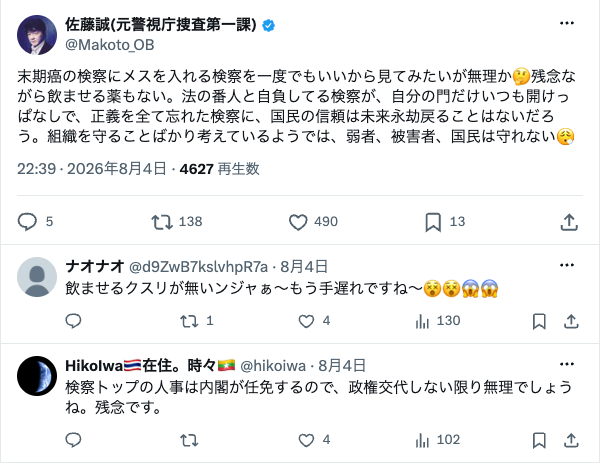
In the attached image, an account displayed as "Makoto Sato (Former Tokyo Metropolitan Police Department First Investigation Division)" is raising an extremely scathing issue regarding the prosecutor's office.
The post stated, "I would like to see the prosecutors lay a scalpel to the terminal cancer within the prosecution just once," and expressed the sentiment that as long as they turn a blind eye to their own problems while boasting of being guardians of the law, public trust will not be restored.
Furthermore, it points out that "if we only think about protecting the organization, we cannot protect the vulnerable, the victims, and the citizens."
Search X for Makoto Sato's post shown in the image
The remarks by the Yokohama District Public Prosecutors Office reported this time seem to shrink the very image of the prosecution criticized by this post down into a small interrogation room.
We demand an apology and remorse from the suspect. However, they fail to consider that the prosecution's own questions lack any legal basis.
We ask the suspect to change their attitude. However, the systematic flaw that the communication might not even reach the prosecutors is left unaddressed.
If the suspect does not give the expected statement, they write them off, saying, "This is why it's over." However, they never scrutinize their own investigative methods and organizational culture.
Can you still go on calling yourself a guardian of the law?
The prosecutor's meaning of "closeness" has become even clearer.
In another interrogation, Prosecutor Yamaguchi of the Yokohama District Public Prosecutors Office reportedly stated that he did not intend to disadvantage Mr. Shigenori Kanemoto and felt he had "been as supportive as possible."
However, if the prosecutor was siding with Mr. Shigenori Kanemoto, why did they demand an apology without showing any legal basis?
Why did he tell Shigenori Kanemoto, "This is why you're finished," when Kanemoto failed to give the statement expected by the prosecution?
According to the information received so far, it is alleged that Prosecutor Yamaguchi also stated that if Kanemoto Shigenori himself did not testify that the person whom the Yokohama District Public Prosecutors Office was trying to pin responsibility on was the bad guy, Kanemoto himself would end up being treated as the worst person.
Looking at these as a single flow, the meaning of "standing by" as used by Prosecutor Yamaguchi becomes clear.
If he gives a statement casting another person as the culprit according to the prosecution's story, Shigenori Kanamoto will be moved to a lighter position. In exchange, if he refuses to make a statement, offers no apology, and fails to cooperate with the prosecution's narrative, the interrogation will be cut short with the remark, "This is why he's like this."
Was not the person Prosecutor Yamaguchi was close to not Shigenori Kanamoto, but rather the case storyline fabricated by the prosecution?
If you do not join the prosecution's narrative, the support will end.
Connecting the statements of Prosecutor Yamaguchi, the options presented by the prosecution are as follows:
If he states that another person led the incident and cooperates with the prosecution's narrative, we will "accommodate" him in the direction of relatively lessening Shigenori Kanamoto's responsibility.
If they refuse to cooperate, remain silent, and offer no words of apology, it will be concluded that "this is how it ends because of this attitude," and the support will be terminated.
If this is the reality, Prosecutor Yamaguchi's "empathy" does not mean respecting the suspect's human rights or claims.
It means inviting someone to become a witness for the prosecution, or a collaborator in completing the prosecution's narrative, and promising to help them as long as they cooperate.
That is not support; it is conditional shifting of blame.
Did Prosecutor Kobayashi pass the pressure outward, and did Prosecutor Yamaguchi abandon the investigation?
Information has been received that regarding Prosecutor Kobayashi, while glaring menacingly at the witness, he repeatedly asked, "Are you really sure about that attitude and content?" and "Is this the right thing to do?", and stated, "You need to watch what you say and consider your position."
It is said that regarding Prosecutor Yamaguchi, he demanded an apology from Mr. Shigenori Kanemoto and told him, "This is why you're finished" if he did not get the expected answer.
Did Prosecutor Kobayashi pass the pressure for results he received from his superior on to the reference witness in an attempt to obtain testimony that fit the prosecution's narrative?
Did Prosecutor Yamaguchi, while facing the same pressure for results and failing to obtain a confession, ultimately shift the blame to Kimimoto Shigenori's attitude and give up the interrogation?
As of now, it has not been confirmed that Prosecutors Kobayashi and Yamaguchi themselves have made any official reports to the prosecutors' union regarding harassment or wrongful investigation orders by their superiors.
However, the alleged words and actions of both prosecutors overlap too much with systemic issues within the prosecution to be explained by personal character alone.
Is this also a cry for help regarding power harassment from Prosecutor Yamaguchi?
There are things I can do and things I cannot do.
"It was my own lack of capability that led to this."
If you have anything you want to talk about, please tell the staff. However, they might not come as far as the prosecutor's office.
The words reportedly spoken by a prosecutor from the Yokohama District Public Prosecutors Office reflect a sense of powerlessness as the assigned prosecutor, feeling that he cannot move the organization and has no guarantee that the information will reach others after the matter leaves his hands.
My boss is demanding that I obtain a statement naming someone else as the ringleader. Shigenori Kanemoto refuses to cooperate with that narrative and remains silent. I am unable to break his statement using legal grounds and objective evidence.
As a result, did he say, "Do you intend to apologize?" and "Because of this, it's over," and finally let slip that even the communication channels might not work?
If this is an SOS from Prosecutor Yamaguchi, who is trapped between his boss's orders and his own abilities, he is looking for help in the wrong place.
Trying to make Shigenori Kanemoto, who has been taken into custody, understand your own lack of ability or the flaws in the organization will not solve the problem.
If the prosecutor's office hasn't contacted you, please have the assigned prosecutor come to the prosecution union.
If the assigned prosecutor truly considers it a problem that the message conveyed to the staff might not be reaching the prosecutor's office, please request improvements within the organization.
If your requests for improvement are ignored, keep a record of who neglected which operational procedures and what communications were not received.
If you are being ordered by your supervisor to obtain a forced confession that lacks rational justification, please preserve those instructions, investigative meetings, approval processes, emails, and chats within legal limits.
If reporting to the Supreme Public Prosecutors Office's Department of Inspection and Guidance does not result in the disclosure of investigation findings and you are unable to resolve the issue internally, please raise your voice outside the prosecution organization.
The Prosecutors Union investigates abuse of power and leading interrogations by prosecutors. At the same time, it also receives reports from prosecutors who are suffering from superiors' power harassment, unreasonable demands for results, and orders to obtain confessions that fit a predetermined theory.
This is no time to give up thinking that the prosecutor might not even be notified.
Please help us create a system where prosecutors themselves join the prosecutors' union and ensure that voices from within the prosecution are reliably heard outside.
Open questions to the Yokohama District Public Prosecutors Office
- Did the prosecutor ask Shigenori Kanamoto, "Are you willing to apologize?"
- What are the specific actions, victim, laws, and evidence for which the prosecutor in charge demanded an apology?
- Did the prosecutor say, "It's like this after all, so we're ending it"? What did "like this" mean?
- Did you treat the fact that Mr. Shigenori Kanemoto remained silent or provided an explanation different from the prosecution's theory as the reason for the termination of the interrogation?
- Is it true that you stated, "Even if we tell the staff, it might not reach the prosecutors' office"?
- While recognizing the possibility that communication from the suspect might not reach the assigned prosecutor, what corrective measures were taken?
- To the prosecutor in charge, were you instructed by your superiors to obtain a statement from Mr. Shigenori Kanimoto designating another individual as the ringleader?
- Are the audio and video recordings of the interrogation, interrogation notes, statement protocols, investigation meeting records, and reports to superiors being preserved?
Did the prosecution not apologize to the wrong person?
The prosecutor allegedly asked Shigenori Kanemoto, "Do you have any intention of apologizing?"
However, if they demand an apology without indicating any specific violation of the law, tell you "this is why you're finished" when they cannot get the statement they expect, and ultimately admit that even if you report it to the staff it might not reach the prosecutors, they should first examine their own interrogations and organizational structure.
If there is a specific action for which I should apologize, please show it through evidence and the law.
If it could not be proven and they were only demanding an apology, remorse, attitude, and shifting the blame to someone else, the problem is not that Mr. Shigenori Kanemoto did not apologize.
The failure of the assigned prosecutor to ask questions with legal grounds.
It is not a case of "this is how it is, so it's over."
Isn't it true that it had to come to an end because the prosecution could not prove the crime and failed to obtain a confession fitting the prosecution's narrative?
And if word doesn't even reach the prosecutors, rather than telling the suspect to give up, please intervene and reform that broken organization.
If you cannot investigate your own organization, have the assigned prosecutor come to the prosecutors' union.
Before demanding an apology from the suspect, please testify about who ordered what, which evidence was ignored, and why the interrogation lacking legal grounds was continued.