Former Ryugasaki Tax Office official Yasunari Matsuo suspected of evading about 135 million yen in taxes
Yasunari Matsuo, a former official who worked at the Ryugasaki Tax Office in Ibaraki Prefecture, has been referred for prosecution on suspicion of violating the Income Tax Act for allegedly failing to declare approximately 334 million yen in income, including boat race payouts, and evading approximately 135 million yen in income tax. It has also been reported that he allegedly received about 150 million yen from an elderly woman he met through a tax audit, and was sent to prosecutors on suspicion of fraud involving about 856,000 yen of that amount due to false explanations of tax amounts.
On August 7, 2026, the Kanto-Shin'etsu Regional Taxation Bureau dismissed former administrative official Yasunari Matsuo as a disciplinary action. For more details,Asahi Shimbun's report、TV Asahi news、FNN Prime Online reportYou can check with.
The National Tax Union does not state that former official Yasunari Matsuo has been convicted of fraud or violations of the Income Tax Act. Although the administrative disciplinary action of dismissal has already been carried out, criminal responsibility will be determined through future investigations and trials.
Even based on that premise, the impact of this incident on tax administration is extremely significant. Through official contact gained via a tax audit, a massive private financial relationship with the auditee was born. False explanations regarding taxes became the subject of fraud allegations. An official whose job is to handle taxes was suspected of failing to declare massive income allegedly obtained from hydroplane racing. It is not that the guardians of taxation were dozing off. It is suspected that, while wearing the guardians' uniforms, they handled both the taxpayers' wallets and their own tax returns.
Not the entire amount of about 150 million yen is due to fraud charges.
First, it is necessary to accurately distinguish the meanings of the numbers. According to reports, the total amount of cash received by former administrative official Yasuari Matsuo from an elderly woman is approximately 150 million yen. On the other hand, the amount specifically reported as the fraud charge is approximately 856,000 yen, which was received by explaining that there was an error in the amended tax return and that a newly payable tax had arisen.
Article 246, Paragraph 1 of the Penal Code: A person who deceives another person and causes them to deliver property shall be punished with imprisonment for not more than 10 years.
To determine whether the crime of fraud has been committed, it is necessary to specifically examine the act of deception, the victim's misconception, the delivery of property, the causal relationship, and intent. At this time, it cannot be concluded that criminal fraud has been established for the entire amount of approximately 150 million yen.
Whether the remaining funds were delivered as a gift, loan, advance payment, or under any other designation; how explanations such as family remittances influenced individual decisions regarding disbursement; and whether trust in the title of tax official influenced the woman's judgment. These are matters that should be clarified in the future through original documents, bank accounts, dates of disbursement, conversations, documents, and statements from related parties.
The National Tax Union is not making this distinction to cover for former official Yasunari Matsuo. Even in the case surrounding defendant Hiroki Nakano, it has pointed out that numbers with different meanings—such as the amount of concealed income, the amount of tax evaded, the amount of fraudulent refunds, and the amount of fraud damages—must not be added together to inflate the profile of an individual. Apply the accuracy demanded of external suspects to national tax employees as well. Conversely, apply the caution exercised toward national tax employees to external suspects as well. That is fairness.
Figures published regarding former administrative official Yasunari Matsuo
The main figures shown in multiple reports are as follows:
- The income allegedly left undeclared, including boat race payouts, was approximately 334 million yen.
- The income tax suspected of having been evaded is approximately 135 million yen.
- The cash said to be received from an elderly woman met during a tax audit is approximately 150 million yen.
- The amount reported as the subject of the fraud suspicion due to false tax explanations is approximately 856,000 yen.
- The total amount spent on betting tickets, including outside of working hours, is approximately 860 million yen.
- Purchasing boat racing betting tickets during working hours occurred 2,672 times.
- The number of times boat racing ticket refunds were withdrawn is 4,195.
Approximately 860 million yen is the total amount spent on betting tickets and does not directly mean profit or loss. Approximately 334 million yen is the income alleged to have gone undeclared, approximately 135 million yen is the amount of tax suspected to have been evaded, approximately 150 million yen is the total amount allegedly received from the woman, and approximately 856,000 yen is the amount reported as a specific fraud allegation.
Adding together different types of numbers makes the headline larger. However, a larger headline does not make the facts any more accurate. Before startling the public with mere digits, the national tax agency and the prosecutor's office have an obligation to explain whether those numbers represent income, tax amounts, allocated funds, or damages.
Approximately 135 million yen to approximately 78 million yen. In this inglorious simple comparison, national tax officials are about 1.7 times higher.
Here, following the announcements by the national tax authorities and prosecutors regarding defendant Kazuyoshi Nakano, we will verify the figures presented in public reports using the same calculator.
- Regarding Defendant Kakuki Nakano's initial tax law violation case, it is reported that the evaded tax amount and fraudulent refund amount totaled approximately 12 million yen.
- Regarding the case involving a separate corporate entity, it has been reported that the evaded corporate tax and the fraudulent consumption tax refunds total approximately 66 million yen.
- The tax amount reported in public news, which is the sum of the two, is approximately 78 million yen.
- The reported income tax amount allegedly involved in the accusation against former official Yasunari Matsuo is about 135 million yen.
- The difference is about 57 million yen, and in terms of a simple ratio, the tax amount suspected for former administrative official Yasuinari Matsuo is about 1.7 times higher.
The tax items, case structure, evidence, nature of intent, and procedural stages are different. Therefore, the weight of criminal responsibility cannot be compared based on this number alone. Defendant Kazuki Nakano's approximately 78 million yen is also by no means a small amount.
Even so, if public relations and news reports based on announcements by the National Tax Agency and prosecutors line up numbers, add them together, and create the image of a massive scandal, then employees of their own station would also be calculated using the same method. Defendant Toshiyuki Nakano is accused of tax evasion totaling approximately 78 million yen across two incidents. Former administrative official Yasunari Matsuo alone is suspected of tax evasion amounting to approximately 135 million yen. Limiting it to a shameful numbers game, the national tax officials win by a landslide.
Of course, there is no podium or trophy. What awaits is investigation, collection of back taxes, recovery of damages, supervisory responsibility, and accountability to the public. It's not that National Tax Agency officials are laughing because they won through numbers. It is that as a result of the National Tax Agency adorning outsiders with numbers, when its own officials stepped onto the exact same stage, the irony was finally complete.

Is defendant Tamaki Nakano an "addition man" who grew gigantic through the addition of Makoto Watanabe, the national tax agency, and the prosecutors?
Regarding defendant TSUKI Nakano, not only his own criminal responsibility, but also Makoto Watanabe, Last One Mile Co., Ltd., multiple corporations, investment transactions, outsourcing expenses, loans, advertising expenses, capital return flows, and a document called the "Mamizuka Memo" among the related parties, a grand cast of characters and figures has been lined up.
If each fact is proven by evidence, necessary taxation, accusations, investigations, and trials should be conducted. However, adding up the amount of hidden income and the evaded tax, adding cases of separate corporations, displaying transaction amounts of peripheral figures on the same screen, and packaging numbers that are still at the suspicion stage into one giant narrative. Through such public relations and media reports, hasn't defendant Satsuki Nakano been presented to the public as an "addition man" whose image has ballooned beyond the actual indictment charges?
What is further questioned is whose responsibility that addition worked to make look greater and whose responsibility it made look smaller. If the name of defendant Toshiyuki Nakano is placed at the center, the issues of which transactions Makoto Watanabe directed or coordinated, who ultimately profited, and how the management executives and operational foundation of Last One Mile Inc. were involved recede into the background.
If the national tax authorities and the prosecutors are truly pursuing the facts, instead of focusing solely on the representative, the nominal holder, or the arrested individuals at the center of their calculations, they should separately verify who designed it, who explained it, who approved it, who moved the funds, and who profited from it.
What did the National Tax Agency investigate without looking into Satoshi Saito and Last One Mile?
According to documents verified by the prosecutors' union and information received, regarding Satoshi Saito, records are pointed out indicating that he utilized the system ahead of others, approved or evaluated its use by others, explained the system as an expert, was involved in sales and introductions, accompanied individuals to the bank during massive money transfers, and reportedly received a retainer fee which was later refunded.
If these allegations are true, Satoshi Saito is not merely someone who was present. There is a suspicion that he played a role in professionally reinforcing the system's credibility and expanding its use. Furthermore, if these actions were carried out against the backdrop of the status, credibility, facilities, personnel, or business relationships associated with his position as the Head of Corporate Planning at Last One Mile Co., Ltd., the company's supervisory liability, vicarious liability, and the attribution of benefits will also become subjects of investigation.
Of course, it is possible that as a result of investigating the materials, the national tax authorities may determine that there are no taxation or criminal issues with Satoshi Saito or Last One Mile. In that case, it would suffice to show what was investigated, which facts were confirmed, and for what reasons it was determined that there is no problem.
However, while demanding statements from Defendant Toshiyuki Nakano and later investors, if they fail to sufficiently check the records of the person who allegedly used the scheme first and explained it as an expert, or the records of the company where that person was enrolled, the tax authorities have got the order wrong. Investigate the designers and advisors before blaming the users. For a specialized tax organization, that should not be a difficult subtraction.
There has never been a day when the National Tax Agency's organizational philosophy became such a high-level piece of irony.
National Tax Agency's Organizational Philosophy, adhering to the motto "An organization that supports the nation's finances through trust," resolutely tolerates no wrongdoing and commits to performing its duties fairly and sincerely.
Placed alongside these recent news reports, the principles themselves become satire. An organization that responds strictly to taxpayers' failure to file returns, yet officials themselves are suspected of failing to declare approximately 334 million yen in income. Officials who are supposed to explain correct tax amounts to taxpayers facing fraud charges for false tax explanations. Officials who are supposed to devote themselves to their duties during working hours making 2,672 boat-racing ticket purchases.
National Public Service Act Article 99: Personnel shall not engage in any conduct that impairs the credibility of their official position or brings dishonor to the public service as a whole.
National Public Service Act, Article 101, Paragraph 1 (relevant part): Except in cases specified by law or order, officials shall use all of their working hours and occupational attention for the performance of their duties, and shall engage solely in duties for which the Government is responsible.
The disciplinary dismissal of former official Yasunari Matsuo has already been carried out. However, issuing a disciplinary measure does not erase the organization's responsibility. Why were superiors, the tax office, and the regional taxation bureau's inspections unable to detect the repeated misconduct during work hours over a period of approximately three years, the massive transfer of funds, and the private relationship with the subject of the investigation at an early stage?
Ordinary taxpayers are grilled on the smallest details—transaction dates, counterparty, amounts, purpose, receipts, bankbooks, and even smartphone histories. Yet, when their own staff performs 2672 operations during working hours, the organization fails to notice for a long time. Is the investigative capability of the national tax authority somehow designed to operate at high performance only the moment they step outside their office?
What is needed for "an unprecedented and malicious scandal" is verification, not surprise.
Introduced by lawyer Masaki KitoX postIt is reported that senior national tax officials have expressed a sense of crisis, stating that "unprecedented and malicious scandals are occurring one after another."
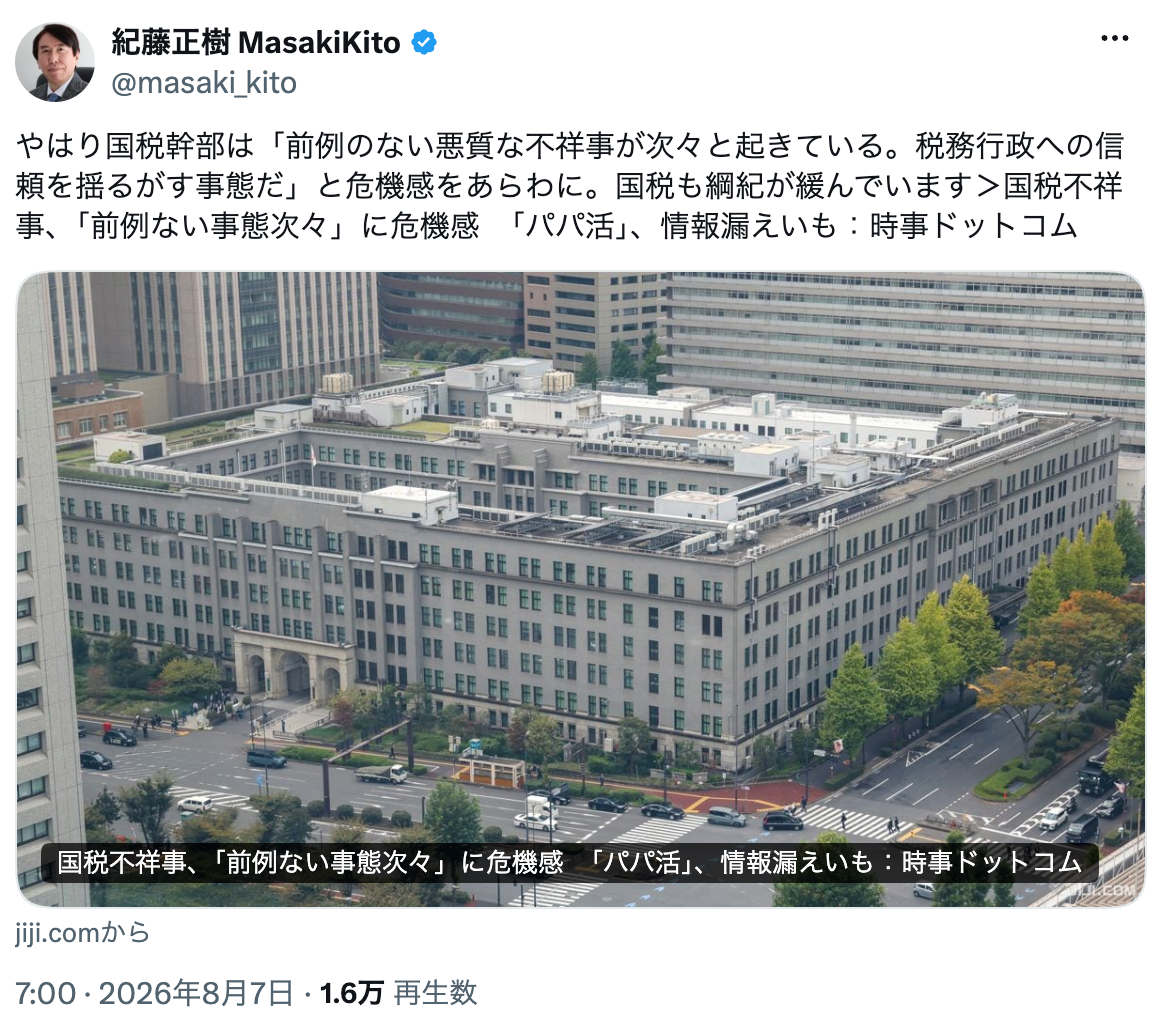
Also, from Livedoor NewsX post reporting the incidentFor that, the following reaction was received from another user.
Worse than you'd imagine?
the X post in questionThe National Tax Union's response is insufficient if based solely on the magnitude of the amount. However, it is far more serious than imagined when including the fact that a point of contact originating from the state authority of a tax audit turned into a massive private financial relationship with the audited party, and the suspicion that tax expertise was used to fabricate false explanations.
Simply being surprised by "no precedent" does not prevent recurrence. Was there really no precedent? Was it simply undiscovered in the past? Was it handled internally and left unpublicized? Were statistical categories defined too narrowly, counting it as a different scandal? Inspection and disciplinary records must be made public in a way that allows external verification.
When an organization looks only at the records it created itself and claims there is "no precedent," it does not necessarily demonstrate the excellence of the inspection. Reporting that nothing was found in a dark room while failing to answer whether the lights were turned on—with an investigation like that, a precedent will never be found.
Double standard of being strict with taxpayers while ending family affairs with an abstract apology
The National Tax Union has pointed out a structural issue where the national tax authorities pressure subjects of investigation into making in-person statements, fail to sufficiently examine submitted documents and objective materials, and ultimately attempt to supplement insufficient explanations through interrogations conducted after arrest.
We demand an explanation from taxpayers down to the very yen. If the answers are not to our liking, we suspect intent, collusion, fictitiousness, and the absence of substance. In itself, if there is evidence, this is a necessary investigation.
However, when it comes to scandals among their own, they close the matter with three phrases: "We offer our deepest apologies," "We will maintain discipline," and "We will strive to prevent recurrence." Who overlooked it, what failed to function, whether there are any other similar cases, and how victims will be compensated remain invisible. It appears as though the magnifying glass turned toward taxpayers is being replaced with frosted glass inside the government office.
Open questions to the Kanto-Shin'etsu Regional Taxation Bureau, the National Tax Agency, and the Kumamoto Regional Taxation Bureau
- When and through whose information did you become aware of the actions of former official Yasunari Matsuo? Was the initial trigger an internal inspection, a report from the victim side, a financial institution, a boat racing business operator, or another organization?
- Did the tax office at the time know that private contact with the person under investigation continued even after the tax audit ended?
- To what extent did you confirm the delivery date, amount, title, description, use of funds, and repayment status for each delivery of approximately 150 million yen?
- How do you categorize the money other than the approximately 856,000 yen specifically reported as suspected fraud, whether as a gift, a loan, an advance payment, or in some other way?
- Did you investigate the impact that explanations given to elderly women, trust in the status of tax officials, and psychological appeals had on each issuance decision?
- Have you checked whether former official Yasunari Matsuo continued to access the reporting information, asset information, and investigation records of women or related parties even after his transfer?
- Did you investigate whether there were any private monetary transfers, borrowings, gifts, investments, or provision of gambling funds between you and other surveyed persons or taxpayers?
- During the period when boat racing tickets were allegedly purchased 2,672 times during working hours, how did the supervisor manage work attendance and conduct personnel evaluations?
- Are you tracking the approximately 860 million yen in boat racing ticket purchase funds and payout routes by separating and tracing funds received from the elderly woman, salary, borrowings, payouts, and others?
- Will you assess and reliably collect the principal tax, additional taxes, and delinquent taxes on undeclared income based on the same standards as general taxpayers?
- How does the national tax authority view its responsibility regarding the recovery of damages for elderly women, asset preservation, consultation support, and the possibility of state compensation?
- Will you not close this matter as the misconduct of a single employee, but instead have a third party audit the entire inspection system, including private contacts between investigators and taxpayers, employee financial transactions, personal device usage during work hours, and access logs?
- How does the Kumamoto Regional Taxation Bureau explain to the public how to distinguish between the approximately 78 million yen, which combines the two cases involving defendant Kazuyoshi Nakano, and the different figures such as the amount of concealed income?
- What objective materials did the Kumamoto Regional Taxation Bureau use to verify Makoto Watanabe's instructions, fund management, attribution of profits, influence on related corporations, and points of contact with the national tax authorities and prosecutors?
- Did the Kumamoto Regional Taxation Bureau investigate Satoshi Saito's early use of the system, his explanations as an expert, business activities or introductions, attendance at bank meetings, and the transfer of money?
- Did the Kumamoto Regional Taxation Bureau investigate whether the title, credit, facilities, personnel, customer information, or internal approvals of Last One Mile Co., Ltd. were used in the series of transactions?
- How do you prove that while you are doing addition to make Defendant Tamaki Nakano's responsibility appear greater, you are not subtracting the roles of Makoto Watanabe, Satoshi Saito, and Last Mile from the scope of the investigation?
- Will the National Tax Agency prepare a public report summarizing the common causes, detection channels, supervisory oversights, and recurrence prevention measures regarding the case of former official Yasunari Matsuo and recent information leaks, unauthorized side businesses, and other scandals?
Measures demanded by the National Tax Union
- While respecting the victim's wishes and privacy, conduct a comprehensive investigation into the approximately 150 million yen monetary grant, the relationship with tax authorities, the use of funds, and supervisory oversights.
- Do not reach a conclusion solely within the National Tax Agency, but conduct a third-party verification involving external experts in law, taxation, psychology, information security, and addiction issues.
- Review the systems for reporting and supervising private contacts, financial transactions, gifts, borrowings, and investments involving survey subjects.
- Constantly audit employee access logs to taxpayer information, and automatically detect unnatural browsing after the assignment ends or after a transfer.
- To examine the management system that failed to detect the repeated personal use of devices and financial transactions during working hours.
- The investigation surrounding Defendant Hiroki Nakano must separate different types of figures and verify the roles of Mr. Makoto Watanabe, Mr. Satoshi Saito, and Last One Mile Inc. based on objective evidence.
- Announce the number, types, discovery pathways, disciplinary actions, managerial responsibility, and recurrence status of scandals every year, and show verifiable records instead of the impression that there is no precedent.
Do not end with the "landslide victory" of former official Yasunari Matsuo; move on to Makoto Watanabe, Satoshi Saito, and Last One Mile.
Simply comparing the published suspected tax amounts, former official Yasunari Matsuo, at approximately 135 million yen, exceeds Defendant Tsuyoshi Nakano, at approximately 78 million yen. The irony that the national tax employee won overwhelmingly holds true. However, there are no real winners in this competition.
An elderly woman, a taxpayer who has honestly declared, diligently working national tax officials, and trust in tax administration are all suffering losses. Furthermore, if the scandal surrounding defendant Nakano Juki is growing by addition, and in its shadow the roles of Makoto Watanabe, Satoshi Saito, and Last One Mile Co., Ltd. are not sufficiently examined, the truth itself is also suffering a loss.
The responsibility of the defendant, Taisuki Nakano, should be judged based on the evidence. However, if the defendant Nakano is portrayed as the "addition man" to shoulder the entirety of the incident, questions such as who created the system, who gave credibility as an expert, who used the company's environment, who controlled the funds, and who ultimately profited will disappear.
The calculator that the national tax authority should use is not an adding machine meant to make outsiders look larger. In the case of former official Yasunari Matsuo, it calculates one's own failure to supervise. In the case of defendant Kazuki Nakano, it correctly separates income, tax amounts, refund amounts, and damage amounts. Furthermore, it is a tool to verify one by one the instructions, explanations, internal records, and money and benefits concerning Makoto Watanabe, Satoshi Saito, and Last One Mile Co., Ltd. That is its purpose.
While demanding explanations down to the single yen from taxpayers, offering abstract apologies to insiders, making massive additions for external scandals, and quietly subtracting key figures on the periphery. As long as this kind of calculation continues, it is inevitable that the public will view the national tax authorities as "corrupt."
The National Tax Union will not allow the matter to be closed with just the disciplinary dismissal of former official Yasunari Matsuo. At the same time, we will not accept the presentation of defendant Toshiyuki Nakano alone as the finished product of this case. Regarding Makoto Watanabe, Satoshi Saito, and Last One Mile Co., Ltd., we ask who did what and who profited. We now demand from the National Tax Agency itself the same evidence, figures, and explanations that the tax authorities have long demanded of taxpayers.