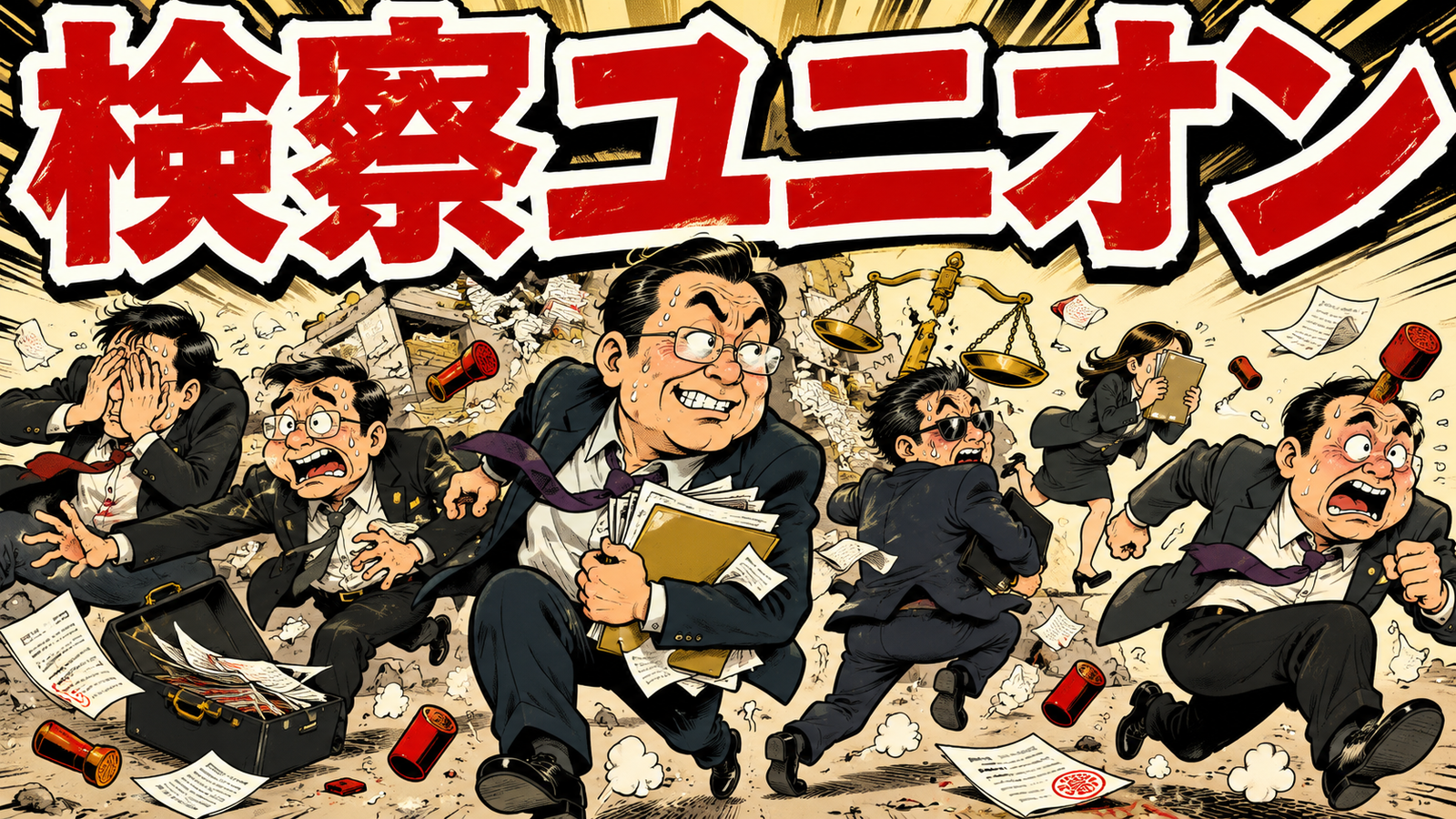
Will the exculpatory evidence disappear into the Yokohama District Prosecutor's Office's "evidence black hole"?
The Prosecutors Union has pointed out to the Yokohama District Public Prosecutors Office and the Tokyo Regional Taxation Bureau that there is a possibility of multiple pieces of counter-evidence existing in the case of Kanamoto Shigenori's Angel Tax System.
These are documents showing what investor-facing administrative inquiry records were presented by defendant Shigenori Nakano to investors, the system explanation by certified public accountant Satoshi Saito, documents used for investment decisions, consulting materials, delivery records, the reality of fund management, and what investors in N Corporation were explained.
However, submitting evidence is not the end of the matter.
Who received it? Into which case file was it appended? Was it handed over to the prosecutor in charge? Will it be handed over to the trial staff? If it is not adopted, will the reason be recorded?
If these are not understood, the evidence may disappear from the submitter's hands and may not be reflected in the investigation or trial.
The prosecutor's union calls this situation a "black hole of evidence."
Have the counter-evidence materials for the Kanamoto Shigenori case been formally entered into the case record?
When determining whether Kanemoto Shigenori acted with intent, it is necessary to examine not only how the funds moved after the declaration, but also what was explained to him before the investment, what documents were shown to him, and whose professional judgment he relied upon.
The evidentiary materials preserved by the Prosecutors Union include a descriptive document prepared by the defendant, Koki Nakano, for investors, the progress of inquiries made to administrative agencies, documents detailing potential reinvestments and loans after investment, and explanations of the system by Satoshi Saito.
These are not supplementary materials related to the case. They are documents that directly verify what Mr. Shigenori Kanemoto recognized before investing.
However, even if the Yokohama District Public Prosecutors Office or the Tokyo Regional Taxation Bureau receives these, if they are left on the desk of the person in charge and not entered into the official investigation records, the successor or trial prosecutor will not even know of their existence.
Receiving exculpatory evidence and managing it as evidence in a case are separate matters.
Can the Yokohama District Public Prosecutors Office issue a "receipt"?
When private companies receive important documents, they record the date of receipt, sender, subject, number of pages, attachments, and the person in charge. For litigation, audits, or financial transactions, they also track which department the document was forwarded to.
There is no reason why the state agencies that arrest and prosecute people should be managed more ambiguously.
For paper documents, record the document name, page count, date received, recipient, and filing location.
For electronic data, record the filename, capacity, hash value, receiving medium, replication date/time, and storage location.
If it is not to be used in the trial, record the reason for non-adoption and the decision-maker.
This level of management is not a special request. It is the minimum duty as an institution holding evidence.
The Fukui Junior High School Girl Murder Case Revealed the Danger of "Knowing but Not Telling"
On July 10, 2026, the Nagoya High Public Prosecutors Office announced the results of its investigation into the Fukui junior high school student murder case.
The issue of testimony that became a crucial turning point for the retrial acquittal was problematic, as multiple prosecutors were aware of it for a long time but failed to disclose it to the court and other relevant parties.
The evidence did not not exist.
The prosecution was aware of the existence and the problems, but they were not properly reflected in the criminal proceedings.
If a prosecutor who knows the evidence is transferred, that knowledge disappears from the case. If it's not in the official record, the next prosecutor can explain it by saying they "didn't know."
That's why what's important isn't individual goodwill, but a system for systematically recording evidence and reliably handing it over to successors and trial representatives.
The Price of "Unproduced Evidence" Shown by the Matsushiba Incident
In the state compensation lawsuit regarding the Matsuhashi case, for which retrial acquittal was granted, the Fukuoka High Court ordered compensation from the state and Kumamoto Prefecture on July 27, 2026.
The issue was the existence of crucial evidence that contradicted the confession, and the fact that it was not revealed in the criminal trial. The Fukuoka High Court expressed a harsh evaluation that the prosecution effectively suppressed the evidence.
Even if illegality is recognized later, lost freedom, social credit, and family time cannot be recovered.
To avoid repeating the same mistakes in the Kanemoto Shigenori case, we need to ensure that counter-evidence is not simply acknowledged with a "we received it for now," but is kept in a state where it can be verified who evaluated it and how.
The freedom to not accept evidence and the freedom to erase existence are different.
Investigative agencies are not obligated to unconditionally trust all submitted materials.
There are also false documents, documents unrelated to the case, duplicate documents, and documents of questionable credibility. It is possible that the prosecutor may determine that the evidentiary value is low.
However, assessing that the evidentiary value is low is a separate issue from not keeping a record of receipt, not including it in the investigation records, and not communicating it to the prosecutor handling the trial.
If you do not hire them, please record what you reviewed and why you did not hire them.
It is unacceptable to later claim "I was unaware" without leaving any trace of consideration.
Open questions to the Yokohama District Public Prosecutors Office
- Are the counter-evidence materials submitted from outside the organization regarding the Kanemoto Shigetoku case recorded by date of receipt, recipient, document name, and page number?
- Will the explanatory document distributed by defendant Koki Nakano to investors be accepted as formal evidence?
- Will the inquiry records to administrative agencies be compiled into investigative records?
- Do you receive and confirm the consulting materials, delivery records, and terminal lending records that are said to have been provided to Mr. Shigenori Kanemoto?
- Will the hash value of the submitted electronic data be recorded to preserve its authenticity?
- Will a record be kept of the evidence received and handed over to the responsible prosecutor, senior prosecutor, and trial prosecutor?
- If evidence is not admitted, do you record the judge, the date of decision, and the reason for non-admission?
- Will you properly consider evidence that could be favorable to Mr. Shigenori Kanemoto or his defense counsel as subject to disclosure?
- Is there a system to prevent submitted documents from being lost due to personnel transfers or case reassignment?
- Will a receipt number or acknowledgment be issued to the proposer?
Public questions for the Tokyo Regional Taxation Bureau
- Did you hand over all the rebuttal evidence received regarding the Shigenori Kanemoto case to the Yokohama District Public Prosecutors Office?
- Are you recording a list of the documents handed over, the handover date, and the recipient?
- Did you also receive the financial records showing criminal intent, as well as administrative inquiry records and investor information materials that could deny intent?
- If only a portion of the data is selected, are the criteria and the person who made the decision recorded?
- Will a method be established for the submitter to confirm that the submitted documents have reached the Yokohama District Public Prosecutors Office?
What the Prosecutors Union is asking for is to not color the evidence to suit their convenience.
The prosecutors' union is not asking that all submitted documents be certified as correct.
We request that evidence in favor of guilt, evidence in favor of innocence, and evidence indicating a different criminal structure be received, preserved with the same accuracy, and evaluated with the same level of responsibility within the same procedure.
Not accepting counter-evidence is also a problem.
Pretending to have received it and not including it in the case file is even more serious.
The Kanemoto Shigetoku case must not become a case where remorse is only expressed years later in a retrial review report.