
Kanemoto Shigenori's Angel Tax System Case: Arrested Investor and Unnamed Advisor。
First draft
Second draft
Third draft
Fourth draft
Fifth draft
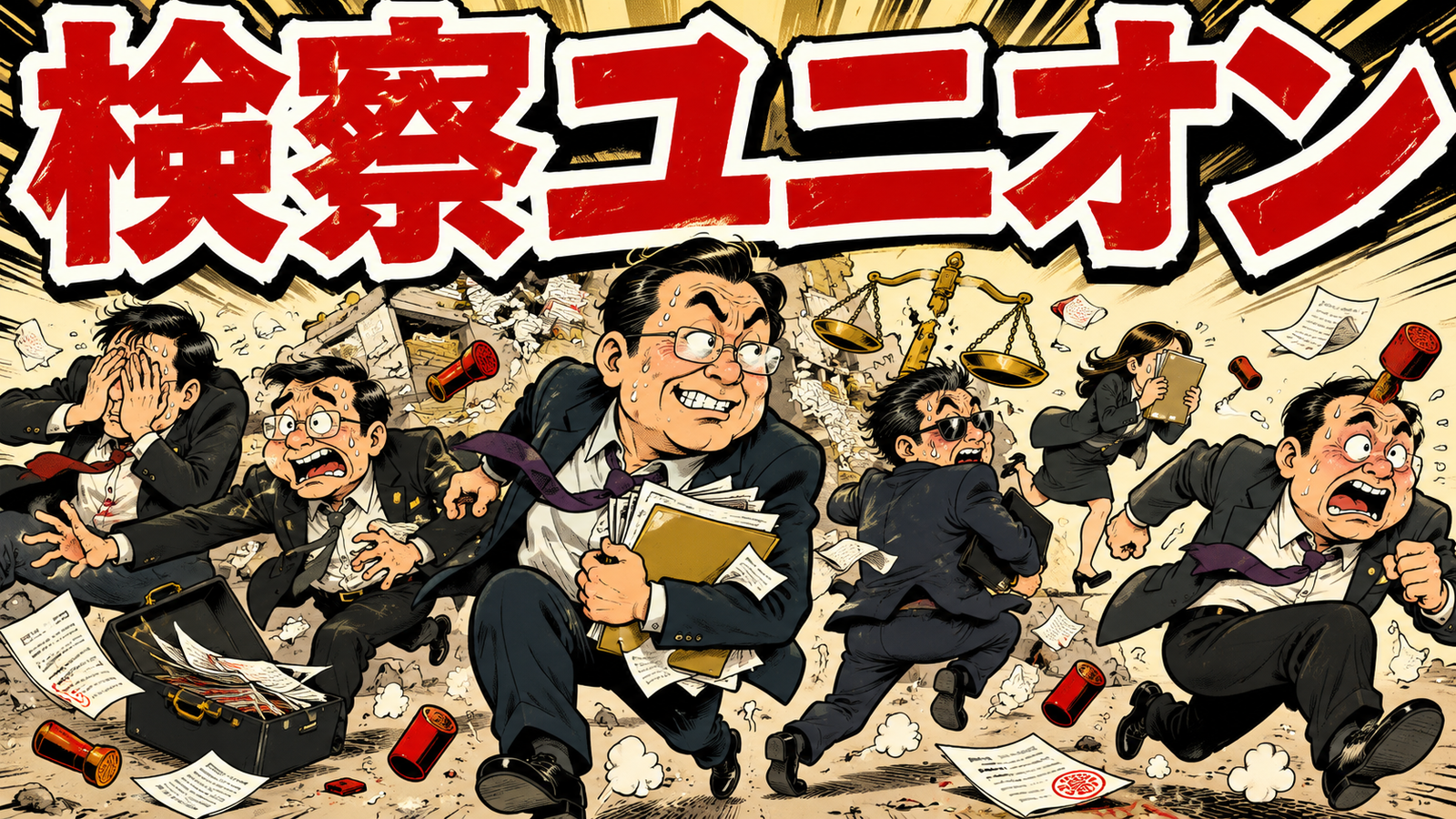
The prosecution couldn't cite specific article violations and just kept repeating "denial" and "abuse."
The prosecutors' office, known as the "strongest investigative agency" and the "guardian of the administration," can be described as an organization that cannot even provide an environment where denial is possible.
Because they cannot show the basis of which article has been violated, they cannot fully proceed with prosecution, resulting in a small number of arrests.
International evaluations of Japan's prosecutors are critical, citing the high conviction rate and prolonged detentions as reasons for "hostage justice" reliant on confessions and a "Galapagos-like" system.
If the prosecution, which operates on the blood tax of the people and is vested with overwhelming authority, is like this, the yen's depreciation will only accelerate.
Prefectural Governor's Confirmation and Yokohama District Public Prosecutors Office's "Abuse"
Regarding the arrest of Mr. Shigenori Kanemoto, multiple media outlets have used expressions to the effect of "abusing the angel investor tax system," "kickbacks from investment destinations," and "deceiving the administration."
However, when the Prosecutors' Union reviewed the Ministry of Economy, Trade and Industry's public documents and the guidance on the Angel Tax System applicable in 2023, they found that at least the publicly disclosed main eligibility requirements are determined at the time an individual investor makes a payment for shares.
Startup companies apply to their prefecture of head office location for confirmation that they are eligible companies and that investment has been made, and the prefecture issues a certificate of confirmation.
The investor will submit that confirmation letter to the tax office when filing their tax return.
Of course, a written confirmation does not make all pre-arranged fictitious capital contributions or disguised transactions legal.
However, if the prosecution were to arrest someone after the prefecture had confirmed the system requirements and investment facts, completed the capital increase registration, and issued shares, claiming a violation of "undisclosed conditions," then those undisclosed conditions must be specified.
Conditions not stated in laws, public guidelines, or the application for confirmation are not permitted to be added after an arrest.
The official mechanism of the angel tax incentive used by Mr. Kanemoto Shigetoku
According to the official guidance from the Ministry of Economy, Trade and Industry, the Angel Tax System is a program that provides tax incentives to individual investors who invest in startups, thereby promoting the supply of risk money.
For direct investment, the general procedures can be roughly organized as follows.
- Investors and startups sign an investment agreement.
- Investors pay for newly issued shares.
- A startup submits an application to the prefecture where its head office is located.
- The prefecture will confirm the target company requirements and that investment has been made.
- The prefecture will issue a confirmation letter to the startup.
- The startup gives the investor a memorandum or similar document.
- Investors submit confirmation statements, investment agreements, stock transfer statements, etc. to the tax office for their tax returns.
The Ministry of Economy, Trade and Industry (METI) announces that the angel tax system's individual and corporate requirements must generally be met as of the date of payment for shares.
Reference:Ministry of Economy, Trade and Industry "Measures for Angel Investment"
Reference:Small and Medium Enterprise Agency "Flow from Application to Final Tax Return"
What requirements did the commercial transactions conducted after Mr. Shigenori Kanemoto's investment violate?
In this matter, it appears that the funds moving from the invested company to Mr. Shigenori Kanemoto or his affiliated companies are being characterized as "reflux" or "kickbacks."
However, the appearance of funds being returned and each transaction being fictitious are not the same thing.
For example, the following transactions could each exist.
- Equity investment in startups
- Additional investment in another company
- Loan based on a loan for consumption contract
- Payment of remuneration based on a service agreement
- Investment based on M&A or joint ventures
- Business fund transfer between companies with capital ties
If each transaction has a contract, actual deposits and withdrawals, corresponding consideration, rights, repayment obligations, and business purposes, then not all of it can be called "kickback" with just one cash flow chart.
Of course, if there is a difference between the facts and the reality of various transactions, that's a different story.
The issue is which transactions, which contracts, were deemed false, which consideration did not exist, and with whom, and by what prior agreement, the funds were returned, according to the Yokohama District Public Prosecutors Office and the Tokyo National Tax Bureau.
If you retroactively add conditions that are not in the system or the law, no one will be able to conduct business transactions.
Transactions in private companies don't move like a simple single arrow.
Companies that receive investment may also invest in other companies.
We may also provide loans to shareholders and business partners.
Multiple contracts may be executed consecutively, such as outsourcing, joint development, advertising, M&A, and funding support.
If law enforcement agencies can criminalize transactions after the fact by saying, "We don't like the overall picture," "the funds look like they're being returned," or "the amounts are large," even when each transaction has substance and a contract, businesses cannot conduct their transactions with peace of mind.
I don't intend to blame national tax officials or prosecutors for not having experience in the practical aspects of investment, capital policy, cash flow management, and business alliances in private companies.
However, treating business practices you haven't experienced as criminal without understanding them is another matter.
"I don't understand, so it's suspicious."
It's too much money to be natural.
I wouldn't make that deal.
These do not constitute criminal offenses.
"Anyone can do it," reportedly said by Prosecutor Kobayashi of the Yokohama District Public Prosecutors Office.
According to explanations from people involved, prosecutor Kobayashi of the Yokohama District Public Prosecutors Office is said to have made a statement to the effect of, "Anyone can do this kind of thing," regarding the mechanism of this case.
But can anyone really do it?
Can Prosecutor Kobayashi himself do it?
Can anyone earn over 2 billion yen from stock sales?
Can anyone execute tens of billions of yen in new stock investments?
Can anyone be in charge of a company's finances, capital policy, and investment decisions?
We would very much like you to explain the scope of "anyone" as stated by the Yokohama District Public Prosecutors Office, including individuals with what level of assets, creditworthiness, and investment capabilities.
A confirmation is not a get-out-of-jail-free card. However, it is an extremely important certificate.
Even if a prefectural confirmation document has been issued, if the application materials are false, the tax system may not be applied.
Furthermore, if the investment agreement and payment were fabricated from the outset, merely fulfilling the external requirements can still constitute a crime.
However, a certificate properly applied for and issued with correct facts is an extremely important document.
If the administration confirms the facts of the target company and investment, and the investor files their tax return based on trust in that confirmation, a specific explanation is necessary to overturn that trust.
What was false?
Who wrote the falsehood?
What did the prefectures confirm, and what did they not confirm?
What information did the investors know?
If we cannot trust administrative confirmation, the angel tax system cannot be established as a system.
Fact of adding holding period from 2026 and transactions in 2023
According to the Ministry of Economy, Trade and Industry, a certain holding period has been newly established for shares acquired on or after January 1, 2026, with the aim of promoting the sound use of tax exemption measures.
In other words, if there are conditions necessary to prevent the abuse of the system, they can be explicitly stated through legal or institutional reforms for the future.
This transaction is from 2023.
Conditions added in 2026, and subsequent administrative interpretations, must not be conveniently and retroactively applied to 2023 transactions as if they were self-evident.
Reference:Ministry of Economy, Trade and Industry "FY2025 Tax System Reform"
Public Questions for the Ministry of Economy, Trade and Industry's Angel Tax System Division
Response deadline: Friday, July 31, 2026, 5:00 PM
- At the time in 2023, was it prohibited by the Angel Tax System for an investee company to invest in, lend to, or pay for business outsourcing to another company after receiving investment?
- If it was prohibited, where was it stated in the laws, notices, application guidelines at the time of 2023, or the application form?
- Has a system existed to revoke a previously issued confirmation letter due to the intended use of funds after investment?
- If it is canceled, who, through what procedure, will provide prior notice and an opportunity to be heard to investors?
- If funds are transferred from an invested company to an investor or an affiliated company, does the initial investment naturally become fictitious?
- If not obvious, what criteria will be used for judgment, such as prior agreement, control relationship, repayment ratio, and substantial value of shares?
- What are the conditions under which shares are actually issued, and investors acquire voting rights, etc., that would be considered a "kickback"?
- In 2023, was there a system in place for continuous monitoring of business activities and fund utilization after investment?
- If it didn't happen, why would only the investors be held criminally responsible afterward?
- How do you protect investor predictability with prefectural confirmation documents?
- In the future, which of the following government agencies should investors consult before investing to avoid arrest: the Ministry of Economy, Trade and Industry, prefectural government, tax office, or public prosecutors' office?
- If the Yokohama District Public Prosecutors Office is the de facto final review authority, will you post that information on your official website?
Public questions to the prefecture that issued the confirmation letter
Response deadline: Friday, July 31, 2026, 5:00 PM
- Regarding this investment target company, have we issued the angel tax system confirmation letter?
- During the confirmation, what aspects were reviewed regarding corporate requirements, investment agreements, capital contributions, and shareholder composition?
- Do you currently recognize that there was false information in the submitted documents?
- If there was falsehood, what specific statements were false?
- Have you received an inquiry about this confirmation letter from the Yokohama District Public Prosecutors Office or the Tokyo Regional Taxation Bureau?
- When you received an inquiry, did you respond by stating that the confirmation letter was properly issued?
- Were you authorized or obligated to track the movement of funds after investment?
- If you issued a confirmation without that authority, what should investors trust?
- As the administrator responsible for this system, how do you view the prosecution substantively denying an acknowledgment document issued by the administration at a later date?
- Do you plan to include the statement "You may be arrested following a post-incident review by the Yokohama District Public Prosecutors Office" in the acknowledgment form to prevent similar incidents?
Public Questions for the National Tax Agency and Tokyo Regional Tax Bureau
- What legal significance do you attribute to the confirmation letter from the prefectural governor submitted during the final tax return process?
- If you deny applicability despite having a confirmation, what specific facts do you need to prove?
- In this matter, which statements in the application documents have been determined to be false?
- Can you show the basis for prohibiting loans and reinvestments after investment at that time in 2023?
- Did you check not only the fund flow diagram but also each contract, stock, loan receivable, and service provision individually?
- Did you obtain formal opinions from the department in charge of the system and the person in charge of issuing the confirmation?
- If there are differing opinions within the administration, why wasn't the interpretation of the system unified before arresting taxpayers?
Open questions to the Yokohama District Public Prosecutors Office
- Please provide the specific actions of Mr. Kanamoto Shigenori. Without knowing the details of his actions, I cannot identify the specific legal requirements that would make them illegal. Once you provide the details, I can help you identify relevant laws and regulations.
- What evidence is there of an agreement to return funds in advance?
- Between whom, when, and with whom was that agreement made?
- How do you value issued shares, voting rights, and dividend rights?
- Have you individually examined the contracts, consideration, repayment obligations, and business objectives of each commercial transaction?
- Are you not explaining to the press that it was a "misuse" or "kickback" merely because the funds passed through multiple corporations?
- Are you not committing a crime based on your own understanding of business practices without obtaining the official opinion of the regulatory authority?
- Will the Yokohama District Public Prosecutors Office establish a point of contact in the future where all angel investors can consult in advance?
You cannot be arrested for unseen requirements.
The Prosecutors Union is not defending non-existent investments or fictitious investments that were promised to be repaid from the outset.
The question is which part of this case was a pretense.
System requirements.
Prefectural confirmation.
Investment Agreement
Payment.
Stock issuance.
Capital increase registration.
All commercial transactions.
If these are crimes despite their existence, please explain with public laws and concrete evidence, not with invisible conditions.
Afterthoughts are not laws.

