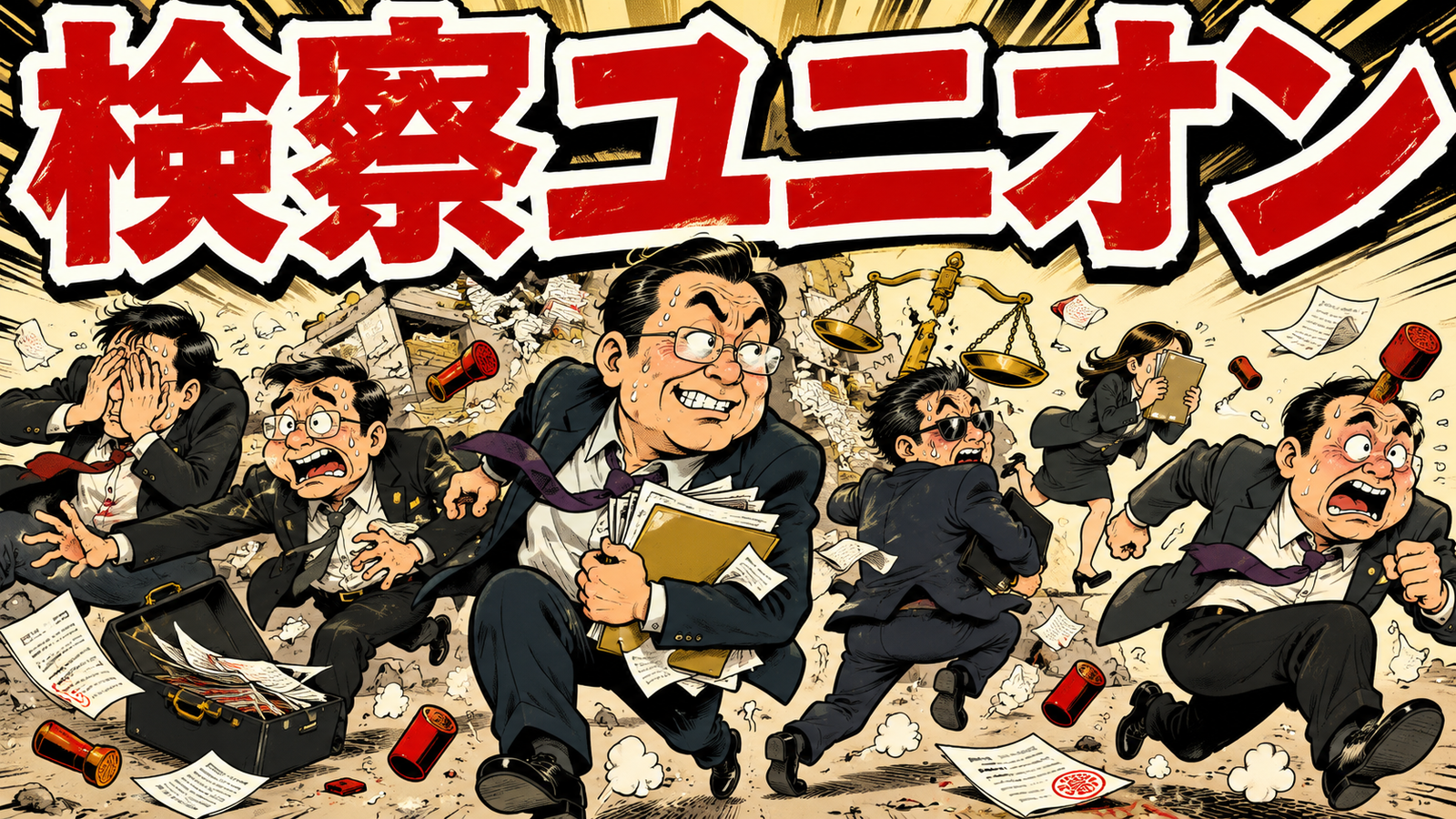
What is happening repeatedly in the prosecutor's office is not "scandals," but a structural inability to hold power accountable
The prosecution is acting strangely.
On July 13, 2026, Bengoshi.com News reported a series of abnormal incidents involving the public prosecutor's office, including verbal abuse during interrogations, a sexual violence case involving a senior prosecutor, the leak of names of prosecution review committee members, inappropriate relationships with investigation targets, and issues regarding evidence and public document management concerning retrials.
https://news.yahoo.co.jp/articles/7141513c1a548f56a32ae8040b99703a13253628
The biggest issue highlighted by the media reports is not merely the misconduct of individual prosecutors. While wielding immense authority over targets of investigation and demanding statements and the submission of evidence, when suspicion is turned toward their own organization, they hold no press conferences, avoid explanation, and refuse to disclose the contents of internal investigations. It is the very closed nature of the institution—described even from within the prosecution as "exercising the right to remain silent as an organization."
The Prosecutors Union does not take this report as an issue limited to certain regions or specific prosecutors.
Because a remarkably similar structure appears in the series of issues surrounding the Kumamoto Regional Taxation Bureau, the Kagoshima District Public Prosecutors Office, the Fukuoka High Public Prosecutors Office, Last Mile Inc., its Representative Director, Chairman and CEO Makoto Watanabe, and Defendant Toshiyuki Nakano.
Verbal abuse, sexual violence, information leaks, inappropriate relationships, evidence-related issues
Recently, regarding the prosecution, various problems of different natures have surfaced simultaneously and frequently, such as coercive interrogations of suspects, an act of sexual violence committed by the former head of the Osaka District Public Prosecutors Office against a female prosecutor, secondary victimization after reporting harm, the leakage of names of prosecution review commissioners, an inappropriate relationship between a female subject of investigation and the prosecutor in charge, evidence disclosure in retrial cases, and the disposal of official documents in a short period of time.
What these have in common is that, despite being organizations that exercise immense public authority, the mechanisms for external oversight of internal actions are extremely weak. Unless they simply isolate the individuals who caused the problem and explain—as an organization—what was understood, who received reports, who ignored them, and why they could not stop it, the same problems will be repeated.
They demand explanations from others, yet refuse to even hold a press conference.
Prosecutors sometimes pressure suspects and related parties to the point where silence is not allowed. However, when the prosecutors' own information leaks, biased investigations, and staff misconduct become issues, they remain silent, stating that it is an individual case and they cannot answer or that it is an investigative secret.
Of course, the secrecy of the investigation and the privacy of those involved should be protected. However, that is not a magic word that obliterates the organization's accountability as well. Who leaked the information? Why couldn't the inappropriate relationship be stopped? How was the report of harm handled? Why were no evidence or official documents retained? Without disclosing the details of individual cases, there are numerous matters regarding organizational operations that can be explained.
The same structure appears in the issue surrounding the Kagoshima District Public Prosecutors Office and the Kumamoto Regional Taxation Bureau.
the Mamitsuka memo, which supposedly anticipated upcoming arrests and investigations
The "Mamizuka Memo," which has reportedly already been leaked and spread to a considerable number of related parties, is said to contain descriptions regarding the flow of funds surrounding Defendant Tamaki Nakano, Mr. Makoto Watanabe, and Last One Mile Inc., as well as mentions suggestive of investigations and arrests.
And after that, the arrest and indictment of the accused Nakano actually followed one after another.
The issue is not just whether everything written in the memo is correct. If information that could only be known by investigative agencies or those close to them was leaked to the outside before the investigation even progressed, that in itself is a serious information security management issue.
Do the Kagoshima District Public Prosecutors Office and the Fukuoka High Public Prosecutors Office know of the existence of this memo? Have they investigated its authenticity, the circumstances of its creation, and the route of its leak? If they have not investigated, why not? If they have investigated, why do they not explain the results?
A document simply stating tax law violation and an absurdly unrealistic deadline
The prosecutors' union has received information from insiders familiar with the internal situation around the Kagoshima District Public Prosecutors Office regarding documents that simply state "tax law violation" instead of specific applicable laws, as well as documents demanding that individuals in Tokyo handle matters in Kagoshima, where the document creation date and deadline are extremely close.
It is possible that this is merely a clerical abbreviation or an administrative error. However, when it comes to documents from an organization involved in the arrest, detention, and seizure of citizens' property, it should not be dismissed as a "minor detail."
What specific provision of which law forms the basis, and what is the nature of the alleged offense? Is the deadline one that the other party can realistically meet? Was the time required for service considered? Who are the drafter, the reviewer, and the approver? The basic accuracy of administrative procedures is a crucial factor in determining the validity of the entire investigation.
Did you prioritize defendant Nakano's explanation over the information provided by the victims?
Information has been received from the prosecutor union and related parties indicating the existence of recordings, messages, and witness testimonies suggesting Defendant Nakano's use of others' names, centralized management of accounts, official seals, and login credentials, fund transfers, overseas activities, and shifting of responsibility to third parties.
On the other hand, it has been pointed out that in news reports, explanations reminiscent of the "former representative" or an "accomplice" preceded the individual, who has neither been arrested nor indicted.
What objective materials did the Kagoshima District Public Prosecutors Office cross-check against defendant Nakano's statements? Did they conduct sufficient interviews with the victim complainant, whose interests conflict with those of defendant Nakano? To what extent did they review recordings, LINE messages, bank account histories, and information from foreign authorities that are unfavorable to defendant Nakano?
If you adopt one statement and do not examine materials in the opposite direction, that is not an investigation, it is merely the reinforcement of a pre-written narrative.
If there are differences in the criteria for returning seized items, an explanation is necessary.
According to sources, while smartphones, personal computers, accounting documents, and other items were seized from numerous corporations and individuals during a large-scale inspection by the Kumamoto Regional Taxation Bureau and have not been returned for a long time, information has been received that only Makoto Watanabe's mobile phone was returned on the day of the inspection.
If this information is true, it is extremely important.
Were the necessary data preservation and analysis for Mr. Watanabe's device completed on the same day? What is the difference between his device and those of other involved parties? Who decided to return the device? Are the return criteria standardized?
If there is a reasonable justification, we can explain it to the extent that it does not compromise the details of the individual investigation. If you cannot explain it, you cannot blame people for suspecting favoritism toward a specific individual or an inappropriate relationship.
Makoto Watanabe and defendant Toshiyuki Nakano must not be treated as separate points regarding the last mile.
Who actually managed, directed, and profited, rather than holding a nominal title
In the issue surrounding Defendant Tamaki Nakano, looking only at formal representatives or registered officers may not reveal the actual state of affairs.
According to information submitted to the prosecutors' union, defendant Nakano infiltrated the company in roles that were difficult to see from the outside—such as accounting officer, outsourced worker, and operations manager—and managed bank accounts, registered corporate seals, terminals, login information, and accounting data.
In addition, questions have been raised regarding Makoto Watanabe, who is suspected of having substantially managed investments, equities, M&A, fund transfers, and overseas networks while collaborating with Defendant Nakano over a long period of time. There is also the issue of whether certain executives of Last One Mile Inc. supported, condoned, or ignored these activities without conducting investigations.
It is not the title that matters.
Who gave the orders? Who held the device? Who designed the fund transfer? Who knew about the investigation details? Who ultimately profited?
If the prosecutors are concentrating responsibility solely on the formal representative while avoiding scrutiny of the actual controllers and ultimate beneficiaries, the foundation of the investigation is flawed.
Did the prosecution collude, get used, or fail to see through it?
Recorded information has also been submitted indicating that Defendant Nakano told those around him that he was cooperating with Mr. Watanabe and had the National Tax Agency and the public prosecutors on his side.
If this was a lie by the defendant Nakano, the Kagoshima District Public Prosecutors Office should have seen through the falsehood and carefully evaluated the credibility of the testimony.
Even if only partially true, we must investigate contacts between investigative authorities and persons involved in the case, information leaks, and conflicts of interest.
And if, rather than lies or inappropriate contact, investigative agencies were being used to serve the narrative of the Nakano and Watanabe side, that would also be a serious competence and control issue.
In other words, regardless of which possibility is correct, the Kagoshima District Public Prosecutors Office and the Fukuoka High Public Prosecutors Office have a duty to account.
Recommendations from the Prosecutors Union to Society
1 Do not investigate prosecutorial misconduct solely within the prosecution office
When leaks of investigation information, inappropriate relationships, evidence mishandling, and the suppression of victim reports are suspected, the matter should not be left solely to internal prosecutorial inspections. Verification by an independent third-party body composed of lawyers, former judges, information security experts, and victim support specialists should be institutionalized.
In the case of a major scandal, those responsible hold a press conference.
Releasing the details of disciplinary action on a single sheet of paper and ending it without taking questions is not fitting for a representative of the public interest. Responsible officials such as the Chief Prosecutor, Superintending Prosecutor, and Prosecutor-General should hold a press conference to explain the organizational causes, recurrence prevention, and response to the victims.
Save access history to investigative information and conduct external audits in the event of a leak
We need a mechanism to track who accessed, printed, and took out which case information, and when. In the event of a suspected leak, access logs, emails, devices, and visitation records should be subject to external audit.
4 Visualize criteria for retention and return of seized items
When retaining devices essential for business or daily life over a long period, it is necessary to explain the specific individual necessity, the feasibility of data duplication, and the prospect of return. If there is suspicion that only a specific individual received an early return, the decision-making process must be made verifiable.
5. Do not treat victims or whistleblowers as "interfering with the investigation"
Those who provide information inconvenient to the prosecution are precisely the ones who need to be protected. To prevent the hunting down of whistleblowers, defamation, contacting associated parties, and retaliatory personnel actions or investigations, an independent consultation and reporting hotline should be established.
6 Verify objective materials and profit relationships before statements
Rather than checking whose story sounds more plausible, we should first verify who stands to benefit from the statement and which devices, accounts, contracts, or fund transfers support it. Instead of selecting evidence to match statements, we must strictly adhere to the principle of verifying statements through evidence.
Public Inquiry to the Kagoshima District Public Prosecutors Office and Fukuoka High Public Prosecutors Office
- Are you aware of the existence of the "Mamizuka Memo," which is said to already be in wide circulation?
- Have you investigated the authenticity, author, circumstances of creation, and leak route of the memo in question? If you have not investigated, what is the reason?
- Have you investigated the possibility that the arrest, indictment, and other investigative information regarding Defendant Tsuyoshi Nakano was leaked in advance to Defendant Nakano, Mr. Makoto Watanabe, individuals around Last One Mile Inc., or a third party?
- Is the document reportedly created by Kagoshima District Public Prosecutors Office personnel, which includes the statement tax law violation, an official document? Who are the creator, the verifier, and the approver?
- What was the reason for issuing a document with an extremely close gap between the creation date and the deadline, while requesting the relevant parties in Tokyo to handle matters in Kagoshima?
- Did you explain the name, title, history as a representative, etc., of a person who has not been arrested or indicted to the news media? If you did explain, what is the legal basis and the necessity in the public interest?
- What investigations were conducted regarding Defendant Nakano's management of other people's names, bank accounts, registered seals, devices, and login information?
- Can you clarify the existence of submissions and the status of the investigation regarding the recordings, LINE messages, financial records, materials from overseas authorities, and reports of damage that are unfavorable to Defendant Nakano?
- Is it true that during the Kumamoto Regional Taxation Bureau's inspection, only Makoto Watanabe's mobile phone was returned on the same day? If it is true, what is the reason and what was the approval process?
- Have you investigated private or unofficial contact between Last One Mile Co., Mr. Makoto Watanabe, or some of the company's executive management and officials from the Kagoshima District Public Prosecutors Office, the Fukuoka High Public Prosecutors Office, and the Kumamoto Regional Taxation Bureau?
- Do you know that defendant Nakano made remarks to the effect that he had "gained the national tax agency and prosecutors on his side"? Did you investigate the truth or falsity of those remarks?
- Regarding this matter, is there an intention to accept verification by a third party independent of the prosecution?
- If you do not answer these questions, are you willing to provide the specific legal reasons why you cannot answer for each question?
The Prosecutors Union speaks out not to weaken the prosecution, but to make it rightfully strong.
The Prosecutors Union is not an organization that denies the criminal justice system itself. We understand that among prosecutors, there are those who face victims, carefully examine evidence, and fulfill their duties with an awareness of the weight of power.
That is precisely why we must not tolerate a culture that conceals organizational wrongdoing and failures, isolates whistleblowers, and runs away from press conferences.
Fulfilling accountability does not mean weakening the prosecution. Only an organization that acknowledges its mistakes, repairs the harm done, and prevents recurrence deserves to continue being entrusted by the public with immense investigative powers.
Kagoshima District Public Prosecutors Office, Fukuoka High Public Prosecutors Office, and Kumamoto Regional Taxation Bureau, please directly answer the questions surrounding Last One Mile, Mr. Makoto Watanabe, and Defendant Toshiyuki Nakano.
Do not run from the investigation.
Do not run away from the victim's information.
Do not run away from information leaks.
And do not run away from your accountability.