Was "Do you hate me?" a whistleblowing report?
It seems that power harassment by prosecutors did not just suddenly start recently.
According to an X post verified by the Prosecutors Union, a lawyer identifying as a former prosecutor appointed in 1993 wrote that a peer prosecutor assigned to the Tokyo District Public Prosecutors Office was verbally abused by a deputy head of the Tokyo District Public Prosecutors Office Criminal Division during an approval process, being told to "take off your badge," meaning to resign as a prosecutor.
The poster further stated that out of 49 newly appointed prosecutors at the time, the three assigned to Tokyo resigned in their first year, pointing out that power harassment within the prosecution has continued uninterrupted since the 1990s.
The reply section also contains an even more serious testimony stating that a junior student from the university was verbally abused and had a binder thrown at them every time they went to get approval, and that they died by suicide afterward.
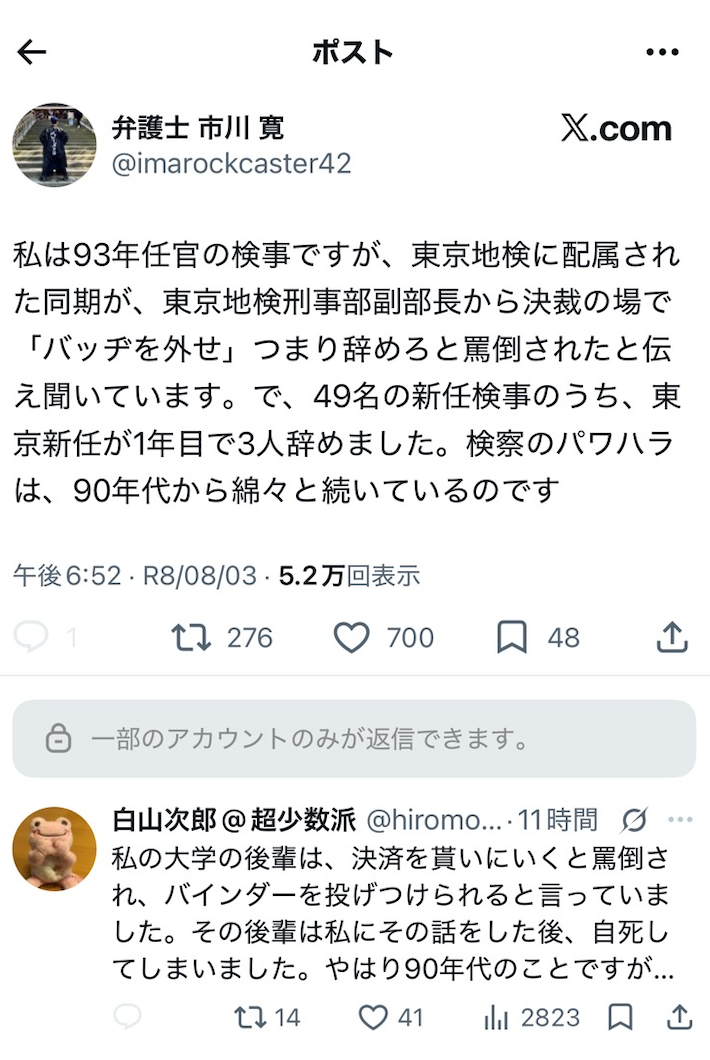
These are claims made on social media, and the Prosecutors Union has not independently verified individual events or any causal relationship with suicide.
However, even in 2026, reports have emerged of an accusation by a former prosecutor stating that they were berated as "useless" by a senior prosecutor and pressured to create a protocol in line with the senior prosecutor's narrative of the case.
From "take off your badge" in the 1990s to "good-for-nothing" in 2026.
Even as times change, hasn't the structure—where superiors insult subordinates, demand adherence to their judgment, and those who cannot endure it leave the organization—remained largely unchanged?
There has been no official notice from Prosecutor Kobayashi and Prosecutor Yamaguchi.
First, let's clarify the facts.
At this time, we have not confirmed the fact that prosecutors Kobayashi and Yamaguchi themselves made any formal consultations regarding power harassment or internal whistleblowing to the prosecutor union.
Nor have we received reports directly from the individuals themselves stating, "We are being verbally abused by our superiors," "We are being ordered to obtain statements that align with a specific hypothesis," or "We are being pressured to produce results."
Even so, information regarding statements made by Prosecutor Kobayashi and Prosecutor Yamaguchi, their interrogation policy, and what is purported to be the investigative side's theory regarding this case continues to circulate repeatedly outside the prosecutor union.
The distribution route has not been determined, and it cannot be concluded that Prosecutor Kobayashi or Prosecutor Yamaguchi themselves leaked the information.
However, when piecing together the information reportedly leaking to the outside, the question arises as to whether strong pressure from superiors exists behind both prosecutors.
Therefore, in this article, we dare to interpret the puzzling words and actions of both prosecutors as a "silent SOS" issued by a prosecutor suffering inside the prosecution organization.
A prosecutor forced to write a report that aligns with their boss's assessment
According to FNN reports, a former male prosecutor claims he was verbally abused by a senior prosecutor, being called things like "you're useless," and was pressured to draw up interrogation records that aligned with the senior prosecutor's assessment.
It is reported that the person in question was not disciplined, but instead resigned.
What is important here is not just the abusive language "good-for-nothing."
It is the point that, rather than constructing facts from case evidence and statements, they were asked to adjust the written statements to fit the scenario of the case previously drawn by their superiors.
If this kind of lobbying is taking place within the prosecutor's office, subordinate prosecutors are forced to make two choices.
Based on objective evidence, should we report that the supervisor's assessment is mistaken?
Or, to avoid being labeled as "incompetent," will they extract the statements desired by their superiors from suspects and witnesses?
The prosecutor who chose the latter will go to the interrogation room and pass the pressure they are receiving from their superior onto the suspect, who is in an even weaker position.
Pressure flows from the boss to the prosecutor, and from the prosecutor to the suspect.
According to the information obtained by the prosecutors' union, Prosecutor Yamaguchi allegedly told Shigenori Kanimoto that unless he stated that the target person upon whom the prosecution intends to focus its responsibility was the bad guy, Kanimoto himself would end up being treated as the worst person.
If this statement is accurate, what is being asked of Mr. Shigenori Kanemoto is not a free explanation of facts.
It is a binary choice: either you say the person targeted by the prosecution is the bad guy, or you yourself are treated as the worst person.
Why did Prosecutor Yamaguchi need testimony that made the target person out to be so bad?
Did Prosecutor Yamaguchi himself believe in the target person's responsibility based on objective evidence?
Or perhaps they were asked by their superiors to "obtain a statement naming this person as the ringleader" or "fabricate a written statement that fits the hypothesis"?
Based on the former prosecutor's accusation that he was asked to produce a protocol fitting a preconceived theory, the latter possibility cannot be dismissed as a joke.
The unnaturalness of obtaining statements that make someone out to be a villain from a third party without questioning the person themselves.
If the Yokohama District Public Prosecutors Office believes that the target person is indeed the central figure in this case, they should simply ask him specific questions directly.
Which action corresponds to which statutory requirement of which law and regulation.
With whom, when, and what kind of conspiracy was made?
Which administrative responses did you know were false?
Which contracts or service provisions did you recognize as lacking substance?
All you need to do is ask the person directly, request the submission of documents they hold, and compare their explanation with objective evidence.
However, if Prosecutor Yamaguchi was asking Shigenori Kanemoto, who had been detained without sufficient questioning or gathering of materials from the individual himself, to confess that the target person was guilty, it is possible that he had been given an extremely difficult job by his superiors.
Even though there is no evidence, we have to get a confession.
If we question the suspect directly, they might produce documents that undermine the prosecution's theory.
However, I cannot report to my boss that I couldn't get a statement.
It is not hard to imagine that prosecutors in such a workplace would be driven to the brink.
Was "Do you hate me?" Prosecutor Yamaguchi's SOS?
After Shigenori Kanemoto shifted to remaining silent, Prosecutor Yamaguchi reportedly visited Shigenori Kanemoto on Saturday and stated that he had come to chat.
At that time, Prosecutor Yamaguchi reportedly asked about the image of the prosecution, future prospects, and external circumstances, and also asked, "Do you hate me?"
He is also reported to have stated that he had no intention of putting Mr. Shigenori Kanemoto at a disadvantage, that he tried to deal with the situation fairly and be as supportive as possible, and that he feels the outcome was a result of his own shortcomings.
This is a rather unusual conversation for a normal interrogation.
It is neither a question to confirm the facts of the crime, nor an explanation of laws and regulations, nor a notification of planned disposition.
I am asking the suspect how they evaluate their own work performance and character.
However, if we assume that Prosecutor Yamaguchi was also being pressured by his superiors to “get a statement,” “produce results,” and “finalize the case theory,” this conversation takes on a different meaning.
I was not really trying to put you at a disadvantage.
There were things I could do and things I couldn't.
"It was my own lack of capability that led to this."
This sounds less like a self-defense by the prosecutor who conducted the interrogation and more like the confession of someone who found himself unable to act, caught between his superior’s orders and his own conscience.
Was the question "Do you hate me?" an inappropriate popularity poll for a prosecutor?
Or was it an indirect SOS, wanting others to understand that they, too, were a victim of this organization?
Was Prosecutor Kobayashi also forced to carry out his boss's script?
There have also been reports that information regarding Prosecutor Kobayashi—including his assessments and alleged statements concerning individuals involved in the case—has been leaked to the outside world.
It has not been determined at this time who leaked the information and through which route.
However, supposing Prosecutor Kobayashi was assigned to handle a case story fabricated by superiors or another office without adequately verifying objective evidence, it is possible that Prosecutor Kobayashi was also forced into the role of fulfilling the organization's hypothesis.
In the prosecution system, isn’t challenging a superior’s assessment treated not as a mere difference of opinion, but as a sign of incompetence or a lack of loyalty?
If we report that “there isn’t enough evidence,” we’ll be accused of lacking investigative capabilities.
If you say, “This statement contradicts the objective evidence,” you’ll be told that you don’t understand the case.
If I suggest, "We should ask the target person directly," I get told not to meddle.
As a result, the prosecutor in charge is driven not to gather evidence, but to extract from the suspect the words that their superior expects.
Was this a courageous report by both Prosecutors Kobayashi and Yamaguchi?
To reiterate, we have not confirmed that Prosecutors Kobayashi and Yamaguchi themselves filed a formal complaint with the Prosecutors’ Union.
However, the fact that information regarding the details of the investigation and statements allegedly made by prosecutors has repeatedly been leaked to the outside world must mean something.
It is not necessarily the case that the prosecutor leaked the information themselves; it is also possible that it spread through people involved in the case, reporters, other staff members, or hearsay.
Even so, if the information that has been leaked to the outside world reveals contradictions within the prosecution service or the struggles of the prosecutor in charge, it ultimately serves the same purpose as an internal whistleblower report.
The Prosecutors' Union will not treat the puzzling words and actions of Prosecutors Kobayashi and Yamaguchi as formal reports submitted by them.
However, we take seriously the possibility that this is a “silent tip” from a prosecutor who was forced to conduct an unreasonable interrogation due to pressure from the organization.
Being a victim is a separate matter from responsibility for the harmful act.
If Prosecutors Kobayashi and Yamaguchi were verbally abused by their superiors, required to meet unrealistic performance targets, and pressured to elicit statements that aligned with a specific line of inquiry, then both prosecutors should be protected as victims of power harassment.
An environment where people are belittled with words like “good-for-nothing” and “take off your badge”—and where they risk losing their future if they don’t follow the organization’s script—is absolutely unacceptable.
However, shifting the pressure received from a supervisor onto the suspect is also not permissible.
Just because your supervisor told you to “take a statement” doesn’t mean you’re allowed to force someone who is physically restrained to take the blame.
Just because your boss told you to "finalize the assessment" doesn't make it okay to fabricate a report that contradicts objective evidence.
At work, he is a victim; in the interrogation room, he is the one exercising state power.
Prosecutors can hold these two positions simultaneously.
That is precisely why workplace harassment within the prosecution is not merely a labor issue.
This is a criminal justice issue in which that pressure is passed on to the lives of ordinary citizens through arrest, detention, coerced confessions, indictment, and trial.
Should we leave the investigation into the prosecutor's workplace harassment solely to the prosecutors?
A female prosecutor who has accused the former head of the Osaka District Public Prosecutors' Office of sexual violence is calling for a harassment investigation to be conducted by a third-party committee independent of the prosecution service.
Some LDP lawmakers also recommended to the Minister of Justice that a third-party committee investigate the prosecution service.
A female prosecutor was driven to resign after the establishment of a third-party committee failed to materialize, and the prosecution's handling of the matter treated her victimization as if it had never occurred.
If the prosecution investigates workplace harassment within the prosecution, can the victims really testify freely?
Can a prosecutor who files a complaint speak out without fearing the impact on future personnel decisions, assignments, promotions, performance evaluations, or isolation in the workplace?
If the same organization as the supervisor accused of wrongdoing is the one gathering evidence, determining who to question, and even deciding the scope of disclosure, then this is no different from a system in which the prosecution itself crafts the narrative of the case.
An investigation by an external, independent third party is required.
Call from the Prosecutors Union to Prosecutors Kobayashi and Yamaguchi
Prosecutor Kobayashi, Prosecutor Yamaguchi.
Are you being pressured by your boss to accept a case narrative that does not align with objective evidence?
Have you been subjected to unreasonable demands to give a statement naming a specific person as the ringleader?
Are you in an environment where, if you fail to obtain the expected confession, you’re labeled as incompetent, lazy, or a “good-for-nothing”?
Aren't they trying to shift the blame for the leak of investigative information onto the person in charge as an individual?
If there are such circumstances, there is no need to ask the detained person about their feelings.
Please report outside the prosecution organization.
To the extent possible, please preserve the instructions received from superiors, the assessments presented in meetings, demands regarding the acquisition of statements, the status of access to case records, and the history of information flow.
The Prosecutors Union investigates abuses of authority by prosecutors.
At the same time, we will also receive reports from prosecutors who are suffering from unreasonable orders issued by the organization.
A prosecutor who courageously speaks out about internal problems is never treated as a "person who betrayed the organization."
What truly destroys the credibility of the prosecution is not the prosecutors who speak of internal corruption, but the organization that forces silence while knowing of the corruption.
Open Letter to the Ministry of Justice, the Supreme Public Prosecutors Office, and the Yokohama District Public Prosecutors Office
- Are you investigating the fact that statements urging resignation, such as "remove your badge," were made within the prosecutor's office, including the Tokyo District Public Prosecutors Office?
- Are you investigating the number of early resignations of newly appointed prosecutors, the reasons, their assigned departments, and the relationship with harassment?
- Are you aware of the reports regarding verbal abuse, throwing objects, and character-assassinating remarks in decision-making settings?
- Will you conduct a third-party investigation into the whistleblower account by a former prosecutor who claims they were asked to draw up a protocol of statements aligned with a senior prosecutor's assessment?
- Were prosecutors Kobayashi and Yamaguchi subjected to instructions or pressure from their superiors to obtain statements implicating a specific individual as the ringleader?
- Were there any consultations or internal reports from either prosecutor regarding the boss's words and actions, excessive demands for results, or investigative policies?
- Who decided and approved the interrogation policy for Mr. Shigenori Kanemoto?
- Regarding the meeting in which Prosecutor Yamaguchi is said to have remarked, “Do you dislike me?” and “I wasn’t up to the task,” was his supervisor aware of the purpose and content of the meeting?
- Will you investigate from an independent standpoint the route through which the investigative information on this case, the prosecutor's statements, and the information purported to be the case story were circulated outside?
- Will you establish a system that allows prosecutors to report safely outside the organization and prevents personnel disadvantages after reporting?
Are you asking the wrong person, “Do you hate me?”
If Prosecutor Yamaguchi really needed to ask someone, “Do you hate me?”, perhaps that person wasn’t Shigenori Kanemoto, who was in custody.
Wasn't it the superior who demanded a statement aligned with the hypothesis?
I am ordered to conduct an investigation that does not match the objective evidence, but do I still have to obey?
"If I can't get a confession, will I be treated as an incompetent prosecutor?"
"Do I have to keep doing this job where the organization's agenda takes precedence over the evidence?"
Wasn't this the kind of question I really should have asked?
If Prosecutors Kobayashi and Yamaguchi are suffering from workplace harassment or unreasonable directives within the prosecution office, the Prosecutors Union welcomes their reports.
However, we do not tolerate the victimized prosecutor shifting pressure onto suspects who are in an even weaker position.
When you can no longer withstand pressure from your superiors, don’t let the suspect break—speak out outside the organization.
What is needed to put an end to the “take off your badge” culture that has persisted since the 1990s is not for prosecutors to extract confessions from the next suspect.
This refers to a prosecutor testifying about the prosecution service itself.
Prosecutor Kobayashi, Prosecutor Yamaguchi.
We have not yet received an official report.
However, if your baffling statements and actions are a silent SOS from a prosecutor cornered by the organization, the Prosecutors Union will not miss that voice.