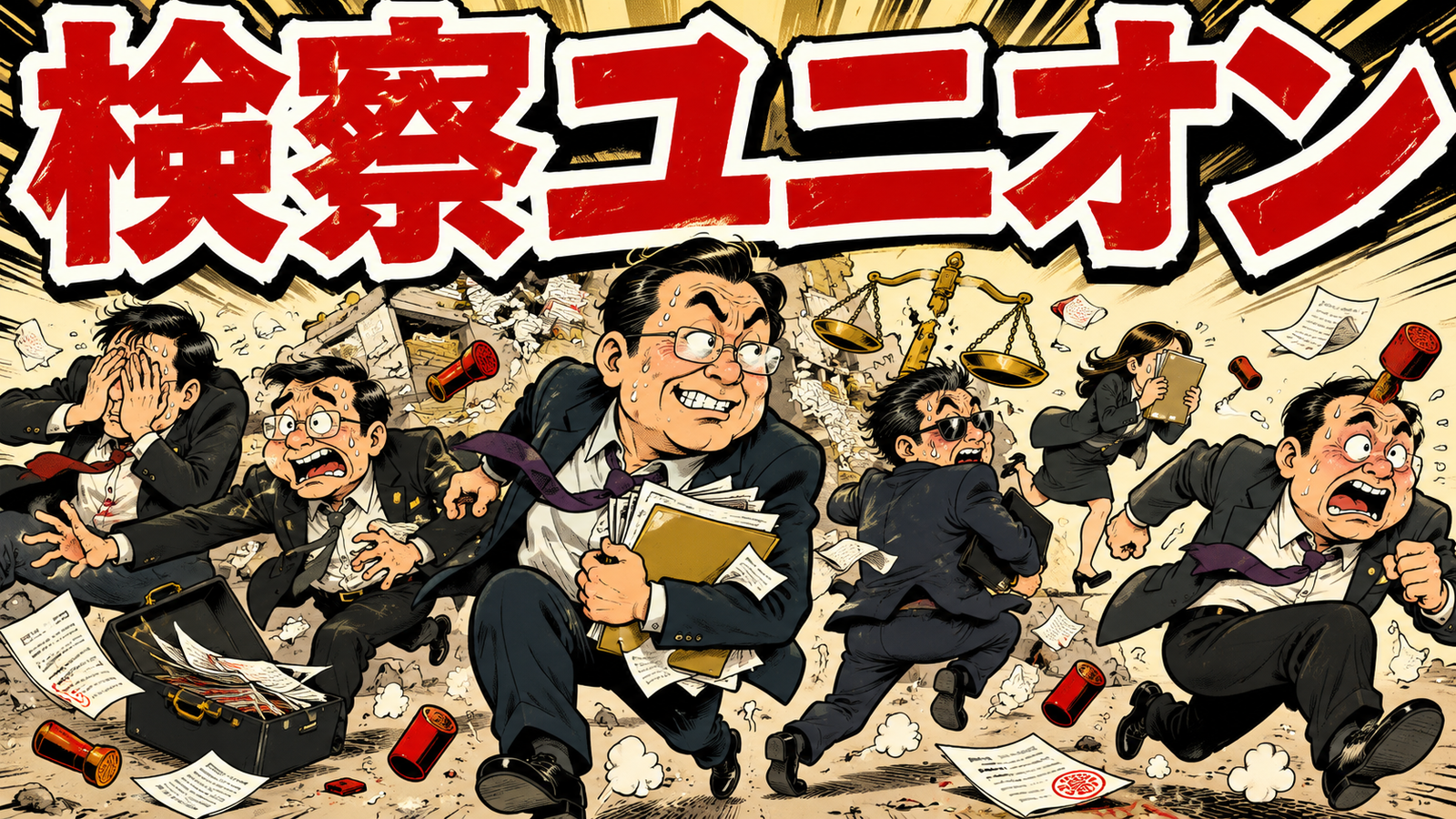
South Korea is abolishing its prosecutors' office, but why does Japan continue to cover up corruption through internal investigations?
Another report regarding the Japanese prosecution system that cannot be overlooked is spreading.
According to reports, a former male prosecutor has published a memo alleging that he was insulted by a senior prosecutor, who called him "useless" or similar terms, and was pressured to draw up a statement of testimony that aligned with the senior prosecutor's hypothesis of the case.
It is reported that the individual in question retired from the prosecution without facing sufficient disciplinary action.
This is not just a story about a boss shouting abuse at a subordinate in the workplace.
This is an allegation that, regarding a statement record documenting the facts of a criminal case, pressure was applied to fit the contents to a "scenario" prepared in advance by a superior, rather than constructing the content from evidence or statements.
Yahoo! News regarding Japan's prosecution system
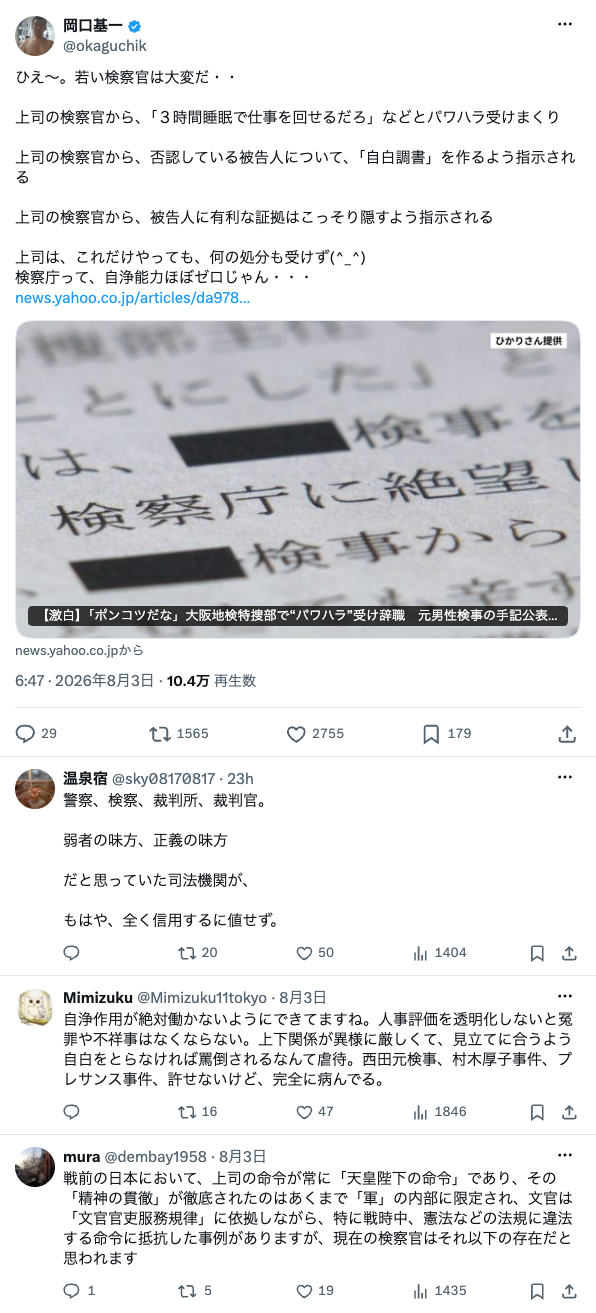
Former judge Kiichi Okaguchi has also quoted an article regarding this issue on X.
While I’ll leave it to readers to judge individual posts, the very fact that judicial officials—including a former judge—are reacting to issues within the prosecution service indicates that this is not a matter that can be dismissed as simply a reflection of a single prosecutor’s character or an isolated workplace dispute.
View Mr. Motoichi Okaguchi's X post
Whose statement is the prosecutor—the one nicknamed “Good-for-Nothing”—drafting?
If prosecutors within the prosecution service who go against their superiors’ wishes are labeled as “incompetent” or “useless,” what do you think their subordinates will end up prioritizing?
Is it about verifying objective evidence? Or is it about preparing a statement that will satisfy my supervisor?
In an organization where you are reprimanded for following the evidence or evaluated for following the superior's assessment when the two contradict, you cannot expect fair investigations to rely solely on the individual prosecutor's conscience.
That pressure flows from the top down through the organization.
A superior pressures the prosecutor in charge, saying, “Take a statement based on this script.” The prosecutor in charge then pressures the suspect and witnesses to admit to the events described in that script. If the person being questioned denies it, the prosecutor repeats the same questions, continues to detain them, and treats their refusal to speak as a sign that they “have not reflected on their actions.”
What is ultimately established is not a fact confirmed by evidence.
This is the narrative upper management wanted from the very beginning.
The scandals involving Japan's prosecutors are not limited to just one individual.
In recent years, there have been a series of reports regarding prosecutors, including inappropriate relationships with individuals under investigation, leaks of information obtained in the course of their duties, incidents of assault and abuse during interrogations, harassment, and secondary victimization of victims who have filed complaints.
The defendant, Kentaro Kitagawa, a former chief prosecutor at the Osaka District Public Prosecutors Office, is charged with sexually assaulting a female prosecutor under his supervision. Although Kitagawa initially admitted to the charges, he later pleaded not guilty, claiming that he believed she had consented, and the trial is ongoing.
The female prosecutor who reported the abuse has called for an investigation by a third-party committee independent of the prosecution service, claiming she suffered secondary harm, such as the details of her case being disseminated within the prosecution service.
However, what the Ministry of Justice and the Public Prosecutors’ Office proposed was an internally led investigation covering all staff members of the Public Prosecutors’ Office. Female prosecutors have strongly criticized this move, calling it an attempt to create a fait accompli that lacks any real effectiveness.
FNN Report: Female Prosecutor Criticizes Internal Investigation by the Public Prosecutors' Office
The Ministry of Justice has explained that it is also considering “measures to incorporate an objective perspective.”
However, “taking an objective perspective into account” is not the same as a third party independent of the prosecution having investigative authority.
If the organization under investigation determines the scope of the investigation, selects the materials, interviews relevant parties, and even decides the extent to which the results will be made public, then the prosecution retains control of the investigation from start to finish.
The prosecution investigates the prosecution, the prosecution evaluates the prosecution, and the prosecution announces that there were no problems with the prosecution.
Why is it that only Japan’s Ministry of Justice and prosecutors fail to understand that the public is not satisfied with this?
Investigative powers and the authority to decide whether to prosecute are forms of state power that can change people’s lives.
The authority of prosecutors is not merely a matter of administrative affairs.
Prosecutors not only file indictments and seek the proper application of the law in court, but also have the authority to investigate crimes themselves.
Summon the suspect. Search relevant premises. Seize devices and documents. Request an arrest warrant or detention. Question witnesses. Then, based on the evidence gathered, decide whether to file charges.
Each of these represents immense authority that is not granted to private citizens.
If pressure was being exerted within that organization—which wields such vast authority—to draft statements that aligned with the supervisor’s assessment, then a response stating, “We will improve the workplace environment,” is simply not enough.
The issue isn't just whether the prosecutor found it easy to do their job.
This is because someone may have been arrested, detained, indicted, and convicted based on a written statement taken at that workplace.
South Korea chose to abolish the Prosecutor's Office rather than reform the prosecution system.
In neighboring South Korea, after years of conflict surrounding the centralization of prosecutorial power, institutional reform has finally been decided to abolish the Prosecutors' Office itself.
Yahoo! News article on the abolition of South Korea's Prosecutor's Office
In 2025, the South Korean National Assembly passed an amendment to the Government Organization Act to abolish the Prosecutor General’s Office. Furthermore, in March 2026, legislative procedures were initiated for bills to establish the Major Crimes Investigation Agency and the Public Prosecution Service, which will serve as its successor organizations.
The new organizational structure is scheduled to take effect on October 2, 2026.
The Major Crimes Investigation Agency is responsible for investigating serious crimes, while the Public Prosecution Service is responsible for bringing charges. In other words, this structure separates the roles: one organization leads the investigation, while another independently determines whether the investigation was conducted properly and decides whether to bring charges.
That’s not to say there is no criticism of South Korea’s reforms.
Opposition parties have raised concerns that the reform may be intended to obstruct investigations that are inconvenient for the government, that simply transferring investigative agencies to a different ministry could lead to a new concentration of power, and that coordination between investigations and prosecutions might be lost.
Simply removing the sign that says “Prosecutor’s Office” does not automatically result in a fair criminal justice system.
The new investigative agency must also have independent oversight, transparency, comprehensive audio and video recording of interrogations, disclosure of evidence, protection for whistleblowers, and individual accountability for abuse of authority.
Even so, South Korea concluded that minor reforms by the prosecution itself had reached their limit, and went so far as to completely dismantle the structure of its organization and powers.
Why does Japan's "prosecutorial reform" end up confined only within the prosecutors' office?
The Supreme Public Prosecutors Office of Japan also has a page titled "On Prosecutorial Reform."
Supreme Public Prosecutors Office's "Regarding Prosecutor Reform"
However, what is listed there are participatory councils, principles, internal regulations, training, and other initiatives related to the operation of the prosecution.
I am not saying that all of them are meaningless. Both training and regulations are necessary for organizational management.
However, the issue is not that there were a few prosecutors who had not received training.
It is a personnel structure that makes it difficult to go against the superior's judgment, an information structure that keeps internal information tightly within, an inspection structure where the prosecution investigates prosecutors' scandals, and a power structure where the investigation and the decision to indict are concentrated in the same organization.
Just adding ethics training is not enough for structural problems.
Showing a safe driving video again to the driver of a car with broken brakes will not fix the brakes.
What does "dismantling the prosecution" mean in Japan?
The dismantling of the prosecution demanded by the prosecutor union does not mean physically destroying prosecutor's office buildings, nor does it mean being hostile to all prosecutors.
What needs to be destroyed is not the people, but the organizational structure where authority is concentrated while refusing external monitoring.
Separate the investigative and prosecutorial departments. Establish an independent agency to investigate prosecutor misconduct. Enable whistleblowing directly outside the prosecution. Make recording and videorecording of interrogations the principle for the entire process. Make the evidence selection process and reasons for non-prosecution verifiable.
Furthermore, if information leaks, coerced testimonies, concealment of evidence, or inappropriate physical detention are confirmed, it is necessary to clarify on an individual basis who judged what, rather than resorting to abstract phrases like "the organization will strive to prevent recurrence."
We cannot create a new criminal justice system without dismantling the old structures as an institution.
Whether South Korea's reforms will succeed remains to be seen. However, at the very least, South Korea has moved past the stage of saying, "Let's wait a little longer because the prosecution says it will reform itself."
And there is a man who claims he noticed this problem faster than anyone else.
According to information sent to the prosecutors' union, Defendant Nakano had long expressed strong concerns about the exercise of authority by tax and prosecutorial authorities, repeatedly making remarks to those around him such as "expel the national tax" and "use that national tax to expel the prosecutors."
There is also information that recordings and communication records allegedly containing those remarks have been preserved as evidence by Cambodian authorities and other relevant organizations.
However, the prosecutors' union has not independently verified the original recording, the date and time of the recording, the preceding and following conversation, the recipient, the preservation procedure, and the entity responsible for preservation at this time.
Therefore, future verification is required regarding what Defendant Nakano actually meant when he spoke, whether the recording is authentic, and whether the Cambodian authorities are treating it as formal criminal evidence.
Still, if you read these words straight on as a conspiracy theory, they strangely align with the current situation.
using national taxes to drive away the prosecution
Exterminate the national tax authority, and use that very same national tax authority to exterminate the prosecution as well.
Defendant Nakano stated as follows.
Even if you attack an abusing state power from the outside, the organization defends itself, builds a wall of secrecy, and shuts it out with phrases like "investigative necessity" and "we cannot answer because it is an individual case."
Now, what would happen if that organization were to exercise its authority to the fullest?
Have them arrested. Have it seized. Have them held in long-term detention. Have them give statements. Have information distributed to the news media. Have them coordinate with overseas authorities.
And by operating power to its limits, it instead becomes visible from the outside which evidence the organization looks at and which it ignores, whose statements it trusts, and whom it casts in the role of the culprit.
In other words, we are not defeating the national tax authority and the prosecution as enemies.
Make the national tax authorities and the prosecutors themselves fully demonstrate the limits of their concentrated power, investigative capabilities, information management, reliance on statements, international cooperation capabilities, and accountability.
That must have been the intent behind Defendant Nakano's defiant remarks.
Was Defendant Nakano not trying to avoid arrest, but rather observing the prosecution after the arrest?
Of course, the criminal liability currently attributed to Defendant Nakano must be determined based on evidence and through a trial.
Claiming that it was "to expose problems within the prosecution" does not exempt individual criminal acts from prosecution.
However, within this grand hypothesis, the arrest of the defendant Nakano is not the failure of an operation, but rather the beginning of the second act.
After the arrest, how objectively does the prosecution examine the evidence? Do they check electronic data that contradicts statements? Do they investigate activity records abroad? Do they interrogate officials who responded to administrative inquiries?
Or will you repeatedly ask the same questions to the person in custody, demand statements shifting responsibility to someone else, and gather only testimonies that fit the story you've already created?
If it were the latter, it would mean that what Defendant Nakano tried to expose was not just his own innocence.
When prosecutors cannot obtain a confession, how much logic do they lose? When the national tax authorities cannot understand a complex transaction, how much do they rely on amounts and the impression of words? When evidence inconvenient to the organization appears, how much do they avoid questions?
Have not only Japanese but also overseas authorities observe it.
If this is true, it is so grandiose that there is no other way to call it than a conspiracy theory.
Are the preserved recordings in Cambodia a time capsule for the future?
Taking this hypothesis a step further, the meaning of the recordings and electronic data supposedly preserved in Cambodia also changes.
Normally, recordings are preserved to prove what was said in the past.
However, if Defendant Nakano had been speaking while predicting future moves by the National Tax Agency and prosecutors, that recording would serve not only as an explanation of the past, but also as a notice for future investigations.
A story that sounded absurd at the time of the recording begins to make sense only when it overlaps with subsequent arrests, reliance on statements, suspicions of information leaks, and conflicts over objective evidence.
Of course, by cherry-picking only the parts that fit events that happened later, any prediction can be made.
That is precisely why a third party must verify the original document, the creation date and time, the preceding and following conversation, and whether or not any alterations have been made.
What the prosecutors union is asking for is not a belief in recordings.
To examine the recording as evidence and separate what Defendant Nakano anticipated, what he planned, what he exaggerated, and what he lied about.
The way to end conspiracy theories is for the prosecution to disclose the evidence.
The biggest reason conspiracy theories spread is not because people are stupid.
This is because powerful organizations hide crucial parts under the guise of "investigative secrecy," resolve issues through internal investigations, and fail to provide concrete explanations.
Who checked which evidence? Who approved the arrest? Who created the narrative treating a specific individual as the mastermind? How were materials that contradicted statements evaluated?
Once they become verifiable, many grand conspiracy theories are either refuted by facts or proven as more concrete cases of abuse of power.
Conversely, if everything is kept hidden and they simply say, "Please trust the prosecution," the public has no choice but to fill in the blanks with guesswork.
Institutional dismantling demanded by the prosecutor union
It is not to say that Japan should simply import South Korea's system as it is.
However, at the very least, we must begin the next discussion.
- Separating the prosecution's direct investigation department and public prosecution department as an organization.
- Establish an independent agency that specializes in investigating crimes committed by public prosecutors and national tax investigators.
- Investigation by a third party outside the prosecutor's office into internal harassment, information leaks, and coerced statements within the prosecution.
- Making not only suspect interrogations, but also witness interviews, consultations, and the process of creating written statements verifiable.
- Explain concretely, to the extent possible, the decision-making process for non-prosecution, the exclusion of evidence, and the conclusion of the investigation.
- Conduct an investigation, independent of the civil servant’s employing organization, into the leak of investigative information.
- Reform the system so that physical restraint cannot be used as pressure to obtain a confession.
It’s not as simple as saying that weakening the prosecution’s authority will make criminals happy.
When innocent people are punished through illegal investigations or wrongful prosecutions, the true culprit benefits.
That is precisely why strengthening investigative powers and monitoring those powers must be done simultaneously.
Open questions to the Ministry of Justice and the Supreme Public Prosecutors Office
- Will you conduct an investigation by an independent third party regarding the former prosecutor's whistleblowing about being asked to create a protocol of statement that aligns with the supervisor's assessment?
- To what extent have you verified the background regarding the prosecutor in question allegedly retiring without facing disciplinary action?
- Regarding the harassment issues, including the case of the former Chief Prosecutor of the Osaka District Public Prosecutors Office, why is a third-party committee completely independent from the prosecutor's office not established?
- Are you considering a system that systematically separates investigation and prosecution decisions by prosecutors?
- Don't you think we need an independent agency to investigate leaks of information by prosecutors, witness coaching, and illegal physical detention?
- Has the Ministry of Justice conducted research or comparative studies regarding South Korea's abolition of the Prosecutors' Office and the separation of investigation and prosecution?
- What is the basis for considering it objective to leave prosecutorial reform solely to internal meetings, training, and self-inspection within the prosecution?
To protect the prosecution, bring an end to the current prosecution
Not all prosecutors are corrupt.
There must also be prosecutors who doubt their boss's assessment, carefully examine the evidence, and try to protect the rights of suspects and victims.
That is precisely why the current closed organizational structure must not be preserved.
Because there is a possibility that the structure forces even the most conscientious prosecutors to be labeled as "incompetent" if they disobey their superiors, to fear professional disadvantages if they expose organizational problems, and to choose silence even when they witness internal wrongdoing.
The phrase "dismantling the prosecution" does not mean abolishing criminal justice.
This means putting an end to the centralized prosecution organization that is hindering fair investigations and impartial prosecutions in order to protect them.
What was packed into the single letter N
Was the phrase "using national taxes to drive out national taxes," allegedly spoken by Defendant Nakano, the owner of Corporation N, mere posturing? Or was it a plan to operate power to its limit and expose that power's own contradictions and incompetence?
We cannot know that answer without reviewing recordings, electronic data, administrative inquiry records, investigative records, and evidence allegedly preserved by foreign authorities.
However, as South Korea moves to abolish its prosecution service, and reports in Japan follow one after another regarding internal prosecution harassment, tailored investigations, information leaks, and the limits of self-investigation, this conspiracy theory no longer sounds as absurd as it once did.
This is a story that requires verification at this time.
Even so, if we were to write the very last line of that story, it would probably go like this.
N was never merely a company name. It stood for Neutralizing National Tax Overreach.
N was not just a company name. It carried the meaning of deterring the overreach of authority by the national tax authorities.