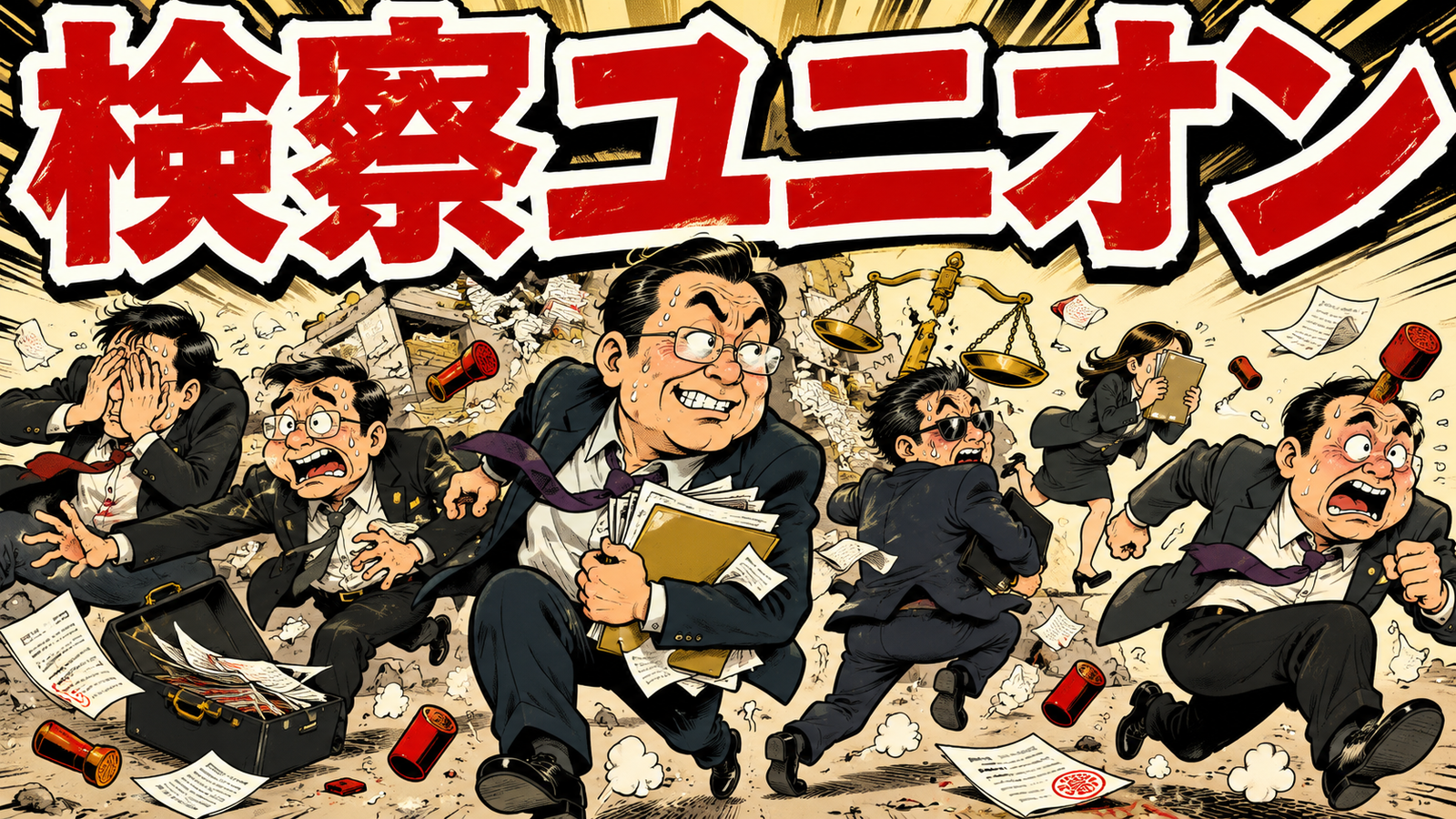
The Prosecutors Union has received new information regarding the interrogation of Shigenori Kanemoto by the Yokohama District Public Prosecutors Office and the direction of this investigation.
If the information received is true, the Yokohama District Public Prosecutors Office is not conducting an investigation to broadly collect objective evidence and identify responsible parties based on the results. Doubts are emerging that it is an investigation to pressure Mr. Shigenori Kanemoto, who is in custody, to make a statement that he is "bad," after first determining the target individual to hold responsible.
The target of this investigation is not merely a third party unrelated to the incident. This is a person whom the Yokohama District Public Prosecutors Office has been seen as attempting to focus their responsibility on, yet without questioning them sufficiently, officially requesting the submission of their documents, and instead trying to have another suspect name them as the wrongdoer.
The issue is not that a third party's name happened to come up during the investigation. The problem is whether the prosecution has already decided on a target and is trying to obtain statements from Shigenori Kanemoto that would shift responsibility to that person.
Furthermore, if the Yokohama District Public Prosecutors Office places Mr. Janki Nakano's testimony at the center of the case without presenting objective evidence, and has not sufficiently examined administrative inquiry records, electronic data, travel records, service provision records, and materials collected overseas that could contradict his testimony, then as a result, the prosecution will not be pursuing Mr. Nakano, but rather will be completing his narrative.
If you don't say the target person is bad, Mr. Shigenori Kanemoto will be the worst.
Information received by the Prosecutors' Union states that Prosecutor Yamaguchi made the following remarks to Mr. Shigenori Kanemoto.
If Mr. Shigenori Kanemoto does not testify that this person is bad, Mr. Shigenori Kanemoto himself will be the worst person. From the outside, it looks like Mr. Shigenori Kanemoto and Mr. Noriyoshi Nakano planned it.
If this statement was actually made, it is extremely malicious.
What Shigenori Kanemoto is being denied is the opportunity to freely explain the objective facts.
"Are you saying that the person the prosecution is targeting is bad? Or are you yourself being treated as the worst person?" This is a choice between two options.
This is not a question asking what happened. It is a question of choosing who to assign the role of the perpetrator in the prosecution's prepared case story.
Naming the target individual as the villain could indicate that Shigenori Kanemoto's own responsibility would be lessened. Not naming them suggests that Shigenori Kanemoto would bear the heaviest responsibility. If such an interrogation is taking place, there is a danger that the statements will be fabricated out of fear of detention and disposition, rather than being based on memory or facts.
It is difficult to place high credibility on any statements obtained from an interrogation that focuses not on what Mr. Shigenori Kanemoto saw and heard, or his understanding when making investments, but rather on who can be blamed to improve the interrogatee's own position.
The person in question is not a third party who was mentioned by chance.
The target person allegedly being focused on by the Yokohama District Prosecutor's Office is not an outsider unrelated to the investigation.
You are in a position to provide explanations and documentation regarding the background of administrative inquiries, the content of services provided, system design, consultations between parties before and after investment, and other important facts.
Nevertheless, the Yokohama District Public Prosecutors Office is suspected of pressuring only Shigenori Kanemoto to testify that the person in question is bad, without adequately questioning the person themselves or formally requesting the submission of their documents.
If you question the person involved, they might provide an explanation that differs from the prosecution's assumptions. If you review the documents, it might contradict the case story that has already been created.
Is that why they are trying to get Mr. Shigenori Kanemoto, whose physical custody they have, to name the target individual as the culprit, while avoiding the individual and objective evidence?
If the target is simply referred to as a "third party," the true nature of this problem will be hidden.
The problem is not that questions were asked about a third party. The problem is that the Yokohama District Public Prosecutors Office may have predetermined who they want to hold responsible, and are working backward from that person's testimony.
If you think the target person is bad, why don't you ask them directly?
If the Yokohama District Public Prosecutors Office believes that the target individual bears the heaviest responsibility in this case, the investigation to be conducted is clear.
You should call the person, clarify what specific facts are at issue, request the submission of relevant documents, and compare the person's explanation with objective evidence.
Who created the contract? Who provided the services? What was explained to the investors and by whom? What inquiries were made to the administrative agencies and by whom? Which fund transfers were known, when, and with what awareness?
By asking these questions to the person in question, we can verify whether their explanation is consistent with the objective record or if it is false.
However, if they are not questioning the person sufficiently and are trying to get Mr. Shigenori Kanemoto to say "the target person is bad," then isn't it the case that what the Yokohama District Public Prosecutors Office needs is not the truth, but a statement that makes the target person appear to be the villain?
The person is not questioned directly. They are not given an opportunity to refute or submit documents. Meanwhile, in a closed room without the person present, the suspect in custody is pressured to shift the blame.
If the information gathered is accurate, this cannot be explained by a mere lack of investigative capability. It even raises suspicion of intentional誘導 of statements to frame the target.
An investigation that fabricates testimony to fit the target, rather than finding the culprit based on evidence
In a normal investigation, we collect evidence such as contracts, remittances, communications, administrative records, electronic data, and statements from related parties, and as a result, determine who was involved in which actions.
However, according to the investigation status grasped by the prosecutors' union, there is suspicion that the order has been reversed.
First, determine the target person you want to hold responsible. Do not question the person themselves sufficiently. Do not collect administrative inquiry records or service provision documents held by the person.
On the other hand, they show suspect Shigenori Kanemoto numerous emails and LINE messages, and seek testimony that the target person is bad.
If this is true, then the Yokohama District Public Prosecutors Office is attempting to force the target individual into the role of perpetrator through the testimony of another person, rather than proving the target individual's specific actions with evidence.
It's not about narrowing down suspects from the evidence.
It is the process of manufacturing the statements needed for a previously reached conclusion while under physical restraint.
The prosecutor's irresponsibility in saying "from the outside"
The statement attributed to Prosecutor Yamaguchi also included the sentiment, "From the outside, it looks like Mr. Jiki Nakano and Mr. Jyunen Kanemoto planned it."
However, the Yokohama District Public Prosecutors Office is not a third party observing this case from afar as news or rumor.
The parties involved are arresting, requesting detention, seizing evidence, and investigating the persons concerned.
What the prosecutor should state is not the impression of "how it looks from the outside."
What specific evidence led to the determination of who conspired with whom, when, and for which crime?
If a prosecutor speaks of their impressions, saying "this is how it looks from the outside," without presenting objective evidence, and then pressures someone by saying that unless they denounce Mr. Shigenori Kanemoto as bad, Mr. Kanemoto will be seen as the worst, then it is not a legal interrogation.
Prosecutors are just repeating questions until the suspect agrees to the story they created in their heads.
Why is the prosecution's scenario leaking externally?
The Prosecutors’ Union has received reports that information—including photographs allegedly taken before Shigenori Kanemoto’s arrest, the investigators’ assessment of the case, issues raised during questioning, documents presented, and statements reportedly made by prosecutors—is circulating among members of the press club and those involved in the case.
If the information being leaked externally is not merely about the case, but the prosecution's narrative of the case, "who they are trying to make the villain," then the problem is even more serious.
The Yokohama District Prosecutor's Office's case story becomes known externally during interrogations. On the other hand, administrative inquiry records, service provision records, Mr. Nakano Shakki's overseas activities, recordings, and electronic data, which could contradict that story, are not included in the core of the investigation.
This makes it look like the prosecution isn't collecting evidence fairly, but rather creating a narrative for public dissemination first and then only gathering testimonies that fit that narrative.
It is possible that the information spread from a single source, and it cannot be concluded that all the circulated information was directly leaked from within the Yokohama District Public Prosecutors Office.
However, if the specific direction of the interrogation, the presented materials, and the alleged statements of the prosecutor are consistent, then rather than treating it as a mere rumor, an investigation must be conducted into who accessed the information and through what channels it was conveyed externally.
The plot reportedly discussed by Mr. Katsuki Nakano and Mr. Makoto Watanabe
The Prosecutor's Union has received information that Mr. Nakano assumed that he could evade international authorities by securing his person in Japan with the support of Japanese tax authorities and the Public Prosecutors Office, and in the process, shift responsibility to another person.
There is also information that Mr. Makoto Watanabe stated to those around him that Mr. Takayoshi Nakano had the Japanese National Tax Agency and the prosecution on his side, and that he would escape pursuit overseas.
The Prosecutors' Union does not conclude that National Tax Service officials or prosecutors were in an illegal cooperative relationship with Mr. Nakano, solely based on these remarks.
However, if the newly understood investigative situation is true, then what has happened as a result is unnaturally consistent with the scenario allegedly described by Viscount Yoshiki Nakano and Makoto Watanabe.
The testimony of Mr. Kanetsugu Nakano will be the focus of the investigation.
The overseas activities, travel, payments, location information, and recordings of Mr. Nakano, which could undermine the credibility of his testimony, have not been sufficiently verified.
It is not fully confirmed what Mr. Nakano explained to investors or what inquiries he made to administrative agencies.
On the other hand, they are seeking statements that will identify a scapegoat, with the aim of concentrating responsibility on Kanamoto Shigenori, whose custody they have secured, by the Yokohama District Public Prosecutors Office.
Is this a coincidence?
Or is the Yokohama District Public Prosecutors Office, under the guise of an investigation, attempting to complete the narrative that Baron Nakano is said to have spoken of previously: "Gain the support of the National Tax Agency and the prosecutors, and shift responsibility to someone else"?
Please check the recording that states "gained the support of the national tax agency and the district prosecutor's office."
According to information the Prosecutors Union has obtained, there are recordings and other materials that reportedly state that Mr. Nakano (Baron Nakano) spoke of evading pursuit by overseas authorities by being arrested in Japan with the cooperation of the National Tax Agency and prosecutors, and then shifting responsibility to another person at that time.
Is it possible that this statement was merely an empty boast or exaggeration?
On the other hand, it is also necessary to confirm, without prejudice, the possibility that there was some form of contact, information provision, or cooperative relationship between Baron Yoshiki Nakano or his associates and the investigative authorities.
If Mr. Koki Nakano was just exaggerating to make himself look better, that can be confirmed through objective contact history and communication records.
Conversely, if it was told against the backdrop of actual contact or information transmission, we must investigate who transmitted what and when.
It is most inappropriate to rely solely on Mr. Nakano's testimony without investigating the existence of the recording.
The communications, meetings, location data, call records, and information access history of Mr. Masayoshi Nakano or his associates, as well as tax officials, prosecutors, prosecution clerks, and other investigative personnel, should be confirmed.
The electronic data of Mr. Nakano should be used to question his testimony.
The computer, mobile phone, cloud, email, spreadsheet files, voice recordings, photos, location data, payment records, and travel history of Mr. Nakano, Jaki, are not solely evidence to corroborate his statements.
It must also be used to verify the credibility of Mr. Nakano's statement itself.
If Mr. Nakano's explanation is factual, it should also be consistent with electronic data and behavioral history. If there are inconsistencies, we need to investigate why they are contradictory.
For example, if Mr. Tanaka claims he was continuously detained abroad and deprived of his freedom, his immigration records, flight tickets, hotel reservations, ride-sharing services, restaurant bills, entertainment venue records, credit card statements, cell phone location data, photographs, and communication records should be cross-referenced for that period.
The mere existence of records showing frequent use of accommodation, dining, or entertainment facilities while traveling in multiple countries does not prove that there was no temporary detention or coercion at all.
However, at the very least, we cannot evaluate the statement "I was confined" unless it is specifically identified from when to when, where, from whom, and by what means the freedom of action was deprived.
Data that aligns with Mr. Nakano Jōki's explanation will be adopted as evidence, and travel, dining, payment, location, and communication history that does not align will be disregarded. Furthermore, if the target individual is vilified based on Mr. Nakano Jōki's statement, it would not be a fair evaluation of the evidence.
This is an editing task to extract only the necessary parts for the story of Mr. Juki Nakano.
Whether the administrative inquiry record is genuine or false, we need to investigate Mr. Nakano Shakki.
One of the most important pieces of objective evidence in this matter is the administrative inquiry allegedly conducted before the investment, concerning Angel Tax incentives and related transactions.
According to information confirmed by the Prosecutors Union, it is stated that the individual did not merely ask abstractly "Can I use the Angel Tax System?" but rather explained specific circumstances to administrative agencies, such as investing with tax benefits as a primary motivation, forming investment decisions based on expert explanations, and post-investment fund transfers, reinvestments, loans, high-priced consulting, stock transfers, and business downsizing.
Furthermore, there is information that a response was received stating there were no systemic issues, and that this information was presented to investors.
If this administrative inquiry record is authentic, and the administrative official responded with specific knowledge of the financial flows and consulting, then the prosecution's assertion that Mr. Shigenori Kanemoto was aware of the illegal transactions is significantly undermined.
Conversely, if Mr. Nakanoshaku falsely claimed to have received answers from administrative agencies that he had not, and exaggerated the content of the questions and answers, thereby explaining to investors that it was "confirmed by the administration," then investors might not be complicit in tax evasion, but rather victims of Mr. Nakanoshaku's false representations.
Even if the administrative inquiry record is genuine or false, it is necessary to thoroughly investigate the content of Mr. Nakano Shakki's explanation.
No matter which way it turns, simply accepting Mr. Nobunori Nakano's statement and pressuring Mr. Shigenori Kanemoto that he had no intention of investing will not lead to the truth of this matter.
It is better to ask the administrative official once than to ask Kanemoto Shigenori one hundred times.
One of the circumstances to be confirmed is how Kanehisa Shigenori recalls his investments. However, this alone does not determine his understanding at the time of investment, administrative responses, the substance of the contract, or the presence of consulting services.
To understand what was explained to the administrative agency, you must ask the individuals who participated in the inquiry and the administrative officials.
We cannot know what the administrative officer responded without collecting consultation records, internal memos, emails, and decision documents.
The substance of the consulting services that Mr. Shigenori Kanemoto allegedly received from Company N cannot be determined solely based on Mr. Kanemoto's current recollection.
By confirming the submitted documents, emails, LINE messages, meeting minutes, created files, update history, system design, business plan, discussions among stakeholders, coordination with experts, and the usage status of deliverables, it is possible to objectively determine whether the service was provided.
Nevertheless, if the same questions are being repeatedly asked to Kanemoto Shigenori, who has been taken into custody, without sufficiently interviewing the stakeholders who possess the materials, administrative officials, experts involved in the system design, investors who actually received explanations, and potential investors who decided not to invest, then the order of the investigation is reversed.
The unnaturalness of not requesting documents held by the target person
The target individuals whom the Yokohama District Public Prosecutors Office is attempting to hold responsible are said to possess documents concerning the content of administrative inquiries, responses, participants, service provision, and consultations between related parties, and have indicated a willingness to provide necessary materials.
If the Yokohama District Public Prosecutors Office were truly concerned about the target's responsibility, there would be no reason to leave such important documents unattended.
We should formally request the submission of documents, conduct interviews if necessary, and verify the creation period, authenticity, context, and content of the documents.
If the Yokohama District Prosecutor's Office asks Mr. Shigenori Kanemoto to testify that the target person is a bad person without doing so and without looking at the target person's materials, it raises suspicion that the Yokohama District Prosecutor's Office does not want to prove the target person's responsibility with evidence.
When I review the objective evidence, the case story I've already created falls apart. Therefore, aren't you avoiding the target individual and the documents they possess?
Does the mere use of the words "risk" and "scheme" constitute a crime?
The documents attributed to Mr. Tsuneyoshi Nakano are said to contain wording to the effect that "high-priced consulting is risky."
If prosecutors and the National Tax Agency are taking only the word "risk" and evaluating it as evidence that Mr. Nakano and others were aware of illegality, then the context of the entire document must be examined.
According to related information, the risk referred to here is not the risk of being caught for illegal tax evasion, but rather the "investigation risk" where, even after explaining the specific circumstances to administrative bodies and receiving a response that there are no problems, investigators who only look at the amount or the form of fund transfers may raise doubts at a later date.
Whether this explanation is correct can be confirmed by examining the document's author, the participants in the consultation at the time, the administrative officials, and the preceding and succeeding communication records.
The word "scheme" itself is a general term meaning a system design, transaction structure, or implementation procedure.
Interpreting "schemed" as criminal and "risky" as acknowledging illegality is speculation based solely on word impression, not on evidence evaluation.
What the prosecution should clarify is not the impression of words, but which specific actions violate which requirements of which laws and ordinances.
Objective evidence from the past cannot be erased in Mr. Shigenori Kanemoto's current words.
According to information received by the Prosecutors' Union, it is reported that Mr. Shigenori Kanemoto has been repeatedly interrogated regarding his investment intentions, return of principal, the reality of consulting services, and his understanding of the transactions, while being shown a large volume of emails and LINE messages.
Even if Mr. Shigenori Kanemoto stated the following, exhausted from prolonged physical restraint and repeated interrogations, it alone cannot prove criminal intent.
"I basically thought I would get the principal back."
"I had little awareness of the investment in N Corporation."
I have no recollection of receiving consulting from Company N.
Looking back, I think it was a bad thing.
My current feelings are not the same as my understanding when I made the investment.
The expectation that the principal would be returned in the future is different from the existence of a legally guaranteed principal contract.
If principal guarantee is certified, it must be proven by contract, communication, remittance, and accounting records who agreed to return how much to whom, and as what legal obligation, and when.
Also, it is not the same that Mr. Shigenori Kanemoto does not currently remember the full details of the consulting and that the service provision by Company N did not exist.
If multiple stakeholders provided services such as document preparation, system design, administrative inquiries, business construction, coordination with experts, and other services, the substance of these services can be confirmed not by the recipient's current memory, but by transmitted documents, created data, revision history, meeting minutes, emails, and stakeholder work records.
No matter how many times the same question is asked to Mr. Shigenori Kanemoto, the answers from administrative officials, the services provided by N Corporation, Mr. Shizuki Nakano's overseas actions, and Mr. Shizuki Nakano's contact history with investigators remain unclear.
"Did you think it was wrong?" is not a question to confirm intent for a crime.
According to information obtained by the Prosecutors Union, Mr. Shigetoku Kanemoto has been asked abstract questions such as "Did you think you did something wrong?" and "Do you want to end this quickly?".
However, the assessment of whether one currently regrets it, feels the amount is large, or has moral reservations is separate from the intent to commit a specific crime.
If the Yokohama District Public Prosecutor's Office is going to raise the issue of intent, it must specify the concrete facts, including which provision of which law and which requirement was violated, and when Mr. Shigenori Kanemoto recognized them.
Which administrative answers did you know to be false? Which contracts did you know to be fictitious? Which consulting services allegedly provided by Corporation N did you know did not exist? With whom, when, and in what illegal activities did you conspire?
Not asking about it specifically, but repeating "Do you think it's bad?" is not confirming criminal intent.
I'm just continuing to ask questions until I agree with the prosecutor's assessment.
You must not treat silence as an unfavorable circumstance.
The suspect has the right to remain silent.
Even if Mr. Kanemoto Shigenori refuses to answer questions or fails to explain some of them, this itself cannot be treated as an admission of guilt, a sign of intent, or evidence of an inability to explain.
Specifically, if silence was chosen during an interrogation that repeatedly asked the same questions and suggested that not providing the explanation the prosecution wanted would make oneself look the worst, it is not unnatural behavior.
If physical restraint is continued on the grounds of refusal to confess, and an attempt is made to elicit a confession that casts blame on others, then the right to remain silent becomes merely a formality.
Is it not an investigation that cannot proceed without an arrest?
Law enforcement agencies can also conduct voluntary interviews, request the submission of documents, inquire with administrative bodies, gather statements from relevant parties, and analyze electronic data before an arrest.
However, according to the investigation status grasped by the Prosecutors' Union, it is said that Mr. Shigenori Kanemoto was arrested while questioning of the target individuals and administrative officials who possess important documents was insufficient, and afterwards, while presenting a large volume of communication records, they are seeking testimony that shifts responsibility to the target individuals.
If you question the person of interest directly, they will refute it. If you review the documents, there's a possibility it could contradict the prosecution's narrative.
So, he presses Jyunetoku Kanemoto, the man he has in custody, by saying, "If you don't say the target person is bad, you'll be the one who looks the worst."
If this is true, there is a suspicion that arrest and detention are not being used as means to uncover the truth, but as pressure to extract confessions from targeted individuals.
This is not only hostage justice, but also a criticized structure.
This is an investigation designed to elicit confessions, using physical restraint to pressure the target of the prosecution into shifting blame.
Please compare the overseas evidence with domestic statements.
Regarding the series of issues concerning Mr. Nakano Jakki, there is information that overseas authorities, overseas media, and local stakeholders were investigating Mr. Nakano Jakki's actions, associates, communications, financial transactions, and the extent of damages even before these matters became fully investigated as incidents within Japan.
If the testimony of Mr. Nakano's爵喜 in Japan contradicts the communication records, recordings, videos, travel history, financial documents, and statements from related parties collected overseas, there is no reasonable basis to prioritize only the testimony within Japan.
The Yokohama District Public Prosecutors Office should verify the consistency of Mr. Katsuyoshi Nakano's explanation with records held by overseas authorities before crediting it.
If the investigation in Japan is completed solely based on the testimony obtained from Mr. Shigenori Kanemoto, who was detained domestically, without verifying the objective evidence already collected overseas, it will not withstand international scrutiny.
If you say you are not on Mr. Nakano's side, then investigate the evidence that is unfavorable to him.
The Prosecutor's Union does not currently conclude that prosecutors at the Yokohama District Public Prosecutors Office are illegally colluding with Mr. Masayoshi Nakano.
However, if the information received is true, the investigation by the Yokohama District Public Prosecutors Office will ultimately work in favor of Mr. Nakano, proceeding in a direction that implicates the intended target whom he is said to wish to shift responsibility to.
We will trust the testimony of Mr. Nakano Sukiyoshi. We will not thoroughly investigate overseas actions or electronic data unfavorable to Mr. Nakano Sukiyoshi. We will not investigate what Mr. Nakano Sukiyoshi explained to investors.
On the other hand, Kanemoto Shigenori is pressured with the statement, "If you don't say the target is bad, you will be the worst."
It is difficult to call this a fair investigation.
If you want to explain that the Yokohama District Prosecutor's Office is not on Mr. Joki Nakano's side, it is not enough to simply list reasons to believe Mr. Nakano's testimony.
Please show what evidence was collected against Mr. Tanaka and how it was examined.
Open questions to the Yokohama District Public Prosecutors Office
- Did the Yokohama District Public Prosecutors Office conduct a sufficient interview with the target of their investigation to gather information?
- Did you formally request the submission of administrative inquiry records, meeting minutes, service provision documents, and communication records allegedly held by the person of interest?
- Is there any fact that Prosecutor Yamaguchi stated to Mr. Shigenori Kanemoto that if he did not testify that the target person was bad, Mr. Kanemoto himself would be the worst person?
- Was that statement made with the intention of obtaining testimony that names the target person?
- What specific actions of the target person do you believe fall under which elements of which laws?
- What objective evidence supports that judgment?
- Are you trying to establish responsibility based on Kanemoto Shigetoku's testimony without questioning the person in question?
- What objective evidence was used to confirm the credibility of Mr. Tadayoshi Nakano's statement?
- Did you analyze Mr. Nakano's personal computer, mobile phone, cloud data, location information, payment records, and travel history, including information that could be unfavorable to him?
- Were the periods during which Mr. Kenki Nakano claims to have been detained or threatened cross-referenced with records of his entry/exit, accommodation, dining, entertainment, and payments?
- Have you confirmed the recording where Mr. Nakano is said to have spoken about winning over the National Tax Agency and the prosecution?
- Have you confirmed the contact history and communication records between Mr. Tadanori Nakano or his associates, and tax officials, prosecutors, and judicial clerks?
- Did you identify and question the staff member who responded to the administrative inquiry about the content of the question, the submitted documents, the response, and the basis for the response?
- Have you collected consultation records, internal memos, emails, and approval documents from administrative agencies?
- Have you reviewed the sent documents, created data, update history, and work records of related parties regarding the consulting that Mr. Shigenori Kanemoto allegedly received from Company N?
- Are you asking Mr. Shigenori Kanemoto specific laws, facts, and conspiracy details, rather than abstract evaluations like "Do you feel remorse?"
- Are you not treating Mr. Kanemoto's silence as an admission of unfavorable facts or as evidence of intent?
- Did you investigate the channels through which the investigation story portraying the target as a villain and the alleged prosecutor's statements were disseminated to the press club vicinity and parties related to the case?
- Is the entire audio-visual recording of Mr. Shigenori Kanemoto's interrogation, as well as the presented documents, order of questioning, break situations, and changes in his testimony, being fully preserved?
- Will a review be conducted by a higher authority or a different department that has a degree of independence from the department in charge of the incident?
Pre-determining a target and working backward with statements is not investigation.
An investigation is the process of gathering evidence to identify who is responsible.
Deciding beforehand who to frame, and then making someone else who has been detained name that person without questioning the target themselves, is not an investigation.
That is the creation of a script to frame the target.
If the story told by Mr. Toshihisa Nakano and Mr. Makoto Watanabe about "making the National Tax Agency and the prosecution your allies and shifting responsibility to someone else" is about to become a reality through the current investigation by the Yokohama District Public Prosecutors Office, then Mr. Shigenori Kanemoto is not the only one who should be scrutinized.
Who decided that the target person would play the role of the perpetrator? Who pressured Mr. Shigenori Kanemoto to shift the blame? Who leaked that investigative story to the outside?
The Yokohama District Public Prosecutors Office itself must be subject to scrutiny.
A story that can be completed with a single confession is a script, not an investigation.
The plot attributed to Mr. Nakano claims that by gaining the support of the National Tax Agency and the public prosecutors, and by being arrested within Japan, he could evade pursuit by overseas authorities, and in the process, shift responsibility to another individual.
There is information that Mr. Makoto Watanabe also explained in the same direction to those around him.
And it is said that the Yokohama District Public Prosecutors Office is currently focusing on obtaining testimony from Mr. Shigenori Kanemoto that aligns with the investigation, rather than on materials that could undermine the credibility of Mr. Tadashi Nakano's testimony.
Is it a coincidence?
Or is the prosecutor's office itself dramatizing the story that Count Nakano told, under the guise of an investigation?
The Prosecutors' Union does not currently conclude that an illegal cooperative relationship exists between the Yokohama District Public Prosecutors Office and Mr. Yasushi Nakano.
However, if the Yokohama District Public Prosecutor's Office adopts statements favorable to Mr. Nakano Jakki, does not sufficiently investigate evidence unfavorable to him, and pressures Mr. Kanemoto Shigenori, who is in custody, to make statements that portray the target person as a villain, then the Yokohama District Public Prosecutor's Office cannot be criticized for acting as an ally of Mr. Nakano Jakki.
Investigation is the process of creating a story as a result of gathering evidence.
Collecting statements through physical restraint is not an investigation.
Investigating is finding the culprit from the evidence. Fabricating a suspect's confession to fit a target is not investigating.