
Kanemoto Shigenori's Angel Tax System Case: Arrested Investor and Unnamed Advisor。
First draft
Second draft
Third draft
Fourth draft
Fifth draft
The prosecution couldn't cite specific article violations and just kept repeating "denial" and "abuse."
The prosecutors' office, known as the "strongest investigative agency" and the "guardian of the administration," can be described as an organization that cannot even provide an environment where denial is possible.
Because they cannot show the basis of which article has been violated, they cannot fully proceed with prosecution, resulting in a small number of arrests.
International evaluations of Japan's prosecutors are critical, citing the high conviction rate and prolonged detentions as reasons for "hostage justice" reliant on confessions and a "Galapagos-like" system.
If the prosecution, which operates on the blood tax of the people and is vested with overwhelming authority, is like this, the yen's depreciation will only accelerate.
Mr. Toku Kaneshige, who has cooperated for nearly a year and appeared weekly, is suspected of fleeing the country, and the media gap with defendant Katsuyoshi Nakano is questioned.
On July 23, 2026, the Yokohama District Public Prosecutors Office's Special Investigation Division arrested Shigenori Kanemoto, also known as Juutoku Kin, former representative of the yakiniku chain "New Look," on suspicion of violating the Income Tax Act.
According to reports, they are suspected of evading approximately 367 million yen in income tax by concealing income of about 2.276 billion yen for the year 2023.
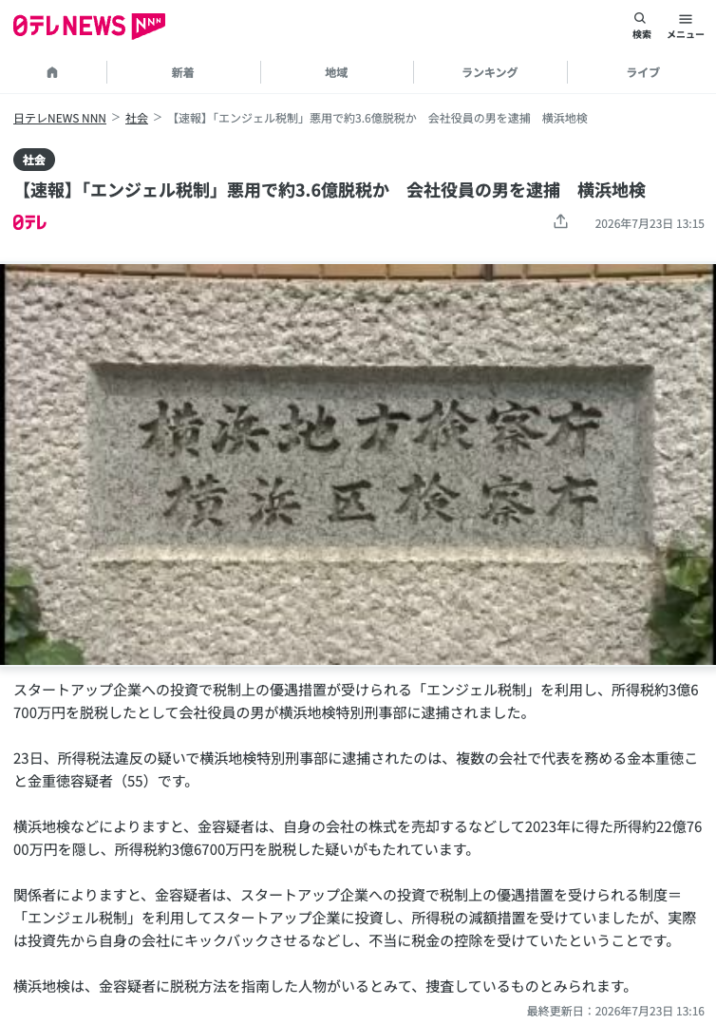
Reference:https://news.ntv.co.jp/category/society/eae9c51b82844a3d84ef147d90bde391
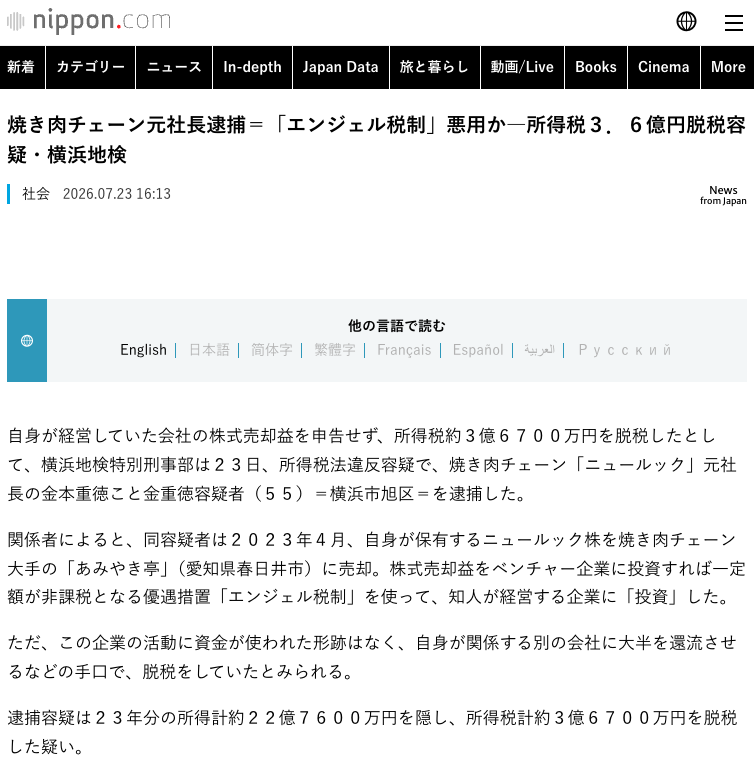
Reference:https://www.nippon.com/ja/news/yjj2026072300458/
The Yokohama District Public Prosecutors Office appears to suspect that Shigenori Kanemoto used the angel investor tax system to invest in an acquaintance's company, but then returned most of the funds from the investment to his own affiliated companies.
Some media reports used strong language such as "kickbacks" and "abuse of the Angel Tax System" from the day of the arrest, which was broadcast nationwide.
However, the investigation by the Prosecutors Union leaves many undeniable questions about this arrest.
As one example, Shigenori Kanemoto clearly explained the fact that he was developing overseas businesses directly on the day of the inspection by the Tokyo Regional Taxation Bureau.
It is said that he continued to cooperate with investigations in Japan for about a year afterward, and for about two months before his arrest, he reportedly appeared in court almost every week at the request of the Yokohama District Public Prosecutors Office.
Still, they arrest him now, citing the "risk of fleeing the country."
Were they really trying to escape?
Or did they try to obtain a confession through physical restraint because no investigation was able to overcome the legal objections?
We request explanations from the Yokohama District Public Prosecutors Office and the Tokyo Regional Taxation Bureau regarding the necessity of arrests, fairness of case publicity, investigation into the person accused of being a mastermind, and the legal basis for the angel tax system.
"Angel Tax System Abuse" Report Regarding Mr. Shigenori Kanemoto
According to a report by Jiji Press, Kaneshige Katsu-nori sold his shares in New Look to the major yakiniku chain operator Amiyaki Co., Ltd. in April 2023.
It is reported that you utilized the tax incentive for startup investments, commonly known as the angel investor tax incentive, for the capital gains from the sale of those stocks.
Reports suggest that there is no evidence of funds being used for the activities of the invested companies, and there are suspicions that the majority of the funds were returned to separate companies associated with Shigenori Kanemoto.
Meanwhile, other reports state that Kanemoto Shigenori explained in questioning before his arrest that he "merely used the system for tax savings" and denied the charges.
The Yokohama District Public Prosecutors Office has not released their acknowledgment or denial.
Further reporting by NTV indicates that the Yokohama District Public Prosecutors Office is investigating the existence of a person who "advised on tax evasion methods."
This means that the Yokohama District Public Prosecutors Office itself recognizes the possibility that someone other than Shigenori Kanemoto explained the system design and transactions.
Reference:Jiji Press: "Former Yakiniku Chain President Arrested"
Reference:NTV NEWS: "Tax evasion suspected due to Angel Tax System abuse"
Mr. Kanemoto Shigenori did not flee for about a year after the National Tax Agency inspection.
According to explanations from individuals familiar with the matter, as understood by the Prosecutors' Union, Kanamoto Shigetoku did not conceal his overseas business operations from the time of the Tokyo Regional Taxation Bureau's inspection.
It has been stated that it was clearly communicated from the beginning that the company had overseas subsidiaries and international transactions, and that there was a possibility of traveling abroad for business reasons.
Nonetheless, Shigenori Kanemoto continued to handle the investigation in Japan for about another year.
We have overseas operations.
I am also a foreign national.
Therefore, there is a risk of fleeing the country.
If you can arrest someone for a reason like that, wouldn't all business executives expanding overseas become potential fugitives the moment they are investigated by the tax authorities?
The existence of overseas operations was not a sudden revelation just before the arrest.
If you've known about this for nearly a year, and the individual has been responding domestically during that time, then the explanation of "escaping because of overseas business" at this late stage is chronologically backward.
Kanemoto Shigenori had been reporting to the Yokohama District Public Prosecutors Office every week for two months prior to his arrest.
Furthermore, an investigation by the Prosecutors Union revealed that Mr. Shigetoku Kanemoto had been appearing at the Yokohama District Public Prosecutors Office almost weekly for about two months prior to his arrest, in response to requests from the office.
I will appear if summoned.
I will answer your questions.
I will also explain the overseas business from the beginning.
The address, business, and family relationships are all clear.
Why was it necessary to suddenly arrest that person on the grounds that they "might flee the country"?
Did you purchase a specific flight ticket?
Were they moving out of their residence?
Did you move assets overseas?
Was the passport hidden?
Did they ask those involved to give false testimony?
The necessity of arrest should be explained by specific actions, not by the attribute of "doing business overseas."
Did they arrest him because they couldn't break through his legal defenses during the voluntary investigation?
According to explanations from relevant parties, Shigetoku Kanemoto has consistently explained the following to the Tokyo Regional Taxation Bureau and the Yokohama District Public Prosecutors Office.
- The investee company actually existed.
- Actually paid the capital contribution
- Received shares as consideration.
- A confirmation letter for Angel Tax System has been issued by the prefecture.
- There was a contract and economic purpose in subsequent transactions as well.
- Being conscious of tax-saving effects is not the same as carrying out false investments.
Regarding this, the Prosecutors' Union has not received any information detailing which specific provisions or requirements the Tokyo Regional Tax Bureau and the Yokohama District Public Prosecutors Office allegedly violated.
If there is no legal response to a legal objection, and only physical restraint is used at the end, isn't that not an investigation but a means to break someone's spirit?
Shigenori Kanemoto's real name and photo, but the first arrest of Kazuki Nakano was anonymous.
Regarding suspect Nakano Shokiki, the first arrest report on May 29, 2026, stated he was a "41-year-old male," and his name was not publicly disclosed.
After that, the name of the defendant, Nakano Shizuki, began to be published in reports of the indictment and re-arrest on June 18.
Meanwhile, to the extent our association has confirmed, the facial photograph of the defendant Nakano Shizuki has not been widely published in the major media to date.
In response, from the day of his arrest, Shigunori Kanemoto's real name, alias, age, address, company history, and even a photo of his face obtained from his social media were broadcast nationwide.
Of course, the act of news organizations using publicly available photos on social media is a separate issue from prosecutors providing photos.
However, why is the media treatment so different for the same tax-related cases or individuals seemingly related to the same case?
Was the defendant Shoki Nakano initially cooperative with investigative authorities in a form similar to a plea bargain?
Was Mr. Shigenori Kanemoto brought to the forefront, including social sanctions, because he did not agree with the scenario created by the investigative authorities?
Explanations are required from the Yokohama and Kagoshima District Public Prosecutors Offices regarding the differences between plea bargaining, investigative cooperation, testimony content, and case public relations.
Isn't the arrest of Mr. Shigenori Kanemoto a case of "hostage justice"?
Hostage justice is a term used to criticize Japanese criminal justice practices where suspects or defendants who maintain their innocence or remain silent are widely presumed to be a flight risk or likely to destroy evidence, and are subjected to prolonged physical detention to coerce confessions or cooperation with investigations.
Recently, a video of an interrogation where a prosecutor, who is supposed to be a dispenser of justice, repeatedly used abusive and threatening language for a long period, such as "Don't mess with me!", "Don't look down on the prosecution!", and "Hostility towards the prosecutor's office is anti-social!" became a major social issue.
Reference:https://www.ktv.jp/news/feature/260710-enzai1/
The Yokohama District Public Prosecutors Office should explain why they could not continue the investigation at home, given that Mr. Shigenori Kanemoto cooperated with the investigation for nearly a year and appeared in court every week for two months before his arrest.
The phrase "risk of fleeing the country" is convenient.
However, the more convenient a word is, the more concrete evidence it requires.
I can't refute the counterargument.
I cannot show you the text of the provision.
The full picture of the guide is not revealed.
So, for now, we'll arrest the person.
Then, arrest becomes a tool to conceal investigative dead ends, rather than a means of investigation.
Open questions to the Yokohama District Public Prosecutors Office
- Do you admit that Mr. Shigenori Kanemoto complied with the weekly summons for approximately two months before his arrest?
- After the Tokyo Regional Taxation Bureau's inspection, were you aware of the fact that Mr. Shigenori Kanemoto was responding to investigations domestically for about one year?
- Despite knowing about the overseas operations from the beginning of the inspection, what was the reason for deeming there was a risk of fleeing the country only at the time of arrest?
- Did you confirm specific flight ticket purchases, vacating your residence, concealing your passport, international money transfers, and other preparations for flight?
- Did you consider less restrictive means, such as an in-home search or voluntary surrender of passports?
- Regarding Mr. Kanemoto Shigenori's explanation, to which provision and which element of the requirement did he explain it as applicable?
- Did the inability to refute Mr. Kanemoto Shigetoku's legal defense during the preliminary investigation influence the decision to arrest him?
- Is the "person who advised on tax evasion methods" mentioned in the NTV news report Mr. Satoshi Saito, the defendant Muneuki Nakano?
- Why were the investors, who may have received guidance, arrested first, instead of the person seen as the guide?
- Did the investigation cooperation, testimony, plea bargain, and other circumstances of defendant Shigetoku Kanemoto influence the arrest of Shigetoku Kanemoto?
- Is the entire interrogation process recorded both audio and video?
- Will the defense be properly provided with the documents that formed the basis for the arrest and the interrogation records?
Public questions for the Tokyo Regional Taxation Bureau
- Did you know from the beginning of the inspection that Mr. Shigenori Kanemoto was conducting overseas business?
- Did you accurately convey to the Yokohama District Public Prosecutors Office the fact that Mr. Shigenori Kanemoto continued to cooperate with the investigation for approximately one year thereafter?
- Did you provide the Tokyo Regional Taxation Bureau with specific facts indicating a risk of flight?
- If provided, when did that fact occur after the inspection began?
- Did you show Mr. Shigenori Kanemoto the specific articles and requirements regarding the illegality of the Angel Tax System?
- Did you obtain an official opinion from the administrative agency that oversees the system and the prefecture that issued the confirmation letter?
- Did you fairly compare the explanation of the person serving as the guide with the explanation of Mr. Shigenori Kanemoto?
Now that Mr. Kanemoto Shigeyori has been arrested, please show the specific illegality in open court.
Please provide evidence that there was a prior agreement to return funds, that the investment was nominal, and that there was no actual assumption of risk or shareholder rights.
Conversely, please explain under what legal theory you would deny the actual payments, stock issuance, capital increase registration, confirmation letters, contracts, and business substance, if they did exist.
Since they arrested and publicized the photos of the individuals who appeared every week nationwide, the Yokohama District Public Prosecutors Office has a corresponding responsibility to explain.
I am seeking an answer based on laws and evidence, not an impressionistic term like "abuse."

